Written By | Fashion Experts
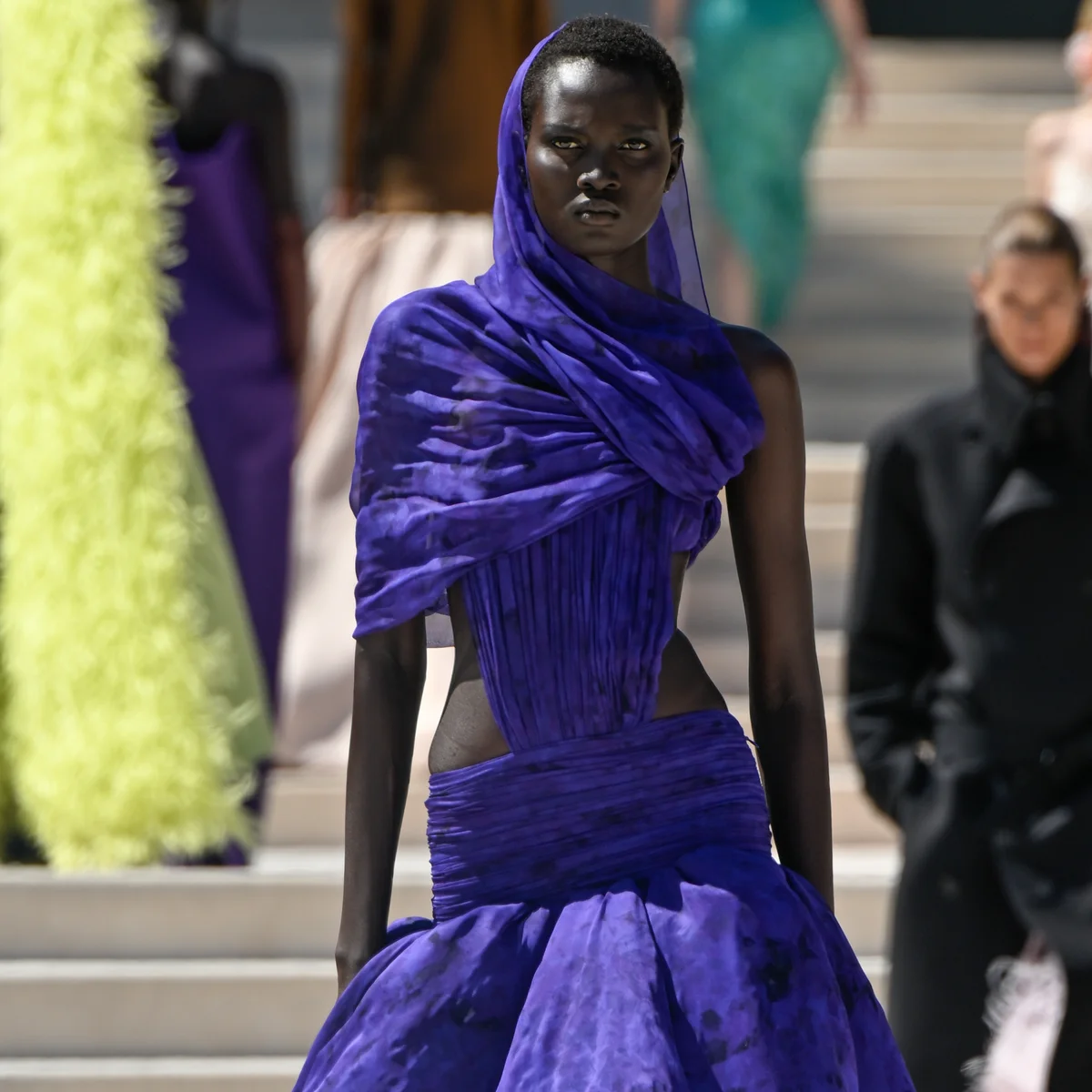
In his debut couture collection for the storied house, the designer traded the gilded salon for an open-air stage at the Cité Universitaire — and critics say he did Cristóbal Balenciaga justice.
Paris
A year after arriving at Balenciaga following a long, celebrated run at Valentino in Rome, Pierpaolo Piccioli used the final days of Paris Haute Couture Week to make his highest-stakes statement yet: a debut couture collection staged not in a private salon but in the open air of the Cité Universitaire, one of the more unlikely settings couture has seen in years. The show closed out a Fall/Winter 2026/27 couture season that critics are already calling one of the most conceptually ambitious in recent memory, and Piccioli's debut is emerging as one of its defining moments.
From Valentino's Baroque to Balenciaga's Architecture
Piccioli spent more than two decades building his reputation at Valentino around maximalist color and romantic, painterly silhouettes. Balenciaga asks for something structurally different — the house's founder, Cristóbal Balenciaga, was as much an engineer of shape as a designer of clothes — and Piccioli has been explicit about how he's approaching the shift.
"I really get that idea of Cristóbal Balenciaga: that a couturier has to be a sculptor, or architect for the shapes, has to be a painter for the colors, a philosopher for how people feel in your clothes. All of this is something that I can take inspiration from," Piccioli said.
It's a framing that positions his debut less as a break from his past work than as a translation of it — the same sensibility for color and emotion, filtered through Balenciaga's architectural discipline.
Taking Couture to the Street
The choice of venue was as pointed as anything on the runway. Rather than the traditional private salons where couture has historically been unveiled to a handful of clients and editors, Piccioli staged the show as an open-air presentation at the Cité Universitaire, a university campus on the edge of Paris, exposing couture — the most cloistered, exclusive tier of fashion — to the ordinary texture of a city street.
"I wanted to have couture related to the moment... it makes it more real in a way; it's more related to life," Piccioli explained.
For a category of fashion often criticized as remote from anyone but the ultra-wealthy few who can afford it, the gesture read as an argument about what couture is for: not a museum piece sealed away from daily life, but something meant to exist within it, even if only a handful of people will ever own a piece of it.
A Season Built on Spectacle
Piccioli's debut arrived inside a couture week that had already leaned hard into world-building. Jonathan Anderson filled the Musée Rodin with tropical vegetation for Dior, drawing on Indian textile and gemstone-carving traditions developed with artisans in Jaipur. Chanel transformed the Grand Palais into a garden inspired by Jack and the Beanstalk, scored to echoes of The Fellowship of the Ring, as Matthieu Blazy reworked the house's signature suit in guipure lace and silk mousseline. At Jean Paul Gaultier, Duran Lantink flipped tulle ball-gown trains into tuxedo fronts and built a column dress from a trio of feathered swan's necks. Against that backdrop of maximal spectacle, Piccioli's decision to move outdoors read as its own kind of statement — quieter, but no less deliberate.
"The Laboratory of Experimentation"
Piccioli has described couture itself, as a practice, in terms that go beyond craftsmanship.
"Couture is the laboratory of experimentation, innovation and challenges," he said, adding, "I feel good doing couture, especially in a house where its identity lies in the couture."
That last point matters specifically for Balenciaga: unlike some maisons for which couture is a marketing showcase sitting atop a ready-to-wear business, couture is close to the founding identity of the house itself, giving Piccioli's debut a symbolic weight beyond a single season's reviews.
Critical Reception
Early reviews have been enthusiastic, with critics framing the collection less as homage than as a genuine continuation of Cristóbal Balenciaga's design language rather than a costume-like tribute to it. One widely circulated review put it plainly: "It wasn't an homage to the work of Cristóbal Balenciaga: it was more. It did him justice." Piccioli's approach, the review continued, was "something entirely different" — an attempt at "a couture for now," rather than a recreation of couture as it once was.
What This Means for Balenciaga — and for Couture
The stakes behind the debut go beyond one show. Balenciaga spent recent years under intense scrutiny following a turbulent stretch during Demna's tenure, and the house's next chapter has been closely watched by an industry eager to see whether a return to couture fundamentals could reset its narrative. A confident, critically praised debut couture collection — particularly one staged as a deliberate rejection of insular tradition — gives the house a clear new story to tell, both to clients and to an industry press that has spent the past year waiting to see what Piccioli would actually do with the job.
For everyday readers who will never sit in a couture show or commission a piece, the ripple effects tend to show up later, in ready-to-wear silhouettes and in the broader fashion conversation about what luxury clothing is supposed to communicate. Piccioli's opening argument — that couture should feel connected to real life rather than sealed away from it — is the kind of idea that tends to filter down, eventually, into how the rest of fashion thinks about itself.



