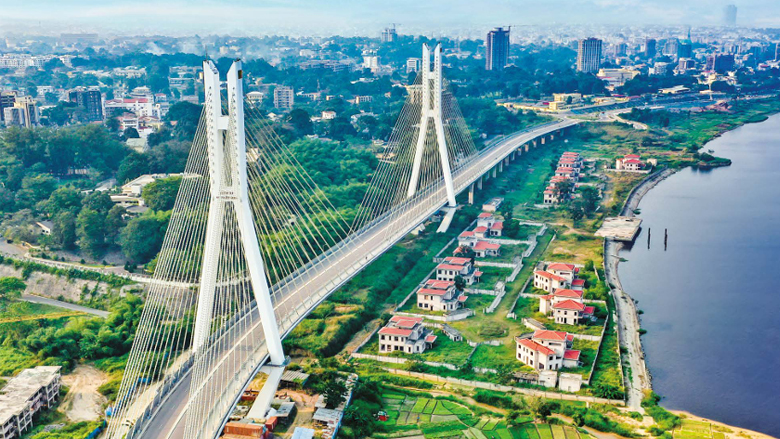
CONGO
Brazzaville, capital of the Republic of Congo, sits on the banks of the Congo River across from Kinshasa, but its economic story has little in common with its giant neighbor. Where the Democratic Republic of Congo is riding a cobalt and copper boom, the smaller Republic of Congo remains locked into a four-decade-old relationship with crude oil — one that has delivered intermittent windfalls but never the broad-based development its 6.1 million people were promised. In March 2026, the International Monetary Fund delivered its starkest assessment yet: a debt load above 97% of GDP, a fiscal position that slipped badly in 2025, and a growth model still almost entirely dependent on a barrel price the government cannot control.

A Post-Financing Verdict from the IMF
On March 16, 2026, the IMF Executive Board concluded its 2026 Post-Financing Assessment (PFA) with the Republic of Congo — a review conducted because the country still owes the Fund significant outstanding credit from earlier Extended Credit Facility arrangements, even though no new program is currently active. The verdict was sobering. Total public debt is estimated to have reached 97.2% of GDP at the end of 2025, among the highest debt burdens in Central Africa and a level the Fund describes as carrying "elevated" vulnerabilities.
The slippage was driven by fiscal indiscipline during 2025. According to the IMF's release, Congo's non-hydrocarbon primary deficit widened to 8.7% of non-hydrocarbon GDP, as an unexpected surge in spending on goods and services crowded out capital expenditure and social transfers, even as stronger tax administration lifted non-oil revenue collection. At the same time, lower global oil prices compressed the hydrocarbon revenues the budget still leans on. The Fund flagged a heightened "sovereign-bank nexus" — meaning Congolese banks hold large quantities of government debt, so fiscal distress and banking-sector risk are increasingly intertwined — along with liquidity tensions across the regional CEMAC treasury-bill market that Congo shares with five other Central African states.
The IMF's headline conclusion was double-edged: Congo's "capacity to repay the IMF is adequate but subject to significant risks," and the approved 2026 budget signals a renewed, if untested, commitment to fiscal consolidation — rebalancing spending toward investment and pro-poor outlays while continuing to strengthen non-hydrocarbon revenue mobilization.
Growth Returns, but Oil Still Calls the Tune
Economically, the headline numbers look more encouraging than the debt picture suggests. The economy expanded by 2.1% in 2024 and an estimated 2.4% in 2025, and the African Development Bank now projects growth will accelerate to roughly 3.4% in 2026. That acceleration, however, is itself a product of the hydrocarbon sector: the AfDB attributes the pickup chiefly to new investment in oil and gas fields, alongside the rollout of the government's Zone Agricole Protégée (ZAP) — a protected agricultural zone program meant to boost food production — and the start of new mining projects.
Oil remains the load-bearing pillar of the entire economy, accounting for roughly 80% of export earnings and the bulk of fiscal revenue in most years. The sector is dominated by the state oil company, Société Nationale des Pétroles du Congo (SNPC), whose monopolistic role in upstream and trading activity has long been cited by the IMF, the World Bank, and watchdog groups as both a source of fiscal opacity and a structural obstacle to diversification. Production itself has been gently declining from its peak: output is expected to slightly exceed Congo's OPEC quota of 277,000 barrels per day in 2026, but that remains well below the record 329,000 barrels per day pumped in 2019. New offshore fields are expected to help stabilize output, but Congo, like other mature oil producers in the Gulf of Guinea, is managing decline rather than chasing growth in its legacy basins.

Diversification on Paper, Poverty in Practice
Successive Congolese governments have announced diversification strategies stretching back to the National Development Plan of the early 2010s, and the current administration's emphasis on agriculture through the ZAP program and on new mining licenses is the latest iteration. Yet independent assessments — including the Bertelsmann Transformation Index's 2026 country report — describe an economy that "remains overwhelmingly dependent on oil, with no coherent strategy for diversification beyond the expansion of other extractive industries such as gas," leaving the country acutely exposed to global commodity-price swings rather than building resilient, broad-based non-oil sectors.
The human cost of that exposure shows up starkly in the poverty data. The national poverty rate climbed to 46.8% in 2023, up from 33.5% in 2015 — a near-deterioration of 14 percentage points in less than a decade, despite years of oil revenue. The World Bank's most recent figures, drawing on the higher $3.00-a-day (2021 PPP) line used for lower-middle-income countries, put the 2025 poverty rate at 51.7%, meaning more than half the population now falls below that threshold. Inequality compounds the problem: Congo's Gini coefficient stands at 48.9, reflecting a wide gap between a narrow oil-and-state-linked elite and a population that has seen little of the resource wealth translate into jobs, services, or rural income growth. The World Bank's 2025 Republic of Congo Economic Update explicitly calls for "strengthening the management of produced, human, and natural capital" as the precondition for raising living standards — a polite way of saying that decades of oil rents have not been converted into the human capital or infrastructure that would let ordinary Congolese benefit.
Regional Integration as a Partial Offset
With its small domestic market — roughly 6 million people — Congo's longer-term growth case rests heavily on regional integration. As a member of the Central African Economic and Monetary Community (CEMAC), Congo shares a currency, the CFA franc, and a regional capital market with five neighbors, which gives it access to a regional treasury-bill market but also means it absorbs region-wide liquidity shocks, as the 2025-2026 fiscal slippage illustrated. Congo is also a state party to the African Continental Free Trade Area (AfCFTA), which in principle offers Congolese non-oil producers — timber, agricultural goods, light manufacturing — preferential access to a market of 1.3 billion people across the continent. In practice, Congo's intra-African trade remains thin, constrained by weak transport infrastructure, a narrow non-oil export base, and the same diversification gap the IMF and BTI reports highlight; AfCFTA's promise for Congo is consequently more a medium-term opportunity than a current source of growth.
What to Watch
Three signals will determine whether 2026 marks a genuine turning point or another false start. First, whether the government actually executes the fiscal consolidation promised in the 2026 budget — narrowing the non-hydrocarbon primary deficit from 2025's 8.7% of non-oil GDP — rather than letting spending slip again as it did last year. Second, whether the ZAP agricultural-zone program and new mining licenses translate into measurable non-oil export growth, or remain, as past diversification plans have, largely rhetorical. Third, whether Brazzaville can stabilize its debt trajectory before global oil prices or regional liquidity conditions force a more disruptive adjustment; at 97.2% of GDP, Congo has little room left to absorb another shock of the kind that hit its budget in 2025.
For now, the Republic of Congo's economic story is one of resilience without transformation: growth has resumed, but it is oil-led growth in a country that knows, and has known for years, that oil-led growth is not a development strategy.
Published By | Business News Editor