Written By | Business Experts
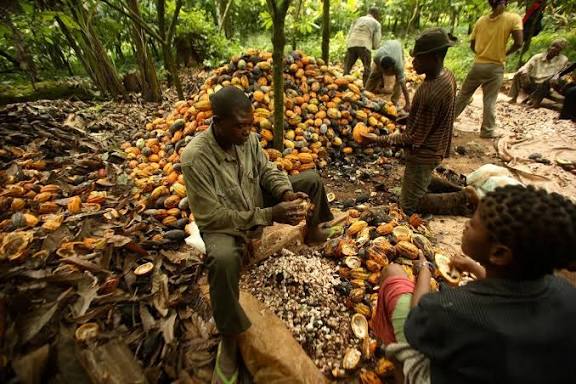
National export revenue fell by CFA187.1 billion in the first quarter of 2026, dropping to CFA606.9 billion from CFA794 billion in the same period a year earlier — a 23.6 percent decline
Cameroon, the largest economy in the Central African Economic and Monetary Community (CEMAC), enters the second half of 2026 with a growth outlook that is recovering on paper but increasingly fragile underneath. The International Monetary Fund's 2026 Article IV Consultation with Cameroon, concluded by the Executive Board on March 30, 2026, projects growth accelerating to 3.3 percent in 2026 and 3.8 percent in 2027, with the medium-term trajectory rising toward 4.6 percent as electricity constraints ease and mining production expands after 2028. Inflation is expected to decline to 2.9 percent in 2026, within CEMAC's convergence bands. Yet that recovery is being tested in real time by a cocoa and oil export collapse, a widening fiscal deficit, and two decades of essentially flat poverty reduction — a combination that illustrates how commodity-price volatility can erode even a comparatively diversified Central African economy.
A Modest Growth Recovery Built on Public Investment
The IMF's February and March 2026 communications describe Cameroon's growth recovery as driven primarily by higher public investment rather than a private-sector-led expansion. The Fund's downside risk list is unusually broad for a single Article IV statement: tight global financial conditions, reduced donor aid flows, volatile commodity prices, and security and climate-related shocks in the Far North, Northwest and Southwest regions. The World Bank's separate country assessment aligns closely with the Fund's figures, projecting growth of 4.0 percent in 2026 and 4.1 percent in 2027, supported by agricultural output gains tied to improved input access, along with manufacturing, extractive industries, transport, and public consumption. The primary sector — agriculture, forestry, and fishing combined — accounted for roughly 19 percent of GDP in 2023, with agriculture alone contributing about 13 percent, underscoring how central smallholder and plantation farming remain to Cameroon's economic base even as the government pushes industrial diversification.
The Cocoa Shock: A 60 Percent Price Collapse Hits Export Earnings
The headline economic story of Cameroon's first quarter of 2026 was not growth but contraction in trade receipts. National export revenue fell by CFA187.1 billion in the first quarter of 2026, dropping to CFA606.9 billion from CFA794 billion in the same period a year earlier — a 23.6 percent decline. Three commodities drove nearly all of the drop: cocoa, crude oil, and liquefied natural gas. Cocoa and cocoa-product exports alone generated CFA199.3 billion in the first quarter of 2026, down sharply from CFA319.9 billion a year earlier. The underlying driver is a global price correction: the World Bank's benchmark cocoa price fell from $8.08 per kilogram in March 2025 to $3.24 per kilogram in March 2026, a decline of nearly 60 percent, as the extraordinary 2023-2024 West African cocoa price spike unwound. Cameroon's government had forecast a 2025-2026 season price range of CFA3,200 to CFA5,400 per kilogram, a band that now looks optimistic against the scale of the global correction.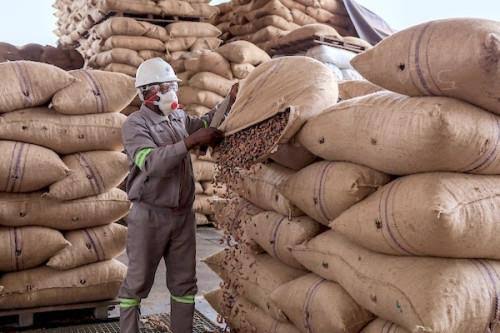
Structural weaknesses compound the price shock. Nearly 27 percent of Cameroon's annual cocoa production is lost each year to poor transport and post-harvest handling infrastructure — losses that persist regardless of the price cycle and that leave farmers doubly exposed when prices fall. Crude oil (37 percent of exports), cocoa beans (18 percent), petroleum gas (10 percent), and sawn wood (7 percent) together define an export base that, despite being more diversified than many CEMAC peers, remains concentrated enough that a simultaneous downturn in two of its top three commodities — cocoa and oil — produces an outsized fiscal and current-account impact.
Fiscal Slippage and a Moderate but Watched Debt Position
Cameroon's overall budget deficit widened from approximately 1.5 percent of GDP in 2024 to about 2 percent of GDP in 2025, while the non-oil primary balance deteriorated to roughly 2.6 percent of GDP against a budgeted target of 1.4 percent — a gap the IMF attributes largely to under-execution of revenue reforms alongside continued spending pressure. The 2026 budget targets a narrower deficit of 1.7 percent of GDP, a figure calibrated to CEMAC's regional fiscal convergence criteria. Government debt itself remains moderate in relative terms, at about 39 percent of GDP, but Cameroon's debt sustainability analysis continues to show a high overall risk of debt distress — a classification driven less by the debt stock than by liquidity and repayment-capacity indicators, external shock exposure, and the country's narrow revenue base. The IMF has repeatedly urged fuel-pricing reform as a fiscal safety valve, given that subsidized domestic fuel prices constrain the budget's flexibility precisely when export earnings are falling.
Electricity Gains Provide a Rare Bright Spot
One structural constraint has genuinely improved: power supply. The Nachtigal hydroelectric dam, a 420-megawatt facility on the Sanaga River, began supplying Cameroon's grid in June 2024 and reached full generating capacity in March 2025, lifting national generation capacity by roughly 30 percent and measurably reducing the outages that have long constrained industrial output. The upstream Lom Pangar regulating dam, with a 6-billion-cubic-meter reservoir, adds an average of 120 megawatts of downstream capacity by stabilizing the Sanaga's flow through the dry season, while the gas-fired Kribi plant contributes a further 216 megawatts. Transmission lines linking Nachtigal to the southern interconnected grid — serving the country's main industrial hubs around Douala and Yaoundé — were targeted for completion in the third quarter of 2025. The IMF explicitly cites easing electricity constraints as a condition for growth exceeding 4 percent from 2028 onward, making the Nachtigal-Lom Pangar hydropower system arguably the single most consequential infrastructure development for Cameroon's medium-term industrial trajectory.
Poverty: Two Decades of Stagnation
Behind the growth and export figures sits a poverty picture that has barely moved in a generation. Approximately 46.4 percent of Cameroonians — around 13.2 million people — live below the $3.65-per-day international poverty line, while roughly four in ten Cameroonians fall below the national poverty line. Household survey data from 2021-2022 put 23.0 percent of the population below the extreme international poverty threshold. Development analysts at the ISS African Futures program describe poverty reduction in Cameroon as having stagnated over the past 20 years, a period during which the economy grew but income gains failed to translate into broad-based welfare improvement, particularly outside Douala and Yaoundé.
The government's principal policy response is the Adaptive Social Safety Nets and Economic Inclusion Project, a donor-funded cash-transfer and public-works program currently reaching about 177,000 households with direct cash transfers and a further 100,000 households through publicly funded infrastructure. On July 22, 2026, President Paul Biya signed a decree clearing the final domestic steps for a $38.6 million World Bank concessional credit to expand the program, aimed at both strengthening existing household coverage and helping unemployed urban youth access income-generating activities and entrepreneurship support. The World Food Programme continues to support the government in building shock-responsive, nutrition-sensitive safety-net systems, reflecting Cameroon's continued exposure to climate shocks and, in the Far North, conflict-driven displacement that compounds chronic poverty.
AfCFTA and CEMAC: Slow-Moving Trade Integration
Cameroon ratified the African Continental Free Trade Area agreement in 2020 but has yet to fully implement its provisions, and Africa still accounted for only 12.7 percent of Cameroon's total exports and 9.5 percent of its imports as of 2023 — a level that leaves most of the projected AfCFTA gains unrealized. A policy workshop held in Douala from June 29 to July 2, 2026, brought together entrepreneurs and trade officials to explore how Cameroonian exporters can better use AfCFTA rules of origin, part of a broader push documented by the Cameroon Economic Policy Institute in its 2026 budget analysis of free-trade reforms. Regionally, a harmonized ECCAS-CEMAC customs code took effect on January 1, 2026, under which CEMAC states will apply a 0.77 percentage-point annual tariff reduction until reaching zero intra-regional tariffs by 2033 — a gradual liberalization timeline that reflects the bloc's historically slow pace of integration relative to West Africa's ECOWAS. Analysis from the ISS African Futures program modeled that under full AfCFTA implementation, Cameroon's GDP per capita (in purchasing-power-parity terms) could rise to roughly $5,467, about $285 higher than under a continuation of current trade policies — a modest but real dividend contingent on translating ratification into operational trade facilitation.
Outlook
Cameroon's near-term story is one of a modest, investment-led growth recovery running headlong into a sharp commodity-price reversal. The 3.3 percent growth the IMF projects for 2026 is real, and the Nachtigal-driven electricity gains provide a genuine structural improvement that previous growth cycles lacked. But a 60 percent collapse in cocoa prices, a widening fiscal deficit, a persistent high risk-of-debt-distress classification, and two decades of unmoved poverty rates together suggest that Cameroon's recovery remains narrowly based and vulnerable to the same external shocks — commodity prices, aid flows, and climate — that the IMF flags as its principal downside risks. Whether the $38.6 million safety-net expansion, the AfCFTA push, and continued hydropower buildout are sufficient to broaden that recovery beyond the capital and the extractive sectors will be the central test of Cameroon's economic policy through the remainder of the decade.



