Written By | Staff Writer
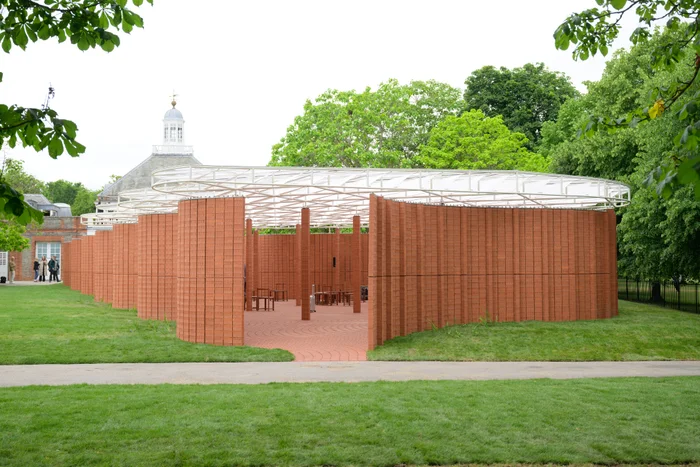
The 2026 Serpentine Pavilion designed by Mexico City-based LANZA atelier
LONDON
There is a word for it that you probably don't know, and once you learn it, you'll want to say it aloud: crinkle-crankle. It refers to an undulating, sinuous wall — alternating convex and concave curves — used in Suffolk and Norfolk gardens from the 17th century onward. Through the simple geometry of its curves, a brick-thick wall becomes structurally self-supporting. More material would make it weaker.
This idea — that constraint enables strength, that the curve contains more intelligence than the straight line — sits at the heart of 'a serpentine,' the 2026 Serpentine Pavilion designed by Mexico City-based LANZA atelier. The pavilion opened June 6 at Serpentine South in Kensington Gardens, and it is already being spoken of as one of the most significant structures in the commission's 25-year history. It is also, quite simply, a delight.
The 25th Serpentine Pavilion: A Milestone Commission
The Serpentine Pavilion has been a defining event in architecture since 2000. Each year, an architect who has not previously built in the UK is invited to design a temporary structure on the lawn of Serpentine South Gallery.
The list of past architects reads as a survey of the most important minds of the past quarter century: Zaha Hadid, Frank Gehry, Bjarke Ingels, Frida Escobedo. This year's commission, awarded to LANZA atelier — founded by Isabel Abascal and Alessandro Arienzo — marks the 25th pavilion.
LANZA is only the second Mexican practice to receive the appointment, following Escobedo's 2018 pavilion. Their selection reflects growing recognition of Mexican architectural thinking — rooted in pre-Columbian logic, colonial baroque, and modernist experimentation.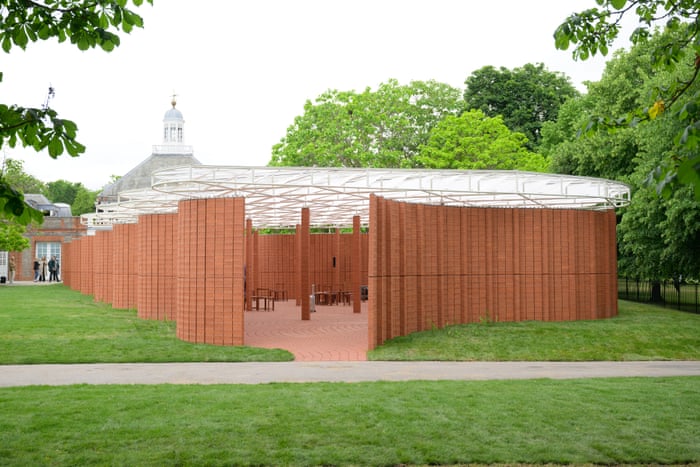
What 'A Serpentine' Actually Is
The pavilion takes its logic directly from the crinkle-crankle wall, scaled up and opened into something that is simultaneously wall, enclosure, corridor, and landscape. A single undulating brick structure — rising to about 4 meters at its highest, dipping to garden-seat height — winds through the lawn, creating intimate, semi-enclosed spaces without ever fully closing off the sky.
This is the first Serpentine Pavilion ever built from brick. The choice is deliberate: brick is the material of the historic Serpentine South Gallery (1934), and LANZA enters into conversation with existing architecture rather than asserting itself against it.
But the brick here is not nostalgic. The structural ingenuity of the crinkle-crankle gives the familiar material an entirely new voice. Walking through the pavilion — through the curves and counterpoints — you feel simultaneously ancient and contemporary.
"The serpentine wall is an intelligence that belongs to no particular culture and to all of them," the architects said. "It is a conversation between engineering and nature that has been going on for centuries. We simply wanted to listen to it."
A Dialogue Between Two Cultures
LANZA atelier's practice is rooted in a Mexican tradition of engaging with site, history, and material. Their projects in Mexico City and Oaxaca are celebrated for their sensitivity to context and their willingness to work with vernacular building techniques.
In London, this sensibility has produced something unexpected: a pavilion that feels deeply English in its material and references — the country garden, the brick wall — while remaining unmistakably Latin American in its spatial generosity and trust in simple forms.
In its first weekend, the pavilion was full. Visitors sat on low sections, walked the curves, found unexpected pockets of shade and light. Children ran through it as though designed specifically for them.
Programming And Presence
The pavilion will remain in Kensington Gardens until October 25, 2026, serving as the site for the Serpentine's annual public events. Park Nights — the long-running series of nocturnal artistic commissions — will take on a new dimension in the pavilion's sinuous embrace.
In 25 years of the Serpentine Pavilion, architects from six continents have contributed — a record that reflects the commission's belief that significant architecture is made everywhere, not only in traditional Western centers.
What 'A Serpentine' Says About Architecture Now
In a moment when much of the most discussed architecture involves spectacular digital fabrication or radical material innovation, there is something quietly radical about LANZA's insistence on the handmade, the historical, the technically simple. The crinkle-crankle requires no digital modeling: it works because physics works, because 17th-century gardeners figured out something true about geometry and strength.
'a serpentine' does not announce itself as avant-garde. It does not make you feel you are in the presence of the future. Instead, it makes you feel you are in the presence of something already figured out — a form that arrived at its own perfection and is now simply, generously, sharing it.
Walk the curves. Find a pocket of shade. Sit on a wall that needs nothing more than its own shape to hold itself up. The building has something to teach you, if you're willing to let it.
The lesson — that strength can come from curvature, that the collective intelligence of a form can exceed any individual act of will — seems worth the trip to Hyde Park.




