PARIS, FRANCE
Paris Men's Fashion Week for Spring/Summer 2027 wrapped today the way it should: not with a whimper, but with four shows that had almost nothing in common except a shared refusal to play it safe. Over the closing weekend, Céline, Sacai, Doublet, and KidSuper sent out a final stretch of menswear that ranged from razor-tailored elegance to clothing spun from captured carbon dioxide—closing a six-day calendar that organizers and editors are already calling one of the most genuinely diverse seasons in recent memory.
Céline's Homecoming
The week's final ready-to-wear show came from Céline, where Michael Rider—who first cut his teeth under Phoebe Philo before shaping Ralph Lauren's aesthetic—presented his Spring/Summer 2027 menswear collection at noon on Sunday. Since taking over artistic direction last year, Rider has been quietly rebuilding Céline's menswear identity around razor-sharp lines and keenly tailored elegance. It's a register that sits in deliberate contrast to Hedi Slimane's rock-and-roll moodiness, and Sunday's show read as Rider's clearest statement yet that his Céline is its own proposition: American precision filtered through Parisian restraint.

Sacai's Season of Liberation
If Céline closed on a note of control, Sacai spent its show working against it. Chitose Abe presented a collection built around a quartet of collaborations, continuing her partnership with A.P.C.—developing a new fabric inspired by patchwork quilts—and anchoring looks with the J.M. Weston Golf Derby shoe in a new Bordeaux hue. The soundtrack leaned hard into Freddie Mercury, looping multiple versions of "I Want to Break Free" across the runway. Abe was direct about what she was chasing: a feeling of liberation in her own design process, translated into clothing that splits the difference between irreverence and craft the way only Sacai's patchwork construction can.
Doublet's Clothes Made From Air
The most conceptually audacious show belonged to Doublet, where designer Masayuki Ino built an entire collection around garments made, as his show notes put it, "from air." The claim wasn't metaphorical: Ino worked with yarns engineered from carbon dioxide captured directly from the atmosphere, turning an emissions-reduction technology into wearable fabric. The resulting pieces looked, by most accounts, surprisingly normal—proof, in Ino's telling, that sustainable material innovation doesn't need to announce itself visually to matter. It's the kind of statement fashion weeks increasingly need and increasingly resist: a genuine materials breakthrough dressed as nothing more dramatic than a good collection.
KidSuper's Cinematic Send-Off
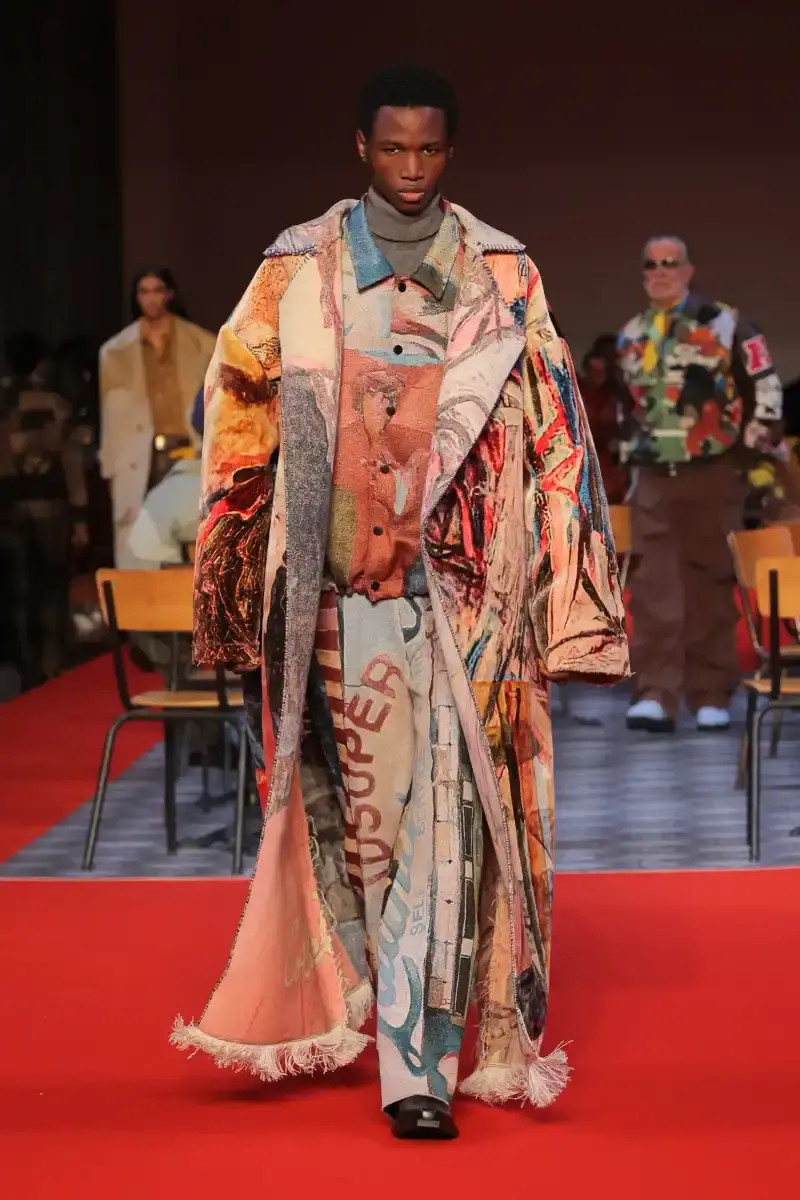
The closing weekend technically began on Saturday night with KidSuper, in a show built around a short film starring French actor Vincent Cassel, projected onto a giant white box hoisted into the rafters as part of staging by veteran producer Thierry Dreyfus. The film traced a grizzled Cassel arriving at a Paris bistro and slowly unraveling over the evening—café society colliding with Brooklyn-honed irreverence and a dash of old French cinema glamour. It treated the runway show itself as only one component of a larger piece of theater.
"I wanted to feel more liberated in my designs this season." — Chitose Abe, Sacai

A Season Defined by Range, Not Consensus
What makes this closing weekend notable isn't that any single show reset the conversation around menswear—it's that four houses operating at wildly different scales all landed on something worth talking about in the same 48 hours. Earlier in the week, Saint Laurent and Louis Vuitton set a tone of headline-grabbing spectacle. The closing weekend pulled the conversation toward something quieter but more substantive: a house rediscovering its own design language (Céline), a veteran designer chasing personal liberation through collaboration (Sacai), a genuine materials innovation hidden inside a wearable collection (Doublet), and a brand treating the runway as a vehicle for short-form cinema (KidSuper).
What This Means for You
None of this season's pieces will be on shelves for nearly a year, but the ideas embedded in them move faster than the garments. Doublet's carbon-capture yarns preview a sustainability conversation shifting from recycled cotton toward genuinely novel material science—expect more brands to experiment with atmospheric or industrial-byproduct textiles over the next several seasons. Sacai's collaboration model is the clearest evidence yet that the multi-brand crossover has become a legitimate design methodology, not a marketing gimmick. And Céline's pivot under Rider is worth watching for anyone who buys into a house's identity rather than just its logo: this is what it looks like when a major brand changes direction without losing its sense of self.
Paris Fashion Week will reconvene for Haute Couture in early July. But for menswear specifically, Spring/Summer 2027 is now a closed book—one that ended not with a single dominant image, but with four very different designers all making the case, in their own register, for why a runway show should still be allowed to surprise you.
Published By | Features Editor