Written By | Entertainment Desk
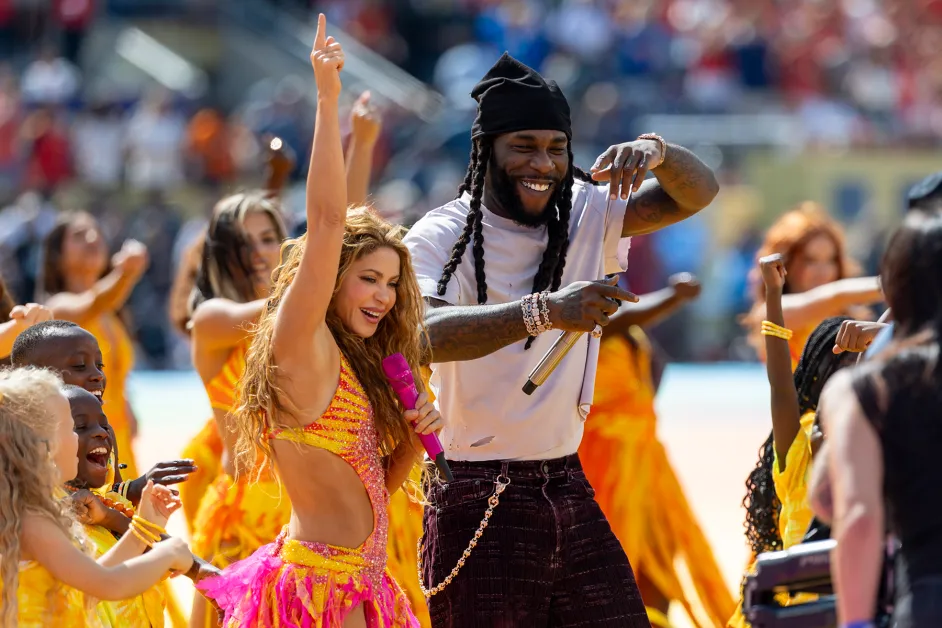
Shakira and Burna Boy's Afrobeats-and-dance-pop anthem has topped charts in a dozen countries and made Shakira the first artist ever to hit No. 1 on Spotify with songs in two different languages.
MIAMI / LAGOS
It opens with a single Italian word repeated like a chant — "dai, dai" — slang for "come on," the kind of thing a coach might shout from the sideline. Six weeks later, that word is echoing out of car stereos on four continents. "Dai Dai," the official song of the 2026 FIFA World Cup, performed by Shakira and Burna Boy, has become the highest-streaming anthem in the tournament's history, and this week it pushed Shakira to a milestone no artist — not Beyoncé, not Bad Bunny, not Taylor Swift — has reached before her: the top of the Spotify Global chart with songs recorded in two different languages.
A Song Built for a Global Tournament
Released May 15 through Ace Entertainment and Sony Music Latin, "Dai Dai" was engineered from the start to straddle continents the way the World Cup itself does this year, co-hosted across the United States, Mexico and Canada. The track blends Burna Boy's Afrobeats foundation with dance-pop and reggaetón textures that are unmistakably Shakira, and its lyrics namecheck football's pantheon directly — Pelé, Diego Maradona, Cristiano Ronaldo, Lionel Messi and Mohamed Salah all get a mention in a song built as much as a locker-room pep talk as a pop single. The pair debuted it live for more than 80,000 fans at Mexico City's Estadio Azteca during the tournament's June 11 opening ceremony, and it has not left the global conversation since.
Breaking Records in Two Languages
The numbers are, by any measure, historic. "Dai Dai" has now surpassed 800 million combined streams across Spotify and YouTube Music, and it became the first official FIFA World Cup song to reach No. 1 on the Billboard Global Excl. U.S. chart since that chart launched in 2020 — outperforming even Jung Kook's "Dreamers," the anthem of the 2022 Qatar tournament, which peaked at No. 4. It has topped the Spotify charts outright in Austria, Belgium, Germany, Sweden, Switzerland and the United Arab Emirates, and reached No. 1 on various national charts in twelve countries total, including France, Spain, Norway, the Netherlands, Slovakia and South Korea. The achievement that has generated the most attention among industry watchers, though, is narrower and stranger: Shakira is now the first artist in Spotify's history to reach No. 1 on the platform's global chart with tracks recorded in both English and Spanish, a distinction that speaks to a two-decade career built on refusing to pick a single-language lane.
A Career Milestone Wrapped Inside a Sports Anthem
The success of "Dai Dai" has also propelled Shakira, now 49, past 100 million monthly listeners on Spotify — making her the first Latin female artist ever to cross that threshold — and back into the top ten of the platform's most-streamed artists worldwide, a chart usually dominated by acts a third her age. For an artist whose commercial peak many assumed had passed after her 2006 smash "Hips Don't Lie," it's a genuinely improbable second wind, one that arrives two decades after she first performed at a World Cup closing ceremony in Germany. Burna Boy, for his part, adds another marquee credit to a run that has already made him Afrobeats' most globally bankable export, further cementing the genre's foothold in mainstream Western pop rather than treating it as a guest feature.
The Money Behind the Anthem
There's a philanthropic thread running through the song's success, too. Shakira has directed both her performance fee and her royalties from "Dai Dai" to the FIFA Global Citizen Education Fund, which supports schooling access in underserved communities connected to the tournament's host regions — a detail that intellectual-property analysts at the World Intellectual Property Organization have highlighted as a rare instance of a major sports-marketing anthem being structured, contractually, around a direct charitable pass-through rather than a straightforward commercial licensing deal.
Why It's Resonating Beyond Soccer
Official World Cup songs have a mixed history — some, like Shakira's own 2010 hit "Waka Waka," become inescapable cultural touchstones; others are forgotten within a news cycle. What separates "Dai Dai" is that it functions as a genuine pop single independent of the tournament, catchy enough to chart on merit rather than novelty, which is precisely why it has outlasted the group stage and kept climbing through the knockout rounds and into the tournament's closing weekend. Music industry analysts point to the pairing itself as the smarter bet: rather than one dominant voice carrying a slogan-heavy hook, the song lets two distinct global fanbases — Shakira's Latin American and European audience, Burna Boy's African and diaspora following — collide into something bigger than either artist's typical reach.
What This Means for Music Fans
For casual listeners, the takeaway is simpler: the song blaring from every watch party and taxi radio this month is not a marketing footnote but a legitimately historic chart entry, one likely to be studied by labels planning the next mega-tournament tie-in. For longtime Shakira fans, it's confirmation that an artist written off by some as a legacy act has instead engineered one of the most statistically significant comebacks in recent pop history — not through a nostalgia tour, but by making a brand-new record that beat the algorithm on its own terms, in two languages, during the biggest sporting event on Earth.



