Written By |

Legend has it that brothers turned into witch Doctors were feared in the village of Karoza
(Picture imagine by Meta AI)
Have you ever heard of Karoza, a place where many people have been swindled of their wealth and property by fraudsters offering witchcraft services? This area, located in Mitooma District, is still feared due to its history of witchcraft practices. The old men of Karoza, who belonged to the Banyantsya sub-clan under the Abateizi Clan, claimed to have the power to control life. They also claimed to be able to reclaim stolen cows or property using their deities, forcing the thief to publicly confess and return the stolen items, often with compensation. Additionally, they asserted they could end anyone’s life at will.
Whenever a misfortune such as robbery or murder befell a family in Ankole or the surrounding areas, people would often travel to Karoza to consult the witchdoctors for a solution. According to a survey, four main witchdoctors—Rwansibani, Itareeba, Nyamukonjo, and Muzigu—were feared and respected. These men were wealthy, dangerous, and treacherous, fearing no one, whether rich or powerful. They would often exploit chiefs and wealthy individuals seeking their services, receiving many cows and goats in return.
Where is Karoza?
Karoza is a remote village in Ruhinda, Mitooma District. It is bordered by Nyaruzinga, Kihunga, Nyakishojwa, and Nkinga, with River Ncwera and Nyerambire to the west and Bukuba and Kahungye in Nyabubaare, Igara West, Bushenyi District, to the east.
There were three feared groups in Ankole known for their atrocities and witchcraft practices. The first group, Abajurunga, also known as Abarogyera-busha, could allegedly bewitch others out of sheer jealousy and were based in Katongore and surrounding areas in Ibanda. The second group, Abatema-nkoro, were known for their brutality, reportedly cutting people on the chest during disagreements and leaving them to die. They were based in Rukokoma near Kyeikucu on the outskirts of Ibanda Parish, Kagongo. This group was suspected of being involved in the killings of Magdalena, who was hanged on a cross on Kagongo Hill, and Rev. Fr. Alexander You, a Catholic priest murdered in the 1980s. The third and most feared group was Karoza, known as Abarwanisa-bikungu, who were said to make ant-hills fight each other.
Did Ant-Hills Really Fight?
According to Mzee Nzigani, the so-called "fighting ant-hills" were not actually ant-hills but large fig trees (Ficus natalensis, locally known as ebitooma). Every witchdoctor had a tree in their compound, where they claimed to keep their deities (emandwa). The so-called fights between these trees were a show of power orchestrated by the witchdoctors to attract clients.
How These Practices Worked
The witchdoctors in Karoza, who were brothers and all wealthy, developed jealousy among themselves, leading to inner conflicts. To protect their families and maintain their feared status, they resorted to securing deities and other supernatural practices. For instance, one brother might trick another by stealing his shadow (kumwibaho ekinyimanyimi) while he was sharpening a panga to clear a piece of land. The man whose shadow was stolen would remain frozen at the spot until the thief returned and woke him up, only to find the land already cleared by his opponent. These incidents fueled hatred and rivalry among the brothers.
Local Witness Accounts
George Kabamwerere, a 100-year-old local peasant, recounted hearing about Karoza’s fighting ant-hills, although he never witnessed them himself. He did, however, confirm the existence of the large fig trees, which have since been cut down. He also shared a story about a new Muruka Chief named Kezekia Bateyo, whose wife was allegedly blinded after fetching firewood from one of the trees. The incident was said to have left her so disoriented that she burned her baby alive.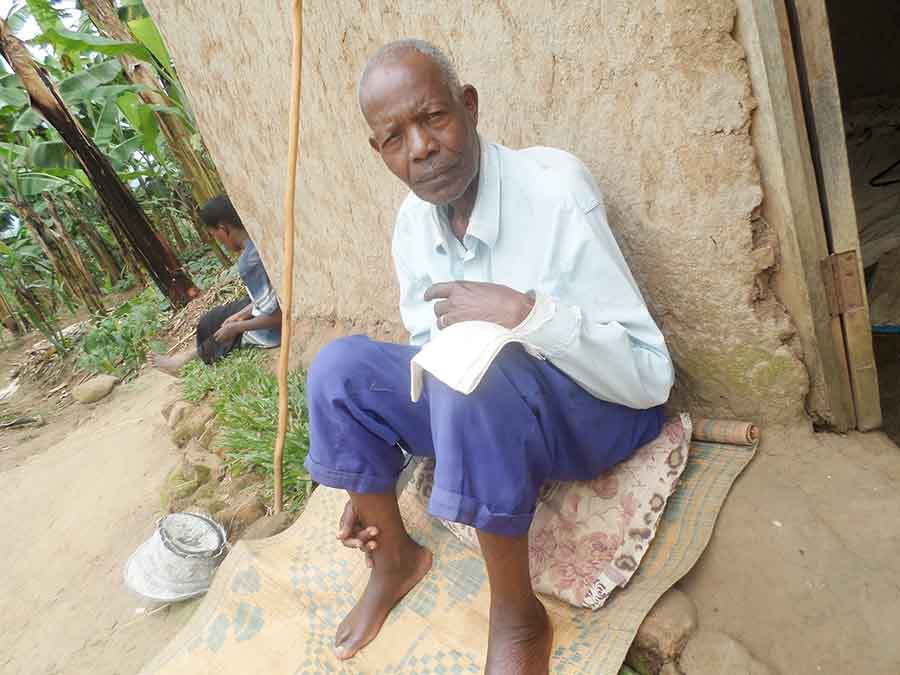
Mzee George Kabamwerere
Albina Mukago, a 94-year-old resident of Karoza B. LC I, confirmed that the area was notorious for its strange practices. She claimed that the witchdoctors made ant-hills fight each other to prove their power, and people would believe in their supernatural abilities. She also mentioned that if someone did not promptly confess to theft, their family could suffer severe consequences, including death. According to her, many women were enslaved and had their ears cut off as punishment for their families' crimes. These women sometimes ended up as wives of the witchdoctors.
Modern-Day Karoza
According to Lawrence Karimbaare, a 66-year-old resident of Kandago, Karoza, the practice of commanding ant-hills to fight was once common in Karoza. The witchdoctors were known for their strong deities, which could locate stolen property and force the thief to confess. However, most of the notorious witchdoctors eventually converted to Christianity, and the places once associated with witchcraft have now become sites of worship.
Karoza is now a religious hub
Deus Katebariirwe, a 72-year-old grandson of Rwansibani, confirmed that his grandfather was known for commanding ant-hills to fight. He recounted how the witchdoctors used to feed the fig trees with cows and goats until the practice eventually died out.
Perez Mugure, a 60-year-old former Chairman of Karoza A LC I, did not witness the fighting ant-hills but confirmed the existence of the large fig trees. He noted that the witchdoctors had strong deities that caused panic and death in the region. Today, however, Karoza has largely moved away from its witchcraft roots and become a religious hub.
In summary, Karoza, once feared for its witchcraft practices, has transformed into a place of religious worship. The notorious witchdoctors are gone, and the area is now known for its churches rather than its supernatural activities.
Torch Media Africa



