Design
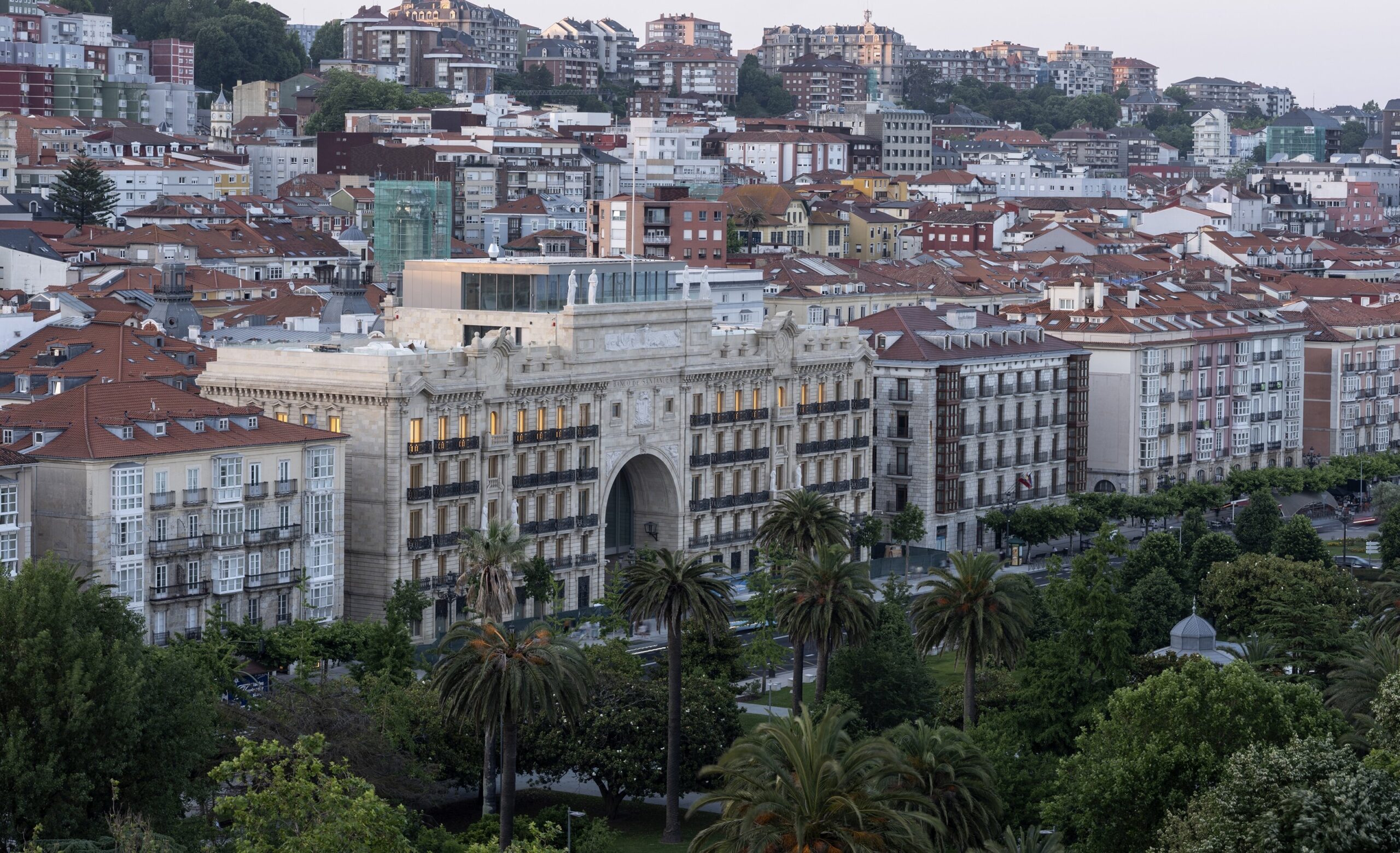
For nearly a century, the Pereda Building on Santander’s waterfront was where money lived — the imposing headquarters of the bank that shares the city’s name, a structure built to project institutional permanence rather than public welcome. This September, after nine years of planning and construction, that same building reopens as Faro Santander, a sweeping new cultural institution designed by David Chipperfield Architects that converts roughly 10,000 square meters of former office space into one of Spain’s most anticipated new museums. It is, notably, the first building David Chipperfield Architects has ever designed in Spain — a milestone for one of the world’s most decorated architecture practices arriving, fittingly, in the form of a building about openness replacing a building about access control.
A Building With a Complicated History
The Pereda Building’s roots stretch back to 1795, and its architectural story since then has been one of continuous renovation and expansion rather than a single, unified vision — a ten-story palimpsest reflecting more than two centuries of the city’s commercial and civic life. That layered history became both the challenge and the raw material for Chipperfield’s team. Rather than erasing the building’s institutional past or restoring it to a single historical moment, the studio has approached the renovation as an act of translation: taking a structure engineered for security and hierarchy and reprogramming it for circulation, transparency, and public flow.
“Architecturally, it boasts a complex and multi-layered history,” said David Chipperfield, the studio’s founder, describing the project. “We focused on rethinking the spaces and connections a public building needs, while recognising that the real significance of the project lies in the institution’s commitment to openness, culture and participation.” That framing — architecture in service of institutional values rather than spectacle for its own sake — has been a throughline in Chipperfield’s practice for decades, visible in earlier landmark projects like Berlin’s Neues Museum and the James-Simon-Galerie, both defined by careful, almost archaeological restraint rather than dramatic reinvention.
What’s Inside
Once complete, Faro Santander’s galleries will occupy five of the building’s ten floors, transforming what were once trading floors and executive offices into exhibition space for the Banco Santander Collection, widely regarded as one of the most significant private art collections in Spain. Beyond simply displaying that collection, the institution has been positioned as a platform for what its team describes as “artistic experimentation” — suggesting an ambition that extends past a conventional corporate-collection showcase and toward a more active, program-driven cultural space.
The technical undertaking behind the conversion is considerable. To protect the artworks that will eventually hang inside a building never designed for climate-sensitive collections, Chipperfield’s team installed an innovative climate-control system that draws on geothermal energy and thermally activated building systems embedded in the structure itself, reducing the need for the kind of energy-intensive conventional HVAC systems that typically dominate museum conservation budgets. The building also incorporates a green roof and a rainwater reuse system for irrigation — sustainability commitments that align Faro Santander with a broader movement among major museum projects this year toward treating environmental performance as inseparable from architectural ambition, rather than an afterthought bolted on at the end.
A Museum’s First Test: What Goes on the Walls
Faro Santander’s opening exhibition has already generated conversation of its own. The museum is set to inaugurate with the Gelman Collection — a program choice that has drawn attention within the art press for the collection’s scope and, in some corners, controversy over specific holdings. That an institution built inside a former bank headquarters is choosing to open its public life with a collection already generating critical debate suggests Faro Santander’s ambitions extend beyond safe, crowd-pleasing programming into genuinely contested cultural terrain — a notable risk for a young institution’s very first impression.
The building has also become the subject of a public architecture debate hosted by Dezeen, in which one commentator described elements of the design memorably as a “refuge for the uncreative” — a sharply critical framing that stands in contrast to the more celebratory coverage the project has received elsewhere in the architecture press. That split reaction is, in its own way, a sign of a building substantial enough to generate real disagreement rather than uniform praise, which is often the more interesting outcome for a major civic project.
Daniel Vega Pérez de Arlucea, Faro Santander’s director, framed the institution’s mission in more accessible terms, emphasizing accessibility over architectural theory: “The transformation was about pursuing our vision of creating a cultural centre that is open to everyone — somewhere that is welcoming and accessible, with wonderfully diverse and high-quality spaces, where every visitor can enjoy a truly unique experience.” That vocabulary of welcome and accessibility is doing real work here, given the building’s history as one of the more literally exclusionary structures in the city — a bank vault, in effect, reengineered into a civic living room.

Why This Fits a Larger Pattern
Faro Santander joins a growing list of major 2026 museum projects built not from scratch but from adaptive reuse of existing, often historically loaded structures — a trend reshaping how cities think about cultural infrastructure. Rather than commissioning new monuments on empty land, institutions and their architects are increasingly choosing to reprogram existing buildings, arguing that repurposing embodied carbon and preserving urban memory carries both environmental and civic value that new construction cannot replicate. For a bank headquarters in particular, the symbolic weight of converting a monument to private capital into a monument to public culture is difficult to overstate.
What This Means for Visitors
Faro Santander opens to the public on September 8, 2026, giving the city’s waterfront a new anchor cultural destination timed to the start of the autumn museum season across Europe. Visitors can expect a building that foregrounds its own layered history rather than concealing it — exposed connections between old and new construction, five gallery floors of varying character reflecting the building’s uneven architectural past, and a program that, based on its opening exhibition choice, seems intent on courting genuine critical engagement rather than simply pleasant Sunday-afternoon browsing.
Looking Ahead
As the September opening approaches, expect intensifying coverage of both the building itself and the specifics of its opening program, particularly around the Gelman Collection debate. For Chipperfield’s practice, Faro Santander marks a symbolically important entry into the Spanish market after decades of major projects across Germany, the UK, and beyond — proof, once again, that some of the most compelling architecture happening right now isn’t about building anew, but about deciding what a building already standing is allowed to become next.
Published By | Features Editor