Economic & Social Transformation
A Small Economy at a Crossroads
Landlocked entirely within the borders of South Africa, the Kingdom of Lesotho is one of the smallest and most externally dependent economies in Sub-Saharan Africa. Its roughly 2.3 million people rely on a narrow set of revenue streams: a shrinking garment-export industry tied to the United States' African Growth and Opportunity Act (AGOA), transfers from the Southern African Customs Union (SACU), and royalties earned by exporting water to South Africa through one of the region's most ambitious infrastructure schemes, the Lesotho Highlands Water Project (LHWP). In 2026, all three pillars are under strain simultaneously, illustrating both the resilience and the fragility of a highly open, resource-poor micro-economy squeezed between global trade politics, commodity cycles, and its giant neighbor's fiscal calendar.
According to the African Development Bank's latest Lesotho Economic Outlook, real GDP growth is projected to slow sharply to just 0.5% in 2026, down from 1.4% in the 2025/26 fiscal year and 5.2% in 2024, before a modest recovery to 1.8% in 2027. The International Monetary Fund's 2025 Article IV consultation, concluded by the Executive Board on September 17, 2025, likewise flagged weakening momentum, citing a deteriorating external environment, tariff-related trade shocks, and uncertainty tied to renewed geopolitical tensions in the Middle East that are pushing up fuel and food prices. Inflation is expected to climb to roughly 5.7% in 2026 before easing to 4.3% the following year, while the current account deficit is projected to widen to 8.7% of GDP in 2026 on the back of higher import costs and project-related capital goods purchases.
The AGOA Lifeline and a Shrinking Garment Sector
Nowhere is Lesotho's external vulnerability more visible than in its garment sector, long the country's largest private employer and the backbone of its manufactured exports to the United States. The sector has been whipsawed by an on-again, off-again AGOA renewal process: the preferential trade program lapsed in September 2025 and was not restored until February 3, 2026, when it was renewed retroactively but for only a short window running through December 31, 2026. That truncated timeline has done little to settle nerves in an industry already contending with new US tariffs and softer global demand for apparel.
Employment in AGOA-assisted manufacturing firms has fallen from 51,325 workers in 2020 to 34,151 in 2024, reflecting a wave of factory closures and production cutbacks even before the latest renewal drama. Research from the Overseas Development Institute has singled out the disproportionate impact on women, who make up the large majority of Lesotho's garment workforce, warning that a "short lifeline" renewal leaves tens of thousands of jobs exposed to any further lapse or non-renewal after 2026. Industry advocates argue that a longer, more predictable AGOA horizon — rather than the current year-to-year uncertainty — is essential if Lesotho is to retain the foreign investment that built its textile base in the first place.
Water Royalties: The Quiet Fiscal Cushion
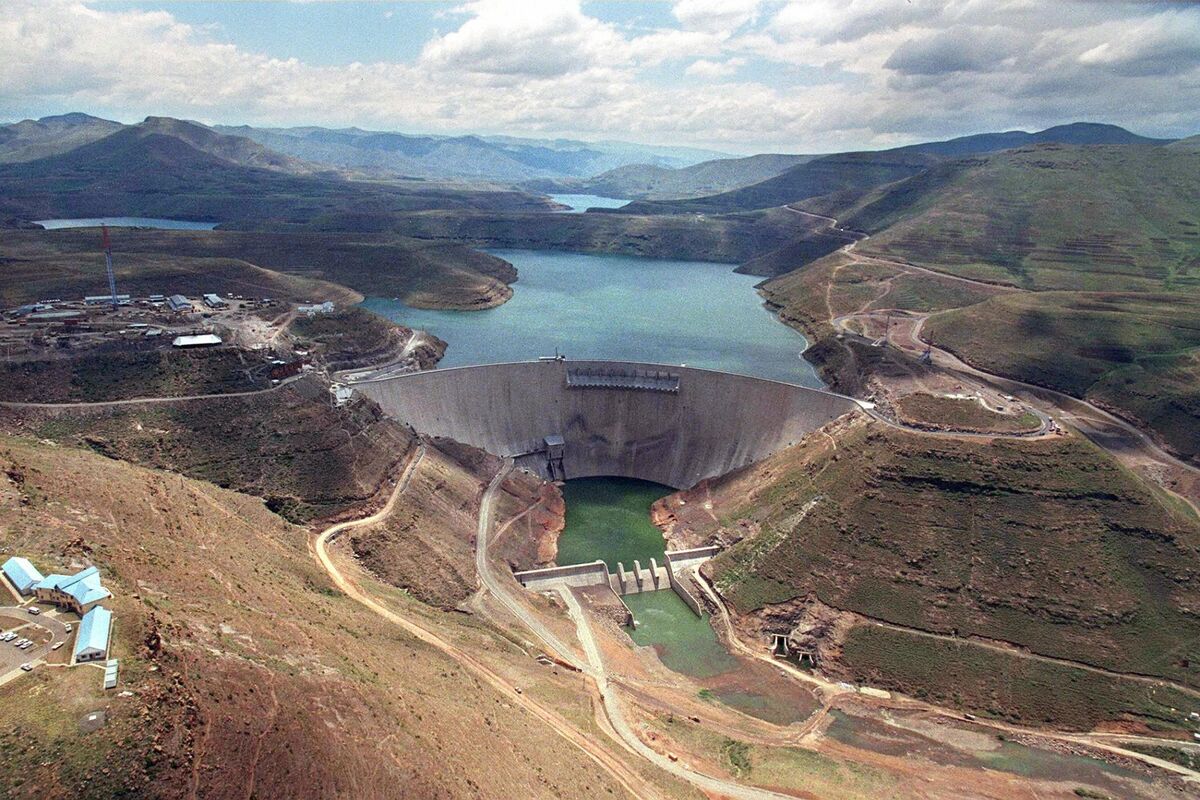
While textiles wobble, an unlikely fiscal cushion has grown steadily larger: the water royalties Lesotho earns for supplying South Africa's Gauteng industrial heartland through the Lesotho Highlands Water Project. Under a renegotiated royalty agreement with Pretoria, payments from the Lesotho Highlands Development Authority (LHDA) have surged, reaching nearly 13% of GDP in fiscal year 2025 before an expected settling to around 10% of GDP over the medium term — a remarkable increase from historical levels and now one of the single largest contributors to government revenue.
The ongoing construction of LHWP Phase II, a multi-billion-dollar expansion project, is expected to sustain and eventually grow this royalty stream further once new delivery tunnels and the Polihali Dam become operational later in the decade. The IMF noted that this water-royalty windfall, combined with still-elevated SACU transfers, helped Lesotho post a fiscal surplus of about 9% of GDP in fiscal year 2024, easing gross public debt to 56.8% of GDP as of March 2025 — roughly 80% of it owed to external creditors.
SACU Transfers: Revenue Without Reliability
That surplus, however, masks a structural vulnerability that successive IMF missions have flagged repeatedly: roughly 20% of Lesotho's GDP in ordinary years comes from its share of the Southern African Customs Union revenue pool, a transfer mechanism tied directly to South Africa's trade volumes and tariff collections and thus entirely outside Maseru's control. The government's FY2026/27 budget, presented to Parliament on February 18, 2026, confirmed that the more recent surplus of roughly 3% of GDP recorded in FY2025 (down from 9.5% the year before) was driven mainly by a sharp decline in SACU receipts, only partly offset by the higher water royalties.
With SACU transfers expected to normalize back toward their long-term 20%-of-GDP average, and water royalties gradually settling lower after their initial renegotiation bump, Lesotho's fiscal authorities face a narrowing window in which two of their three major revenue pillars are moving in the same direction: down.
Diamonds Lose Their Shine
Lesotho's third traditional export earner, diamond mining — historically around 8% of GDP — is also retrenching. Global rough-diamond prices have fallen sharply amid weak demand and the rapid rise of lab-grown alternatives, squeezing margins at Letšeng, the high-value mine that has long been Lesotho's flagship diamond asset and one of the world's richest sources of large, gem-quality stones. In September 2025, Letšeng's operator announced a 20% workforce reduction, a visible sign of how a global shift toward synthetic stones is reshaping one of the country's oldest export industries. With diamonds, textiles, and SACU transfers all facing headwinds at once, Lesotho's near-term growth outlook rests increasingly on the water sector and on public investment tied to LHWP Phase II construction.
Poverty, Health, and the Cost of Aid Cuts
These macro pressures land on a population that is already among the poorest and most health-burdened in the world. An estimated 37% of Lesotho's population lives in poverty, and unemployment stood at roughly 31% in 2024. Lesotho also carries the world's second-highest adult HIV prevalence rate, at approximately 24.6% among 15-to-49-year-olds, behind only neighboring Eswatini. Decades of PEPFAR and Global Fund support — including a $75 million PEPFAR contribution in 2022 — helped Lesotho make substantial progress toward the UNAIDS 95-95-95 testing, treatment, and viral-suppression targets.
But the IMF's 2025 Article IV report specifically warned that disruptions to US official development assistance pose fresh risks to Lesotho's health-related social services, with the baseline scenario now assuming a near-term pullback in donor-funded health support just as the fiscal space to fill any gap domestically is shrinking.
Debt, Fiscal Space, and the Reform Agenda
A World Bank report released in April 2025, "Private Sector-Led Growth and Public Sector Reforms Can Create More Jobs and Grow Lesotho's Economy," argued that the country's long-term prosperity depends on diversifying beyond its traditional triad of textiles, SACU transfers, and water royalties, calling for public-sector reforms to crowd in private investment and job creation outside the shrinking garment sector. The report's central message — that Lesotho cannot simply wait out the current downturn in its legacy export sectors — echoes IMF and AfDB recommendations for strengthening domestic revenue mobilization, improving the business environment, and using the current water-royalty windfall to build fiscal buffers rather than fund permanent spending increases.
Outlook
Taken together, Lesotho's 2026 economic story is one of a small, structurally dependent economy managing simultaneous strain across all three of its traditional pillars. The short AGOA renewal offers only temporary relief to garment exporters and the women who form the backbone of that workforce; SACU transfers remain hostage to South Africa's trade cycle; and diamonds face a global demand shift with no clear reversal in sight. Only the LHWP water-royalty stream is currently expanding, buying Lesotho fiscal breathing room and underscoring how central this decades-old bilateral water-sharing arrangement with South Africa has become to Maseru's public finances — a reminder that in Lesotho, water, not diamonds or denim, may now be the country's most reliable export.
Published By | Features Editor