Written By | Health News Agencies
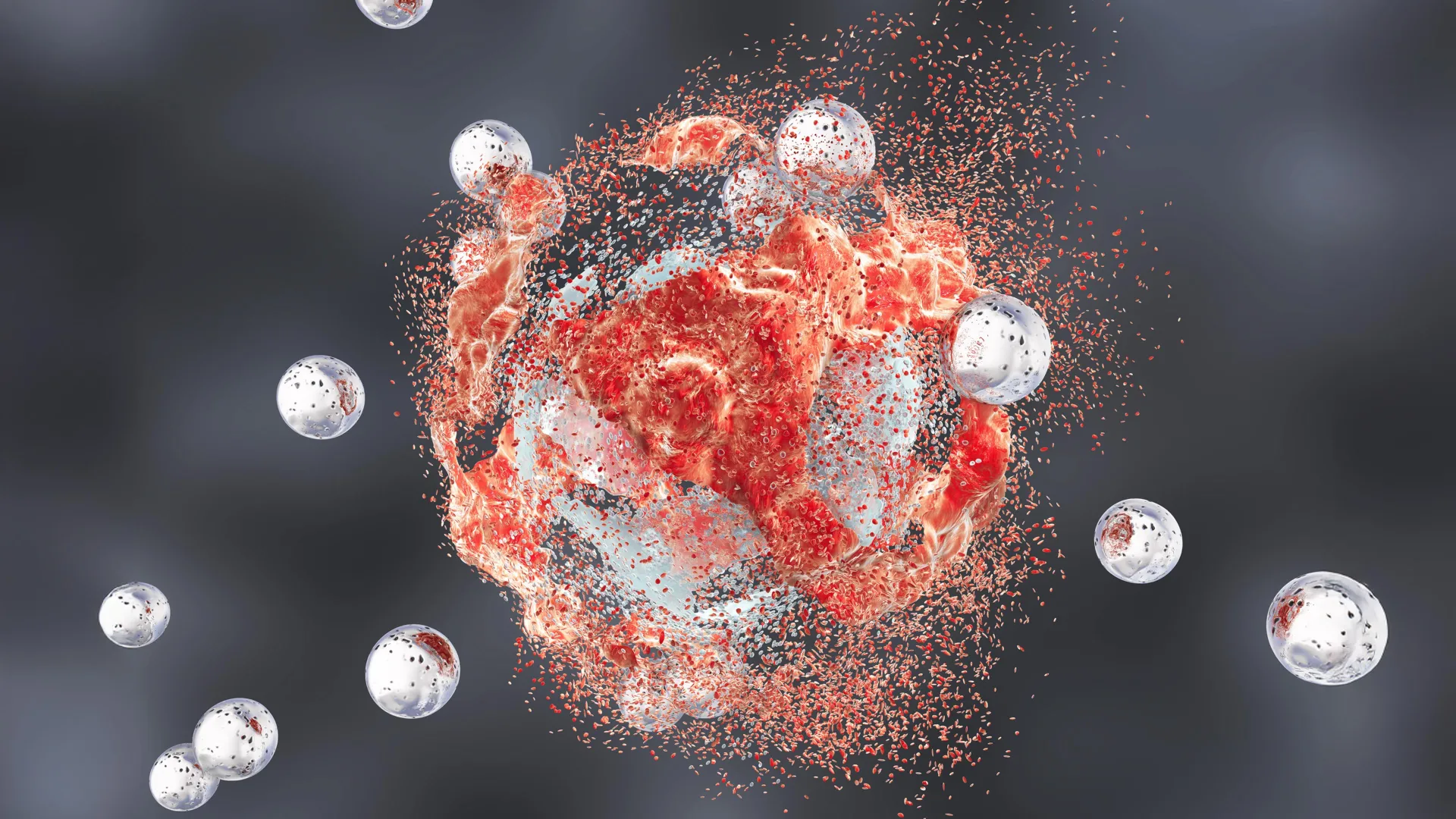
Cornell scientists engineered microscopic silica particles that make cancer cells self-destruct — and wake up the immune system to finish the job
NEW YORK
Picture a tumor cell getting tricked into committing suicide, then the body's own immune system waking up from a years-long nap to hunt down whatever's left. That's not science fiction — it's the real result researchers at Weill Cornell Medicine and Cornell Engineering are reporting this week, and it's got the cancer research world buzzing.
The weapon of choice: ultrasmall, fluorescent, glass-like nanoparticles nicknamed “C' dots” — short for Cornell Prime dots — originally invented years ago as a medical imaging tool, not a cancer treatment. In a study published in the journal Cancer Research and picking up fresh attention this week, scientists showed these particles can be re-armed to directly kill aggressive prostate tumor cells while simultaneously flipping the surrounding immune environment from cold and passive to hot and aggressive.
For the roughly 1.5 million men worldwide diagnosed with prostate cancer each year — and the thousands whose cancer stops responding to standard treatment — early results like these represent exactly the kind of one-two punch oncologists have been chasing: a therapy that kills tumor cells directly and recruits the immune system to mop up survivors.
HOW A GLASS BEAD KILLS A TUMOR
C' dots are built from silica — essentially the same silicon dioxide found in sand, in the shells of tiny marine organisms called diatoms, and even in trace amounts in leafy greens. Cornell researchers, led in part by engineer Ulrich Wiesner, originally designed these ultrasmall particles to glow under specific imaging conditions, helping surgeons see tumor margins in real time. They've already been tested safely in human clinical trials as an imaging and drug-delivery tool.
What's new is the discovery that the particles themselves, when specifically targeted to prostate cancer cells using a homing molecule that binds to PSMA (prostate-specific membrane antigen, a protein that studs the surface of prostate tumor cells), can push those cells into a violent form of self-destruction called ferroptosis. Unlike ordinary cell death, ferroptosis works by overwhelming a cell's fatty molecules with oxidation until its membranes essentially disintegrate from the inside out.
“We're very encouraged by these results,” said Dr. Michelle Bradbury, the endowed professor of imaging research in radiology and director of the Molecular Imaging Innovations Institute at Weill Cornell Medicine, who helped lead the study. “A treatment that directly induces tumor-cell death while transforming the immune microenvironment, as this does, would represent a new clinical paradigm.”
FROM COLD TUMORS TO HOT TARGETS
Prostate tumors have long been considered “immunologically cold” — meaning they're skilled at hiding from the immune system, which is one reason why immunotherapy drugs that work wonders in melanoma or lung cancer have mostly flopped against prostate cancer. The Cornell team's mouse studies suggest C' dots may crack that problem open.
In mice with aggressive prostate tumors, C' dots alone modestly slowed tumor growth but didn't cure anything on their own. The real fireworks came when researchers combined C' dots with immune checkpoint blockade drugs — the same class of immunotherapy used against melanoma and lung cancer. That combination produced complete or near-complete remissions, with tumors vanishing and mice surviving indefinitely, in 4 of 10 treated animals. When the team added a third ingredient — a drug blocking CSF-1R, a receptor that controls tumor-friendly immune cells called macrophages — the remission rate climbed to 5 of 10 mice, a 50% cure rate in animals that would otherwise have died of aggressive, treatment-resistant disease.
Neither C' dots alone nor immunotherapy alone came anywhere close to those numbers, researchers noted — it was the combination that flipped the tumor's immune microenvironment from a fortress that shuts immune cells out to a battlefield where the body's own defenses finally show up and fight.
FROM MICE TO MEN: HOW FAR AWAY IS THIS?
It's important to be clear about what stage this research is at: these are preclinical results in mice, not a treatment available to patients today, and certainly not a cure ready for prime time. But the path from lab bench to hospital bed here has an unusually well-paved head start. Because C' dots have already gone through human safety trials as an imaging agent and drug-delivery vehicle for other applications, researchers have a running start on the safety data regulators will eventually want to see before allowing therapeutic trials to begin in patients.
The Cornell team says its next steps involve further preclinical safety and efficacy testing to refine dosing and confirm the treatment combination works consistently before pursuing the human trials needed for eventual FDA review. That process, typical for any experimental cancer therapy, generally takes years, not months — but the fact that the core nanoparticle technology is already a known quantity in humans could meaningfully shorten the runway compared to starting from scratch.
WHY PROSTATE CANCER HAS BEEN SO HARD TO CRACK
Prostate cancer is the second most commonly diagnosed cancer in men worldwide, and while many cases are slow-growing and highly treatable, a meaningful subset become aggressive, spread beyond the prostate, and eventually stop responding to hormone therapy — the backbone of standard treatment. Once that happens, patients often cycle through chemotherapy, newer hormone-blocking drugs, and PSMA-targeted radioligand therapies, but options narrow quickly and outcomes for advanced, treatment-resistant disease remain sobering.
The immunotherapy revolution that transformed treatment for melanoma, lung cancer, and several other tumor types over the past decade has largely bypassed prostate cancer. Checkpoint inhibitor drugs, which essentially take the brakes off the immune system's T cells, have shown only modest benefit in most prostate cancer patients when used alone. Researchers have long suspected the reason lies in the tumor's microenvironment: prostate tumors recruit immune cells called tumor-associated macrophages that actively suppress any immune attack, effectively running interference for the cancer. That's part of why the Cornell team specifically tested adding a CSF-1R blocker — a drug that disables those macrophages — on top of the C' dot and checkpoint inhibitor combination, and why doing so pushed remission rates even higher.
EXPERT PERSPECTIVE
Cancer immunologists outside the study have pointed to the ferroptosis-plus-immunotherapy combination as part of a broader, increasingly promising trend in oncology: pairing therapies that directly kill tumor cells with therapies that unleash the immune system, rather than relying on either approach alone. Researchers have long suspected that ferroptosis-inducing treatments could make “cold” tumors more visible to the immune system by releasing tumor debris and danger signals as cells rupture — and this study offers some of the clearest mouse evidence yet that the theory holds up in a real, difficult-to-treat cancer type.
Outside experts have also noted that the reuse of an imaging-and-drug-delivery platform for a completely new therapeutic purpose is itself notable — repurposing a nanoparticle already characterized in humans could, in principle, help this approach reach clinical trials faster than a brand-new compound would, though they caution that mouse-to-human translation in oncology fails far more often than it succeeds, and enthusiasm should be tempered until the same results are replicated in additional independent studies and larger animal cohorts.
Specialists also note the importance of the PSMA-targeting approach, since PSMA is already a validated target in prostate cancer — it's the same protein exploited by PSMA-targeted radioligand therapies already approved for advanced prostate cancer patients, suggesting the biological target itself carries less risk than an entirely novel one might.
THE BIGGER PICTURE IN NANOMEDICINE
This study also lands at a moment when nanoparticle-based cancer therapies are having something of a renaissance across oncology. For years, the field promised more than it delivered — early hopes that nanoparticles could be engineered to seek out tumors with pinpoint precision ran into messy real-world biology, immune clearance problems, and manufacturing headaches that kept most candidates stuck in the lab. The C' dot platform's advantage is that it has already cleared some of those hurdles: it has documented safety data in humans, a manufacturing process that has been refined over more than a decade of academic and clinical development, and now a newly discovered therapeutic mechanism layered on top of a tool doctors already trusted for imaging.
Researchers say the same PSMA-targeting, ferroptosis-inducing strategy could, in principle, be adapted to other PSMA-expressing cancers beyond prostate, though that work remains speculative and untested. For now, the Cornell team's focus stays narrowly on prostate cancer, where the unmet need for treatments that work once hormone therapy fails remains one of oncology's most persistent challenges.
WHAT THIS MEANS FOR YOU
If you or someone you love is living with prostate cancer today, this isn't a treatment you can ask your oncologist for yet — it's mouse data, however promising, and years away from being tested in people, let alone approved. What it does represent is a genuine scientific advance in a stubborn problem: prostate tumors' knack for evading the immune system, which has limited how much cutting-edge immunotherapy has been able to help patients with this disease compared to some other cancers.
For men currently managing prostate cancer, especially aggressive or treatment-resistant forms, the most useful takeaway is to keep an eye on clinical trial listings over the next few years as this and similar combination approaches move toward human testing — and to keep an open conversation going with your care team about emerging options as they become available.
THE BOTTOM LINE
Silica — the stuff of sand and glass — is having an unexpected moment in cancer research. By repurposing an imaging tool most people have never heard of into a tumor-killing, immune-awakening weapon, Cornell researchers have opened a promising new front against a cancer that has resisted the immunotherapy revolution longer than almost any other. It's early. It's mice, not men. But a 50% complete remission rate in the toughest tumors researchers could throw at it is the kind of number that gets an entire field's attention — and it has.



