World Politics
Background
Ceuta is one of two small Spanish exclaves on the North African coast, wedged into Morocco's Mediterranean shoreline near the Strait of Gibraltar, and it has functioned for decades as one of Europe's most sensitive migration flashpoints. Because it sits on African soil while remaining part of Spain, and therefore the European Union, it offers a uniquely short route for migrants seeking to reach European territory without crossing open water toward mainland Spain, Italy or Greece. Morocco disputes Spanish sovereignty over both Ceuta and its sister exclave Melilla, viewing them as colonial remnants that should belong to Morocco, a claim that has periodically been leveraged, according to Spanish officials and outside analysts, as diplomatic pressure against Madrid. The territory saw a similarly large surge in 2021, when roughly eight thousand people crossed into Ceuta over a matter of days after Morocco eased its border controls amid a separate diplomatic dispute, an episode widely seen as a preview of the dynamics now playing out again.
The proximate trigger for this week's crisis, according to regional reporting, traces back to Spain's decision to allow Brahim Ghali, leader of the Polisario Front, the movement fighting for the independence of Western Sahara from Moroccan control, to be admitted to a Spanish hospital. Morocco considers Western Sahara integral national territory and treats any gesture of support for the Polisario Front as a serious provocation. Analysts describe a recurring pattern in which diplomatic friction between Rabat and Madrid over the Western Sahara dispute is followed, within days, by a visible relaxation of Moroccan border enforcement on the Ceuta frontier, functioning as an unofficial pressure valve that Spanish officials have at times explicitly accused Morocco of manipulating.
Compounding the political trigger is a recent legal shift inside Spain itself. Spain's Supreme Court issued a ruling establishing that migrants who reach Spanish territory by sea cannot be summarily returned across the border without individualized due process, a decision that changes the incentive calculus both for migrants weighing the crossing and for Moroccan border officials deciding how strictly to police the shoreline. Taken together, the diplomatic dispute over Ghali's hospitalization and the altered legal landscape around summary returns appear to have combined to produce the conditions for this week's surge.

Key Developments
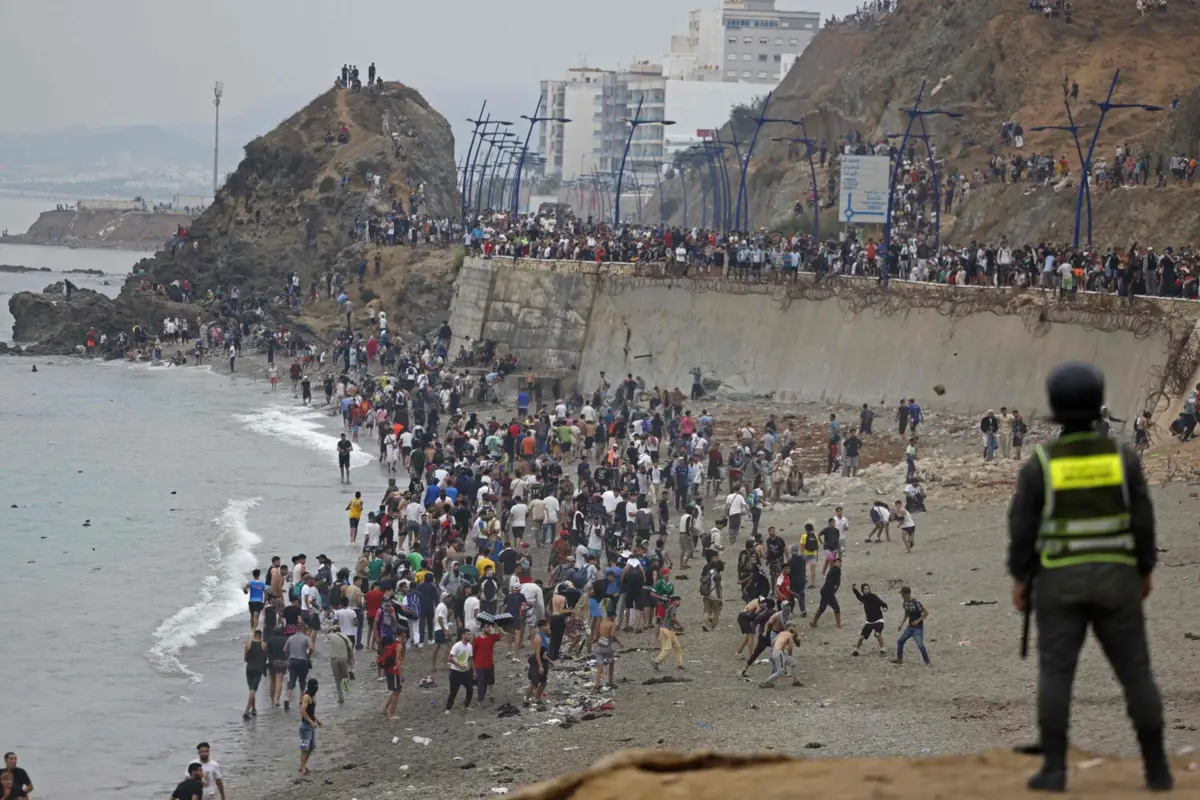
The crisis erupted on Wednesday, July 29, and intensified overnight into Thursday and Friday, July 31. Spain's Interior Ministry estimated that approximately forty-nine thousand people crossed into Ceuta within a single twenty-four-hour period, an extraordinary figure for a territory with a total population of roughly eighty thousand. Video footage from the area, widely circulated and cited by multiple outlets including CNN, NBC News and CBS News, showed large groups of migrants entering through the Tarajal border crossing, with many swimming or floating on inflatable tubes around coastal barriers separating Moroccan and Spanish territory, while others forced their way through a land gate and ran into the city itself.
At least eighteen people are reported to have drowned attempting the crossing, according to figures cited by CBS News and NPR, though earlier reporting on Wednesday and Thursday from CNN and Fox News had put the death toll at nine, reflecting how quickly the situation and its human cost escalated over a roughly forty-eight-hour window; officials have cautioned that the final toll may rise further as search efforts continue along the coastline. Local officials estimated that between two thousand and three thousand people ultimately made it into Spanish territory and remained there as of Friday morning, with city authorities describing overwhelmed reception capacity.
In response, the Spanish government deployed military platoons alongside air, naval and diving units to reinforce exhausted local police and Civil Guard officers, while the European Union's border agency, Frontex, also moved to help stabilize the situation. Rachid Sbihi, who leads a local association representing Civil Guard officers, described the situation as a 'serious humanitarian crisis,' noting that thousands of migrants, including unaccompanied children, were left sleeping in parks and on sidewalks with no clear plan for shelter or processing. Prime Minister Pedro Sánchez traveled to Ceuta on Friday morning alongside Interior Minister Fernando Grande-Marlaska to assess the response directly, though Sánchez's government stopped short of declaring a formal state of emergency, arguing that the legal threshold for such a declaration had not been met even as it rushed additional security resources to the territory.

Reactions
The political fallout has extended well beyond Spain's borders. Italian Prime Minister Giorgia Meloni said she had spoken with her interior minister, Matteo Piantedosi, and convened security officials to weigh what she described as 'extraordinary measures,' including the possible suspension of Schengen free-movement arrangements with Spain, calling the images from Ceuta 'striking evidence' that uncontrolled illegal immigration poses a genuine threat to Europe's borders. The threat to suspend Schengen, even if not ultimately carried out, reflects how quickly a localized crisis at one member state's external frontier can escalate into a bloc-wide political flashpoint, echoing similar tensions that have flared periodically since the 2015 migration crisis.
Domestically, the crisis has sharpened an already polarized debate over Sánchez's migration policy. Santiago Abascal, leader of the right-wing Vox party, characterized the crossing as an 'invasion,' language that has become a recurring feature of European anti-immigration rhetoric in recent years. Alberto Núñez Feijóo, head of the opposition center-right People's Party, separately criticized the government's operational handling of the crisis, though stopping short of the more inflammatory framing used by Vox. Spain's government, for its part, has pushed back on suggestions that its own policies are to blame, with some officials pointing instead to Morocco's border enforcement choices and the diplomatic dispute over Western Sahara as the proximate cause.
The Trump administration in Washington also weighed in, with the White House reportedly attributing the crisis in part to Spain's migration policy framework, according to reporting from the Moroccan outlet Yabiladi, a characterization Spanish officials have disputed. The episode has additionally reignited longstanding tension between Madrid and Rabat, with Spanish officials describing Morocco's loosened enforcement as a form of pressure or, in blunter terms used in past disputes, 'blackmail' tied to the Western Sahara issue.
What's Next
In the near term, Spanish and EU officials will be focused on stabilizing conditions in Ceuta itself: processing the several thousand migrants who have already crossed, continuing search operations for anyone still missing at sea, and preventing further large-scale crossings while diplomatic channels with Rabat are reopened. Given that the 2021 episode was resolved only after direct diplomatic engagement between Madrid and Rabat, a similar high-level channel, potentially involving concessions or reassurances on the Western Sahara question, will likely be necessary to bring Moroccan border enforcement back to its prior posture.
At the EU level, the crisis is likely to intensify pressure for a bloc-wide response, both in terms of Frontex resourcing and in the broader, long-running debate over how migration burdens are shared among member states. Meloni's suggestion of suspending Schengen arrangements, even if more rhetorical than a concrete policy proposal at this stage, signals that other European governments facing their own migration pressures may use the Ceuta episode to push for tighter external border controls or renewed negotiations over the EU's asylum and relocation framework.
Domestically, the crisis adds strain to Sánchez's already fragile coalition government, which has faced repeated no-confidence pressure and a difficult parliamentary arithmetic in recent months. How his government balances humanitarian obligations toward migrants, including a large number of unaccompanied minors, against a hardening domestic political mood on immigration will shape both the government's immediate response and its broader standing heading into future electoral tests. Officials will also need to grapple with the longer-term legal implications of the Supreme Court's ruling on summary returns, since if that precedent continues to alter incentives at the border, Ceuta and Melilla could see recurring pressure well beyond this week's episode, particularly at moments of renewed friction with Rabat.
Published By | News Editor