Written By | Deuson Muto
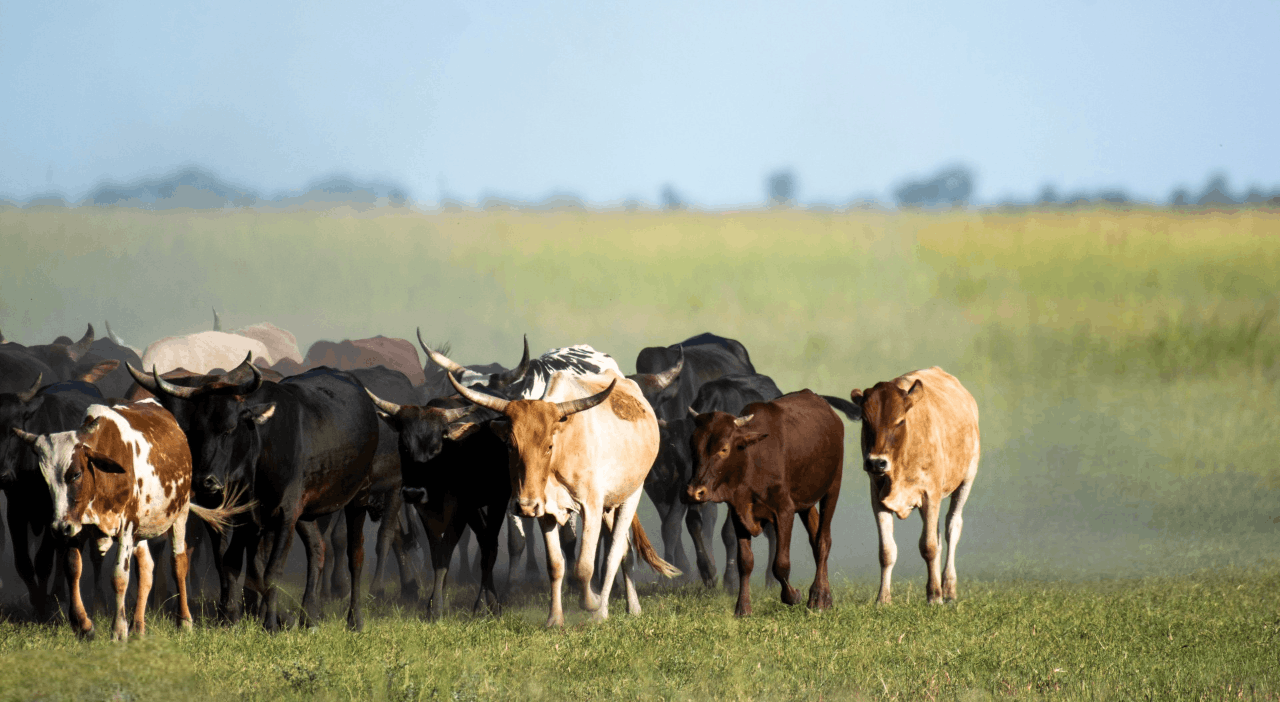
Cattle grazing under the sun, echoing the village’s past wealth and unity.
Every time I sit quietly and reflect, I ask myself a difficult question: Is life truly getting better, or is it becoming harsher and more hostile for human beings to survive and thrive?
Thirty years ago, in my village of Oburam, life was very different. Land belonged both to individuals and to the community. Because of this, life felt easier and more secure. Families had land to farm and could grow enough food to sustain themselves. Community grazing land allowed people to rear cattle, goats, and sheep freely. Those who had many cows often grazed them together with those who had only a few. It was a system built on cooperation rather than competition.
Life was friendly, supportive, and deeply connected. When one family prospered, the entire community benefited. Wealth did not feel isolated within individuals. It circulated through relationships.
Some families became well known for their large herds and prosperity. The families of Ntaama, Baafa, Mwirumubbi, Maatari, Rwapabuuka, and Katongole owned more than eighty cows, along with goats and other livestock. Their wealth was not just a personal achievement; it was part of the village economy and social fabric.
Our village also had many elderly people, men and women in their 60s, 70s, and beyond. They were the custodians of wisdom, culture, and community values. The gap between generations was small because young people worked, learned, and lived closely with the elders. Knowledge passed naturally from one generation to the next. Life had a sense of continuity.
But thirty years later, the picture has changed dramatically.
The old generation has almost completely disappeared. Many of the elders who once held the community together are gone. With them, much of the knowledge, discipline, and unity they maintained has faded. The wealth that once defined the village has slowly melted away. The great herds have disappeared. The strong pillars of the village economy have weakened.
Education arrived, and people welcomed it with hope. Education was supposed to improve life and strengthen communities. But in many ways, it replaced rather than complemented the traditional systems that had sustained people for generations.
Instead of integrating education with farming, livestock keeping, and local economic practices, many families abandoned these foundations. Parents sold large portions, sometimes all of their land, to educate their children. Community land that once supported everyone was divided, privatized, and slowly sold off.
Over time, the safety net that once protected the community disappeared.
Today, many families who once owned large herds and fertile land struggle to meet basic needs. Young people grow up without land to cultivate, without livestock to rear, and without the strong communal bonds that once defined village life. The community spirit that once allowed neighbors to support each other has weakened.
It raises a painful but important reflection: development should not mean abandoning what once sustained us.
Education is valuable, but it should strengthen culture, agriculture, and community systems, not erase them. Progress should build on the wisdom of the past rather than replacing it entirely.
If the past teaches us anything, it is that true wealth is measured not only in money, education, or modern systems, but also in community, land, knowledge, and the ability of people to support one another.
Perhaps the lesson for the future is balance. We must combine education with agriculture, modern knowledge with traditional wisdom, and individual success with community wellbeing.
Because when a community loses its land, its elders, and its shared responsibility for one another, it risks losing more than wealth - it risks losing its identity.
And once identity is lost, rebuilding it becomes the hardest task of all.



