Written By | Jovita Hasto
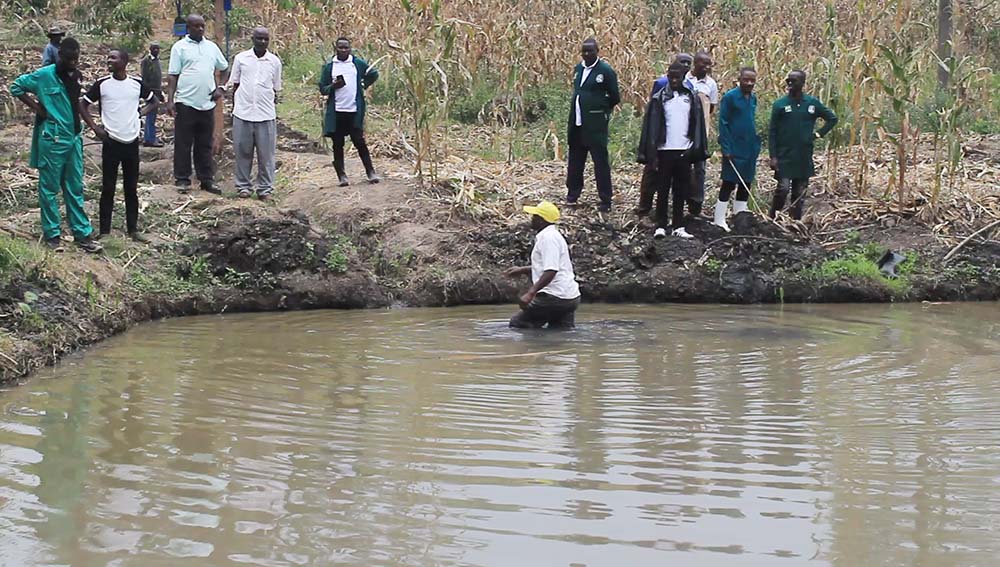
Experts say poor sanitation can lead to fish deaths, warning farmers to remove water lilies early so that fish can access enough oxygen.
IBANDA
Fish farmers in Ibanda District have been urged to maintain proper sanitation of their fish ponds if they are to protect and sustain their aquaculture businesses.
Experts say poor sanitation can lead to fish deaths, warning farmers to remove water lilies early so that fish can access enough oxygen. They also noted that poor-quality feeds hinder fish growth, making it difficult for farmers to produce marketable fish.
Water lilies were identified as one of the greatest threats to fish farming. Fisheries experts urged farmers to remain vigilant if they want to maximize returns from the aquaculture business.
Mr. Edgar Nkamushaba, a fisheries expert in Ibanda District, explained that when weeds decompose at the bottom of ponds, they reduce oxygen levels, making it difficult for fish to breathe. He advised farmers to weed their ponds regularly or install water channels to improve water circulation.
"We have seen farmers allowing water lilies to grow, and once they start decomposing, they affect water quality. As a result, oxygen levels reduce and the fish die. Ponds should be kept clean, or farmers should install nets and inlet and outlet pipes to keep the water fresh," he said.
He added that farmers should also invest in quality fish feeds if they want to achieve higher yields.
"Currently, there is a factory in Jinja manufacturing fish feeds (pellets), making it easier for farmers to access quality feeds. Farmers should know what to feed their fish. Fish should not be fed leftovers from the dining table because that will not produce the quality fish needed for the market. There are feeds specifically designed for fingerlings and mature fish, which are sold at between Shs3,000 and Shs6,000 respectively," he added.
Mr. Nkamushaba further advised farmers to seek guidance from fisheries experts if they want to manage their fish farming enterprises sustainably.
He stressed that many farmers who fail to seek technical knowledge often incur losses and eventually develop negative perceptions about fish farming.
"Most farmers think fish farming can be done without technical knowledge, but that is not the case. Those who have tried without guidance are counting losses. I also want to inform farmers that if they do not have ponds, they can use plastic containers or tarpaulin tanks to rear fish and still earn an income. It is simply a matter of seeking knowledge from experts," he advised.
Ms. Lilian Atukwase Rwentaro, a fish farmer from Rwenkobwa Town Council in Ibanda District, said farmers should understand that fish farming has several stages that must be followed carefully.
She explained that she started fish farming in 2021 but suffered losses during her first attempt due to limited knowledge.
Driven by her passion, she later sought guidance from district fisheries experts, who trained her on best practices.
"At first, I dug very deep ponds because I wanted them to resemble a lake. I also mixed different fish species, making harvesting difficult. I expected to harvest after only six months, but the results were disappointing. I had to seek technical knowledge because I loved fish farming," she said.
Ms. Atukwase said the practical lessons she received enabled her to redesign and properly organize her ponds.
"The ponds were poorly designed, which affected feeding and management of the fish. Even the catfish settled too deep. I later learnt the correct pond measurements and redesigned them accordingly."
She said fish farming has greatly improved her livelihood.
"I have been able to meet my family's needs. In addition, I have ventured into value addition and acquired skills to establish a fertilisation hub where we rear black soldier flies, which are used as fish feed, among other products," she said.
Ms. Atukwase encouraged other farmers to develop a passion for fish farming and to acquire the necessary technical knowledge before venturing into the business.
"For example, farmers need to understand the quality of water required for fish to survive and grow well. Passion, combined with the right knowledge, is key to success in fish farming," she said.



