The designer's long-awaited debut at the Roman house rewrites the rules of luxury fashion with a radical call for collective creativity.
MILAN — June 8, 2026
When Maria Grazia Chiuri walked out at the end of her debut collection for Fendi and received a standing ovation from an audience that included celebrities, buyers, critics, and her own family, it was the culmination of a journey that began 37 years ago in the same house. A young design assistant in 1989, she could not have imagined she would one day return as chief creative director — not as a triumphant outsider, but as a prodigal daughter.
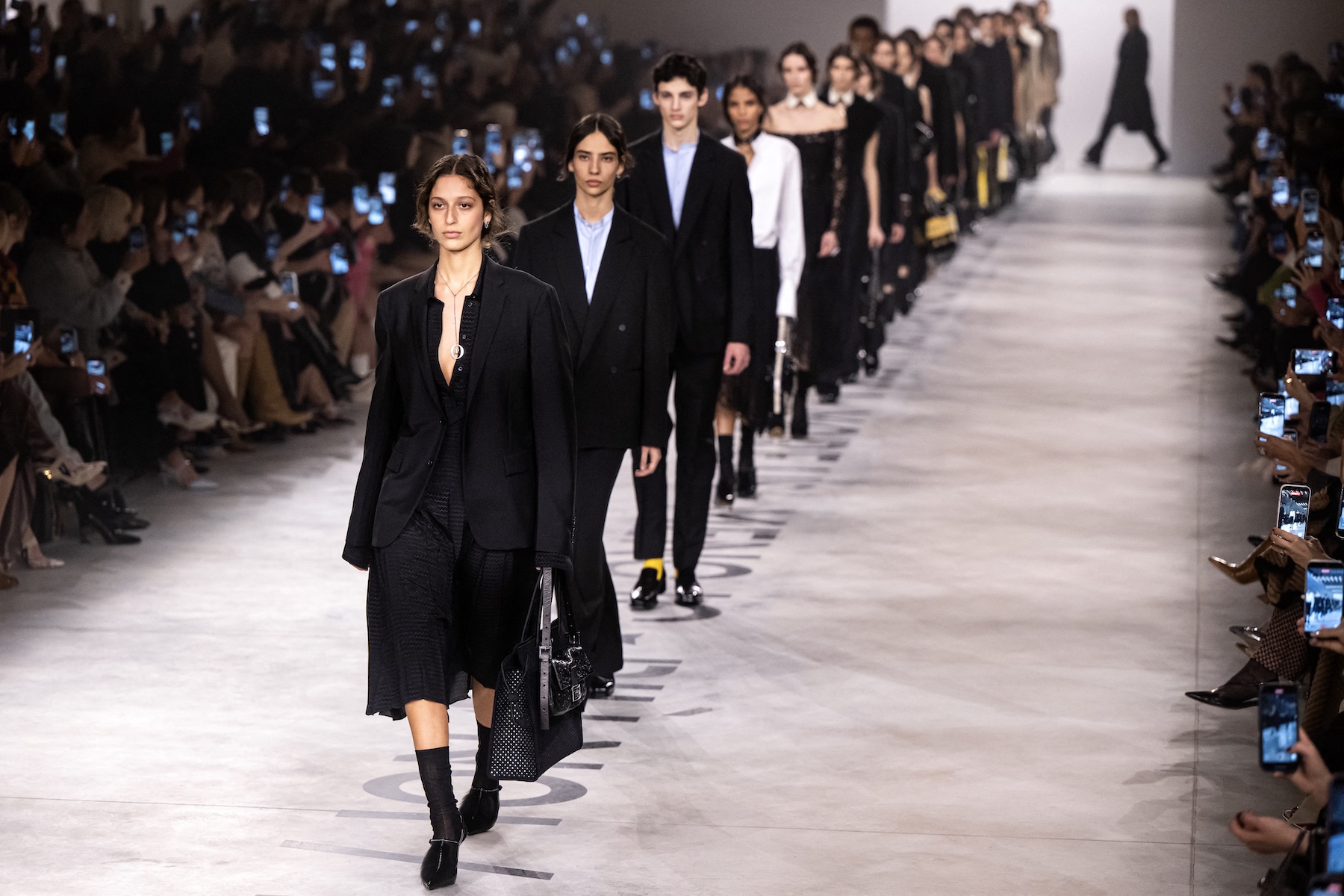
Her Fall/Winter 2026 collection, titled Less I, More Us, is the most talked-about fashion debut of the year, and perhaps of the decade. The show — held in February at Fendi's Rome headquarters, though its cultural reverberations continue to grow — upended expectations at every turn: stripping the label's palette back to near-monochrome, introducing the brand's first co-ed runway, and announcing a creative philosophy so far removed from the maximalist luxury of recent years that it felt, to many, like a genuine provocation.
The provocation, it turns out, was entirely intentional.
A Homecoming Unlike Any Other
Chiuri spent the better part of two decades away from Fendi after her early years there. She built her reputation at Valentino before taking the top job at Christian Dior in 2016 — becoming the first woman to lead Dior's creative direction in the house's 70-year history. Her tenure there was defined by a feminist sensibility and a commitment to craft.
Leaving Dior for Fendi, announced in early 2026, raised eyebrows. Why trade the world's most prominent fashion platform for a return to a house where she had been relatively junior? The answer, she has suggested, is personal: Fendi is where she became a designer.
"I have carried Fendi with me for 37 years without ever fully knowing it," she told one interviewer. "Coming back is not nostalgia. It is recognition."

The Collection: Stripping Back To Find The Core
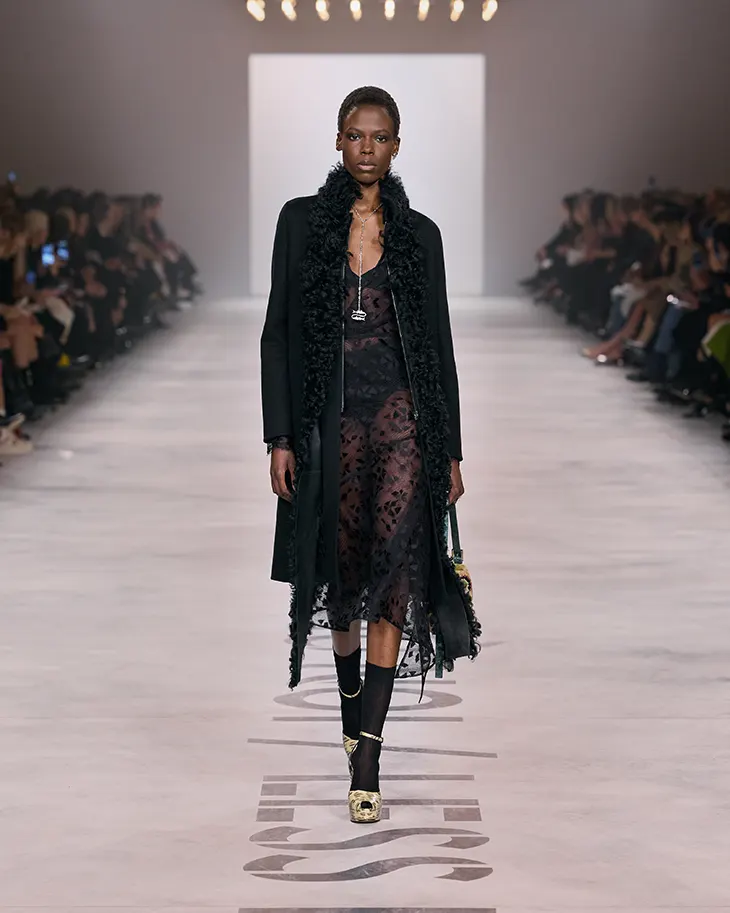
Less I, More Us arrived in a near-colorless palette — creams, blacks, and deep charcoal grey — broken only by occasional flashes of Fendi's signature yellow appearing in knits, socks, and accessories like a signature winking from beneath a disguise. Where Karl Lagerfeld and Kim Jones before her had embraced opulence, Chiuri stripped it back with almost ruthless discipline.
The architectural silhouettes were impeccable: suits cut to land like whispers on the body, tailored with attention to the house's Roman atelier traditions. Embroideries echoing the 1920s — delicate, almost fragile — were applied to pieces that also featured cargo details and boilersuit functionality. The tension between ornamentation and utility was not a contradiction but a dialogue.
For the first time, Fendi showed menswear on the same runway as womenswear — two riffs on the same idea, a black suit over a blue shirt, worn by male and female models as deliberate visual echoes. It was a statement about what fashion can do when it stops performing gender and starts exploring form.
"My first collection for Fendi is not a personal manifesto," Chiuri wrote in press notes. "It is a gesture toward something larger — toward the people who make these clothes, who wear them, who give them meaning."
Less I, More Us: The Philosophy Unpacked
The collection's title is not merely a slogan but a genuine design methodology. Chiuri has spoken at length about the collaborative nature of fashion — that any garment bearing a single designer's name is the product of dozens or hundreds of hands: pattern-cutters, embroiderers, finishers, seamstresses.
The embroideries were created in collaboration with artisans from Fendi's in-house workshops, whose techniques date back generations. Fine laces were sourced from Italian producers whose families have been making them for over a century.
"The house is already full," Chiuri has said. "I don't need to bring my ego into it. I need to listen."
This philosophy has resonated beyond the fashion press. In an era of brand fatigue and commodification, a luxury house announcing that its new direction will be defined by collective spirit rather than individual authorship feels genuinely refreshing.
The Reaction
Reaction to the debut has been divided — a sign that it hit a nerve. The consensus among buyers and editors is that the collection represents a significant creative statement, one that will take several seasons to fully unfold. Some critics, however, have found the restraint almost too extreme, questioning whether a stripped-back Fendi can compete for attention.
Others have found it bracing. "In a season full of look-at-me fashion," one prominent critic wrote, "here is a designer asking: look at us, instead. It is more interesting than it sounds, and considerably braver than it looks."
Celebrities who attended — including K-pop star Bang Chan and singer Huh Yunjin, both Fendi brand ambassadors — expressed genuine enthusiasm on social media rather than rote promotional appreciation. Something, it seemed, had genuinely moved them.
What It Means For Fashion's Direction
Chiuri's arrival at Fendi is one of several high-profile creative director changes reshaping luxury fashion in 2026. Her debut signals that the pendulum may be swinging away from the logomania and maximalism that dominated the post-pandemic years, back toward something more considered, more craft-focused, more interested in meaning than in spectacle.
Or perhaps it signals nothing so tidy as a trend. Perhaps it is simply what happens when a designer with genuine conviction, genuine history, and genuine craft gets the platform she has earned.
Less I, more us — and more, it turns out, is exactly enough.
Published By | FASHION