Background
On January 20, 2025, his first day back in office, President Donald Trump signed an executive order attempting to end automatic birthright citizenship for children born on U.S. soil to parents who are in the country illegally or on certain temporary visas. The order directly challenged more than a century of settled constitutional interpretation rooted in the Fourteenth Amendment, ratified in 1868, which states that “all persons born or naturalized in the United States, and subject to the jurisdiction thereof, are citizens of the United States.” The Supreme Court’s 1898 ruling in United States v. Wong Kim Ark had long been understood to guarantee citizenship to nearly anyone born within U.S. borders, regardless of their parents’ immigration status, with narrow exceptions for children of foreign diplomats and, historically, certain Native American tribes prior to a 1924 law.
Trump’s order was blocked almost immediately by federal district courts, and lower appellate courts split on procedural questions, particularly around the scope of nationwide injunctions that judges had issued to halt enforcement. The case that ultimately reached the Supreme Court, Trump v. Barbara, consolidated several of these challenges brought by states, immigrant families, and civil rights organizations including the ACLU and the National Immigration Law Center. Justices heard oral arguments earlier this year in one of the most closely watched constitutional cases of Trump’s second term, alongside companion cases on nationwide injunctions that the administration had used the birthright citizenship fight to press the Court to limit.
An estimated 255,000 children are born in the United States each year to noncitizen parents, according to the Migration Policy Institute, and would have been rendered without automatic legal status had the order taken effect. Civil rights groups warned the policy would have created a class of stateless or undocumented children born on U.S. soil, with cascading effects on eligibility for Social Security numbers, passports, and other basic government services.
Key Developments
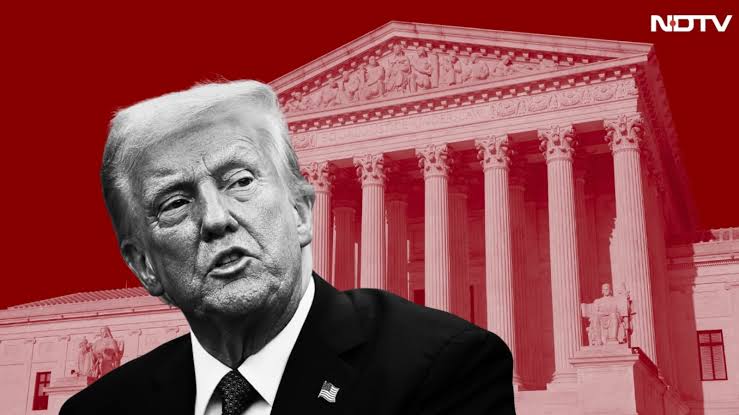
On June 30, 2026, the Supreme Court ruled 6-3 that Trump’s executive order is unconstitutional, delivering one of the term’s most consequential defeats for the administration’s immigration agenda. Chief Justice John Roberts wrote the majority opinion, joined by the Court’s three liberal justices and, notably, only one of the Court’s conservatives, Justice Amy Coney Barrett — an alignment that underscored how far outside the legal mainstream the administration’s position had fallen.
Roberts grounded the opinion in the text and history of the Fourteenth Amendment, pointing to the drafters’ deliberate use of broad, universal language to define citizenship after the Civil War, in contrast to narrower proposals debated at the time that would have excluded certain populations. He also leaned heavily on Wong Kim Ark, describing it as controlling precedent that Congress and the executive branch cannot override by statute or order without a constitutional amendment. The opinion rejected the administration’s central legal theory — that children of undocumented or temporary-visa parents are not “subject to the jurisdiction” of the United States in the sense the framers intended — calling it inconsistent with more than 125 years of settled law.
Justice Samuel Alito wrote the principal dissent, joined by Justices Clarence Thomas and Neil Gorsuch, arguing that the “subject to the jurisdiction thereof” clause was never meant to extend automatic citizenship to children of parents who owe allegiance to a foreign government and are present in the country unlawfully. Roberts’ majority opinion took the unusual step of directly rebutting Alito’s reasoning point by point within the body of the opinion itself, a level of engagement legal commentators described as a notably sharp response from the Chief Justice.
Adding a further wrinkle, Justice Brett Kavanaugh — a Trump appointee — joined the majority in striking down the executive order on constitutional grounds but wrote separately to suggest that Congress could achieve a narrower version of the administration’s goal through ordinary legislation rather than an amendment, a position immigration lawyers quickly disputed given the Fourteenth Amendment’s constitutional status.
The ruling arrived alongside two other closely watched decisions issued the same day: a 6-3 ruling upholding West Virginia and Idaho laws requiring student athletes to compete according to sex assigned at birth, and a decision striking down post-Watergate era limits on political party spending. Taken together, the trio of rulings capped a dramatic final week of the Court’s term, but the birthright citizenship case was widely regarded as the most significant, both for its direct rebuke of presidential power and its implications for millions of American families.
The case also carried significance beyond immigration policy because of how the administration used it. Rather than defending the executive order purely on its merits, Justice Department lawyers had also asked the justices to use the case as a vehicle to curb the practice of federal district judges issuing nationwide injunctions that block a policy everywhere in the country, not just for the specific plaintiffs before the court — a tool that has frustrated administrations of both parties in recent years. The Court largely sidestepped that broader procedural fight in this case, choosing instead to resolve the underlying constitutional question directly, which had the effect of settling the birthright citizenship dispute nationwide regardless of how the injunction question is eventually resolved in other pending cases.
Reactions
Trump responded within hours on Truth Social, writing that the ruling was “too bad for our Country,” but said the fight would move to Congress. “We can easily make it up in Congress through Legislation, with the support of the President,” he wrote, adding, “No long and unwieldy Constitutional Amendment is necessary!” — a claim constitutional scholars quickly disputed, noting that ordinary legislation cannot override a right the Court just held is guaranteed directly by the Fourteenth Amendment.
Republican lawmakers split over the path forward. Senator Eric Schmitt of Missouri called the decision “wrong, dangerous, and disastrous for American sovereignty,” and argued Congress should pursue a constitutional amendment “in moments of national crisis.” Senator Lindsey Graham, a close Trump ally who chairs the Senate Judiciary Committee, said he would make restricting birthright citizenship a top legislative priority, while acknowledging the steep procedural hurdles — a constitutional amendment requires two-thirds majorities in both chambers of Congress and ratification by three-quarters of the states, a bar essentially unreachable in the current political climate.
Immigrant rights organizations and Democrats celebrated the ruling as a landmark defense of constitutional rights. Kica Matos, president of the National Immigration Law Center, one of the groups that challenged the order, called it “an important victory for our democracy and the communities who courageously challenged Trump’s egregious abuse of power to rewrite the Constitution.” The ACLU and Asian Law Caucus, which also represented plaintiffs, issued similar statements framing the decision as a bulwark against executive overreach. Democratic lawmakers, largely quiet during oral arguments, used the ruling to argue that Trump’s broader efforts to reshape immigration policy through unilateral executive action have repeatedly run into constitutional limits.
What’s Next
With the executive order struck down, the practical effect is that hospitals, state vital records offices, and federal agencies including the Social Security Administration and State Department can continue to treat U.S.-born children as citizens at birth regardless of their parents’ immigration status, exactly as they have for well over a century. The ruling also likely narrows, at least for now, the administration’s broader push to use this case as leverage to curtail nationwide injunctions, since the Court resolved the underlying constitutional question directly rather than remanding on procedural grounds.
Politically, the decision sets up a fight in Congress that most legal analysts view as symbolic rather than viable, given the near-impossible threshold for a constitutional amendment. Still, Graham and other Republicans are expected to introduce legislation or hold hearings in the coming months, in part to keep the issue alive for the 2026 midterm campaign season. Some conservative legal scholars, including ideas floated by Kavanaugh’s separate opinion, may try to test narrower statutory approaches targeting specific categories of visa holders, setting up the possibility of future litigation even though the core constitutional holding is now settled.
For families directly affected, immigration attorneys say the ruling removes an acute source of anxiety that had built since Trump signed the order in January 2025, particularly for the hundreds of thousands of children born annually to parents with pending asylum claims, temporary protected status, or other precarious legal categories. Advocacy groups say they will continue monitoring for any administrative attempts to functionally restrict birthright citizenship through smaller-scale agency actions, such as passport or Social Security number processing rules, even after the Supreme Court’s direct rejection of the executive order itself.
Published By | News Editor