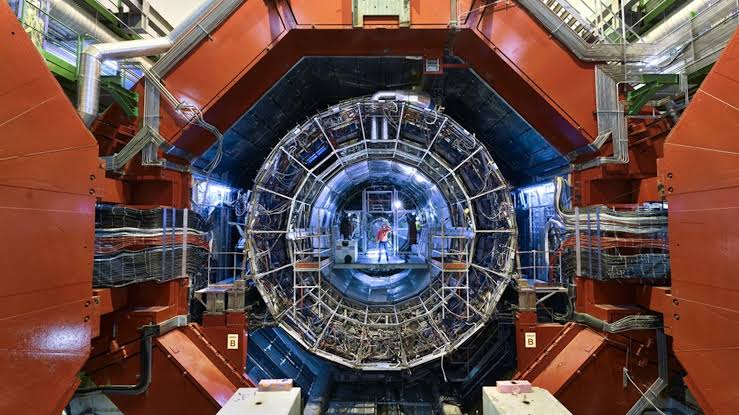
The Large Hadron Collider has smashed oxygen and neon nuclei together and found the fiery fluid that filled the cosmos in its first microseconds. It was never supposed to appear in collisions this small.
Editor's note: the results were first reported by CERN in July 2026 and have drawn fresh attention this week in new coverage. Quotes are from published CERN and University of Copenhagen material.
Imagine cooking up the hottest substance since the dawn of time, and discovering you did not need the giant pot after all. That is, in essence, what physicists at CERN's Large Hadron Collider are now telling the world. By smashing relatively tiny atomic nuclei together at close to the speed of light, they have found signs of quark-gluon plasma, the searing primordial soup that is believed to have filled the entire universe in the first millionth of a second after the Big Bang.
For decades, scientists believed you needed the heavyweights to make it. Lead nuclei, more than 200 times heavier than the protons usually fired around the LHC, were the standard recipe. Now, results from all four of the collider's main experiments suggest that far lighter nuclei, including oxygen, the very stuff in the air you are breathing, and neon, the glowing gas in old shop signs, can do the job as well.
The finding was announced by CERN in July after the LHC's first-ever oxygen collisions the year before, and it has been echoing around science news this week, with fresh write-ups reaching a mass audience under headlines about "Big Bang matter in surprisingly small collisions". It is a story about how the smallest events can reveal the biggest truths about where everything came from.
What is quark-gluon plasma?
Everyday matter is made of atoms, whose nuclei contain protons and neutrons, which in turn are built from smaller particles called quarks held together by other particles called gluons. Normally, quarks are locked inside protons and neutrons and can never be seen alone. It is one of the stranger rules of nature.
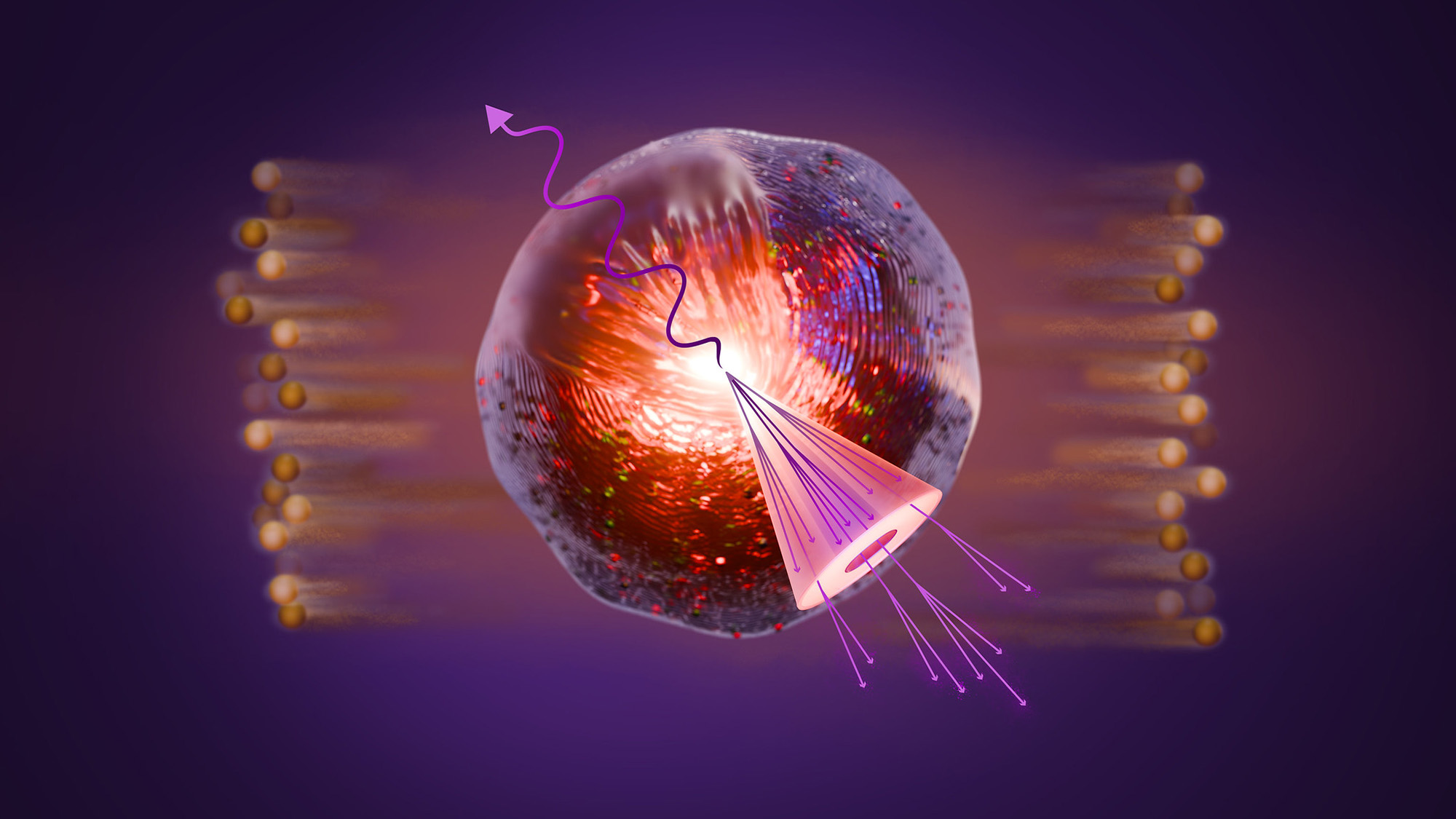
But turn up the temperature far enough and the rule breaks. In the unimaginable heat of the early universe, protons and neutrons did not yet exist. Instead, quarks and gluons swirled together in a hot, dense, liquid-like state known as quark-gluon plasma, or QGP. According to CERN, this plasma forms at temperatures more than 100,000 times hotter than the centre of the Sun. As the young universe expanded and cooled, the plasma condensed into the protons and neutrons that make up everything we see today, including you.
That makes QGP the closest thing physicists have to a time machine. Study it, and you study the universe as it was in its first fleeting moments. The trouble is that it only lives for a tiny fraction of a second. The droplets expand and turn into a spray of other particles almost instantly, so scientists cannot look at the plasma directly. They have to work out what happened from the debris that flies out.
The 'too small' problem
For years, physicists produced QGP by colliding lead ions, giant nuclei packed with 208 protons and neutrons, in the belief that you needed that much mass to pile up enough energy in a small enough space. Smaller collisions, such as those between single protons, were thought to produce nothing but a quick, messy shower of particles.
Then the cracks began to show. Hints of plasma-like behaviour started appearing in collisions between protons and lead nuclei, and even in proton-proton collisions, a signal the ALICE experiment has previously reported. That was puzzling. If the plasma could appear when so little matter was involved, what was the smallest system that could create it? And how could scientists be sure they were seeing a real droplet of the primordial fluid rather than something else mimicking it?
The solution was to build a bridge between the two extremes. In 2025 the LHC delivered its first-ever collisions of oxygen-16 and neon-20 nuclei, an intermediate size designed to answer exactly that question.
Four experiments, one answer
A year of analysis later, the verdict is in, and it is remarkably consistent. According to CERN, all four main LHC experiments report signs of quark-gluon plasma in the small-nuclei collisions.
ATLAS clearly observed "parton energy loss", a telltale sign of plasma, in which energetic particles crossing the plasma lose energy. It saw this through imbalances between pairs of particle jets in both oxygen-oxygen and neon-neon collisions, and the effect was stronger in the most head-on impacts, just as the plasma picture predicts.
CMS found that the production of charged particles was suppressed in oxygen and neon collisions compared with proton-proton collisions, another expected plasma fingerprint. It also reported varying suppression of upsilon mesons, particles made of a bottom quark and its antimatter partner, when comparing oxygen and neon.
LHCb found that particles containing charm quarks were suppressed more strongly in neon-neon than in oxygen-oxygen collisions, which fits the idea that the bigger neon nucleus creates a larger volume of plasma.
And ALICE, the experiment built specifically to study this state of matter, compared neutral pions in oxygen-oxygen and proton-oxygen collisions and reported what CERN calls unambiguous evidence of parton energy loss in oxygen-oxygen collisions. Its preliminary results also show baryons flowing more strongly than mesons, which the leading explanation attributes to the plasma.
No single measurement is a smoking gun on its own. Together, from four independent detectors and several different signatures, they paint a picture that is hard to explain any other way.

The bowling pin and the ball
One of the most eye-catching results comes from researchers at the Niels Bohr Institute at the University of Copenhagen working with the ALICE collaboration. Their study, published in Physical Review Letters, found that the shape of the nuclei themselves leaves an imprint on the collision.
Oxygen-16 nuclei are relatively rounded, and collisions between them produce a correspondingly rounded pattern of particles. Neon-20 nuclei, by contrast, are shaped more like a bowling pin, and the particles flying out of the collisions reflect that elongated shape. In effect, the plasma acts like a snapshot of the geometry of the nuclei that made it.
"The particles from the primordial matter are directly governed by the geometric shape of the atomic nucleus," said Emil Gorm Dahlbaek Nielsen of the Niels Bohr Institute. It is a striking idea: instead of measuring how nuclei spin and vibrate in low-energy experiments, as scientists have done for more than 70 years since Aage Bohr won the 1975 Nobel Prize for his work on nuclear structure, researchers can now read the shape off the wreckage of a high-energy smash-up. The team describes that as a potential paradigm shift.
Lead researcher You Zhou summed up the achievement: "We have pushed the boundary for how small the atomic nuclei can be while still recreating this primordial matter." On the method, he was refreshingly blunt: "We smash them together at the highest energies we can create."
Why it matters
The first reason is the simplest: it tells us how the universe worked. If the plasma can form in collisions involving so few particles, it suggests that this extreme state of matter is far more robust than anyone thought, and that it does not require a huge system to flow like a liquid. That forces theorists to rethink the models they use to describe the early universe and the strong nuclear force that binds quarks together.
The second is practical. Light-ion collisions give scientists a whole new tool. Because small systems are cleaner and easier to model than lead collisions, they offer a sharper way to test how the plasma behaves, how much energy particles lose passing through it and how its properties change with size. CERN notes that the planned High-Luminosity LHC upgrade is expected to allow the plasma to be studied in greater depth.
The third is the thrill of the chase. The Copenhagen team plans to go even smaller, with helium-4 collisions, to find the smallest system that still produces the plasma. Somewhere between a single proton and an oxygen nucleus lies a boundary, and finding it would mark the edge of one of nature's most extreme states of matter.
Expert perspective: confident, but still counting
The physicists involved are careful about how far they push the claim. CERN describes the findings as "indications" and "signs" of the plasma, and several of the key ALICE results are labelled preliminary. Analysis of the full dataset is still under way, and the different experiments use different methods and measurements, so scientists will want to see them line up in the final publications.
But the direction is clear. What had been a debate about whether small systems could ever behave like a droplet of primordial fluid has become a question of exactly how small they can go. Nielsen and Zhou's remarks capture the mood in the field: excitement that a long-standing assumption has fallen, and a sense that the real work of mapping the new territory is only starting.
It is also worth remembering what scientists mean by "recreating" the Big Bang. The collisions make tiny droplets that exist for a sliver of a second, far smaller than a speck of dust, and nothing of the universe's birth is being repeated. What is being recreated is a state of matter, not an event, and that is precisely why it is so useful.
What this means for you
You will not see a gadget come out of this next year. Fundamental physics rarely works that way. But history shows that the machines and methods built to probe nature at its deepest level have a habit of changing everyday life. The World Wide Web was invented at CERN, and the detectors, magnets and computing techniques developed for collider experiments have spilled into medical imaging, cancer therapy and data science.
On a deeper level, the result is a reminder that the stuff of the early universe is not locked away in the past. It is something we can summon, briefly, in a lab beneath the Franco-Swiss border, using the same oxygen you breathe. Every atom in your body was once part of that primordial soup, and now we are learning how little it takes to make it again.
And for anyone who has ever wondered why scientists keep asking for ever larger machines, this story has a nice irony: sometimes the next big discovery comes from going small.
The bottom line
A year ago, no one had ever collided oxygen nuclei in the LHC. Today, four of the world's most sophisticated detectors are telling the same story: the fiery fluid of the early universe can appear in surprisingly small collisions, and it carries the fingerprints of the shape of the atoms that made it.
There is still plenty of checking to do, and more data to come. But the message from Geneva is exciting enough already. The Big Bang's first soup was not made only by giants. Even a puff of oxygen can cook it.
This article is based on public releases from CERN and the University of Copenhagen, and on coverage by ScienceDaily and other outlets. Readers can find the technical papers on the experiments' own websites.
Published By | Tech Wiz