World Politics
Russians finish voting on Sunday in an election whose outcome was never seriously in doubt, but whose staging tells a great deal about how the Kremlin intends to carry its war into a fifth year. The three-day ballot for the 450-seat State Duma, which opened on Friday 18 September and closes on Sunday 20 September, is the first parliamentary election Russia has held since the full-scale invasion of Ukraine began in February 2022. It is also the first in which residents of four partially occupied Ukrainian regions — Donetsk, Luhansk, Kherson and Zaporizhzhia — have been enrolled as voters for the national parliament, an act Kyiv and the European Union have denounced as an attempt to launder annexation through the machinery of an election.
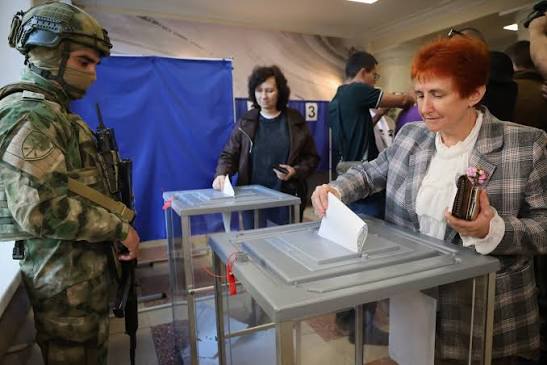
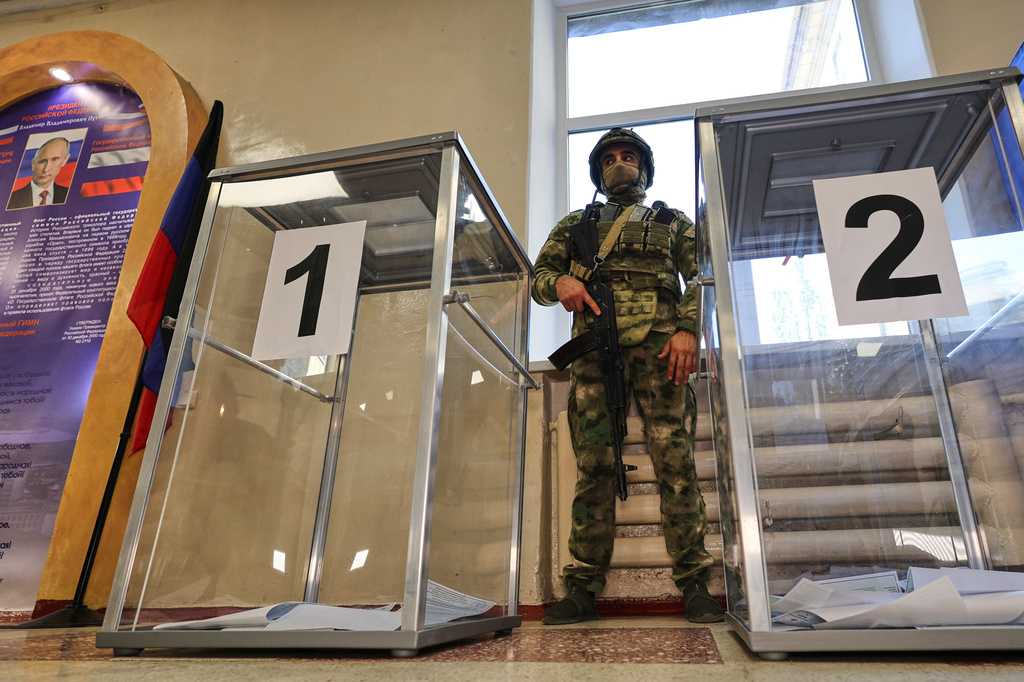
At one polling station in the Russian-held part of Donetsk region, an Associated Press photographer recorded voters dropping ballots into a box while an armed Russian soldier stood beside it, watching. That image is, in miniature, the story of this vote.
Background
The State Duma is the lower house of Russia's parliament and has functioned for years as a reliable instrument of the executive rather than a check on it. United Russia, the party chaired by Dmitry Medvedev and backed by President Vladimir Putin, entered the election holding 321 of 450 seats — figures vary slightly between sources, with some citing 324 after the 2021 election, in which the party took 49.8 percent of the party-list vote. Alongside it sit the parties of what Russian analysts call the "systemic opposition": the Communist Party (KPRF) under Gennady Zyuganov, the Liberal Democratic Party (LDPR) under Leonid Slutsky, A Just Russia under Sergey Mironov, and New People under Alexei Nechayev. All of them vote with the government on questions the Kremlin treats as existential, and the war is one of those.
The one registered party campaigning on an explicitly pro-peace platform, the liberal Yabloko, was removed from the party-list ballot by Russia's Supreme Court in August. The court cited alleged violations involving foreign funding, campaign material distributed through banned foreign platforms and copyright rules; the party denies wrongdoing. Yabloko retains a few dozen candidates in single-member districts and in regional races, but it lost the free national airtime that party-list registration would have guaranteed it from late August — a point the Election Atlas monitoring project's Vadim Ternovoy argues could have mattered. "Had Yabloko remained on the ballot," he told The Moscow Times, it would have been "entitled to free airtime on the country's largest television and radio stations … which could have had a significant impact on public opinion."
The narrowing is structural, not incidental. Ternovoy notes that the number of legally registered political parties in Russia has fallen from 75 to 17 over the past decade, and that for the first time since 2012, only parties exempt from collecting 200,000 voter signatures were able to register Duma lists at all. The number of people putting themselves forward for elections at every level is down roughly 20 percent since 2022. Golos, the independent monitor that had documented Russian election violations since 2000, was forced to close last year after its co-chair was jailed. The exiled outlet Vyorstka counted at least 36 opposition candidates barred from Duma and regional races, more than half of them from Yabloko; seventeen were disqualified over online posts mentioning the late Alexei Navalny, who remains on Russia's register of "extremists and terrorists." Among those removed were the Communist Saratov politician Nikolai Bondarenko, disqualified after a 1,000-ruble (about $12) fine over a 2024 photo of Navalny, and Boris Nadezhdin, the anti-war would-be presidential candidate of 2024, who was barred, briefly detained, designated a "foreign agent" and left Russia in August.
Key Developments
Putin framed the vote in a televised address before polling opened as a referendum on national resolve rather than a contest between programmes. Casting a ballot, he said, would help secure Russia's victory and demonstrate "that millions of people stand behind our soldiers, that we are a united people bound together by shared values, historical memory, and love for our homeland, and that no one will succeed in dividing or intimidating us." He singled out the occupied regions, saying residents there would vote for the Duma "for the first time since their reunification with Russia," and noted that soldiers at the front would vote too. He cast his own ballot online, in footage circulated by his personal correspondent.
Russian authorities say the four annexed regions hold more than 3.5 million voters. Moscow declared their annexation in September 2022 without controlling all of their territory, and no state outside Russia's small circle of partners recognises it. Voting there, and in some Russian border areas, began at the end of August rather than on 18 September — officials cited security. Turnout claims from those regions strain credulity: the Moscow-installed authorities in Donetsk reported that 75 percent of voters, more than a million people, had cast ballots early, and Zaporizhzhia's regional commission put turnout at 72.88 percent by Saturday evening. On Sunday, polling stations in Donetsk were ordered to close at 2 p.m. Moscow time rather than 8 p.m., which officials attributed to intensified drone activity and the need to move ballots safely.
Nationally, Russia's Central Election Commission put turnout at 44.75 percent as of 6 a.m. Moscow time on Sunday. Online voting set records: more than 5.8 million ballots had been cast electronically by late Saturday, split between the federal Remote Electronic Voting platform and Moscow's separate system, with 33 regions offering the option. Meduza reported that by midday on the first day, online votes in Moscow were running roughly a hundred times the 2021 level while in-person turnout registered at zero — and that access to Gosuslugi, the state services portal required to vote online, stopped working from abroad in the days before the vote. CEC chair Ella Pamfilova said the Moscow system came under a "powerful" external attack in the early hours of Saturday and that all attacks had been repelled.
Reactions
Kyiv called the voting in occupied territory illegal, urged foreign governments and international organisations to withhold recognition, and warned Ukrainians that helping to organise it could carry criminal liability. A coalition of nine Ukrainian human rights groups told residents of occupied areas to stay away from the polls "to protect their lives and health," describing the exercise as an attempt "to legitimize the Russian occupation." European Commission spokesperson Christian Wigand said the vote was "another blatant violation of international law," and that the EU "does not, and will never recognize either the holding of these, so-called elections, sham elections, in the temporarily occupied territories of Ukraine or their results."
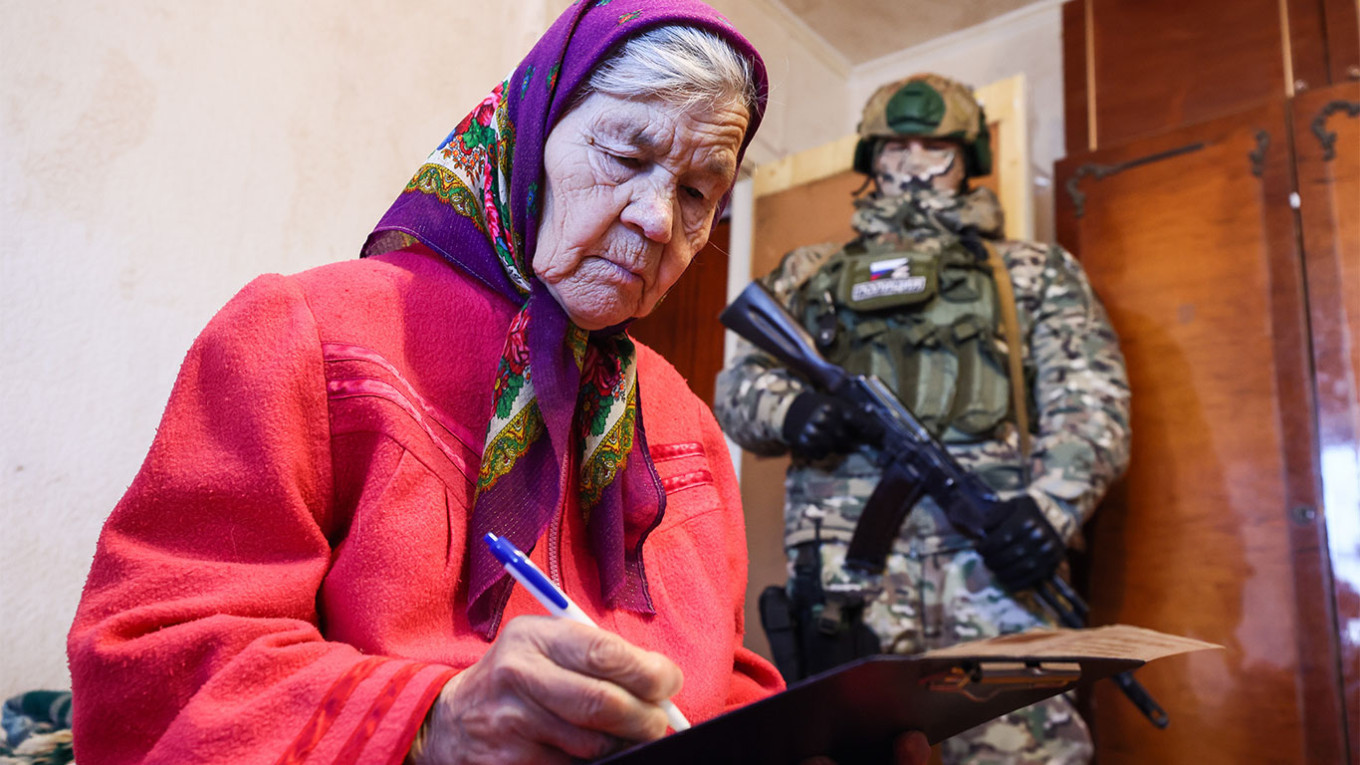
Violeta Artemchuk of the Donbas SOS rights group said commission members were going door to door escorted by Russian troops and security officers, and that public-sector workers were threatened with dismissal while pensioners and people with disabilities were told benefits could be withdrawn if they were deemed "disloyal." Volodymyr Fesenko of Kyiv's Penta Center was blunter: "Elections held at gunpoint are a farce."
Inside Russia, Yabloko said one of its observers lost consciousness while being arrested by police at a St Petersburg polling station on Saturday after officials accused him of trying to "disrupt the elections"; he was taken to a police station and charged with disobeying orders. Yabloko and the KPRF said nearly 1,300 of their observers were turned away from polling stations, and reported sealed ballot boxes being opened, refusals to issue paper ballots and unsecured premises overnight. Party chairman Nikolai Rybakov appealed to Pamfilova, saying "the scale of what's happening does not allow us to view this as a misunderstanding." Meduza reported that observers in Ufa were offered vodka — drinking on site is grounds for immediate removal — and that observers in Chuvashia were offered bribes to stay away. The KPRF's Altai branch threatened not to recognise online results, alleging state employees were pressured to vote for named candidates.
The Central Election Commission's account is different. It described Saturday as calm, said the Interior Ministry logged 367 reports relating to the electoral process and 24 false bomb alerts across 15 regions, and said public observers found most irregularity claims unconfirmed. It registered more than 380,000 domestic observers, of whom 97,040 were United Russia's and 42,743 the Communists', plus 1,126 international observers and "electoral experts" from 133 countries. Russia did not invite the OSCE. Its Parliamentary Assembly president, Pere Joan Pons, called the exclusion a breach of Russia's commitments and "a deeply worrying pattern of disregard for the principles of transparency, democratic accountability and the rule of law."
What's Next
The first results were due after 9 p.m. Moscow time (6 p.m. GMT) on Sunday, when polls close in Kaliningrad. United Russia is expected to keep its dominant majority, and the systemic parties their allotted places. The more interesting numbers will be the marginal ones: whether the reported turnout can be reconciled with the Levada Center's June finding that 66 percent of Russians did not know when the election was being held and 28 percent did not intend to vote; and how far the record online tally, concentrated in regions with historically lower rates of detected fraud, diverges from paper results.
Two consequences are already visible. The first is legal and diplomatic: seating deputies elected from Donetsk, Luhansk, Kherson and Zaporizhzhia embeds the annexation in Russia's constitutional architecture, and any future negotiation over those territories — including the trilateral US-Russia-Ukraine track that mediators hope to convene in the United Arab Emirates — now runs against a parliament that formally represents them. The second is domestic. Ternovoy argues that the most telling outcome may not be the seat count at all but the surge of public attention to the shrinking of political competition itself: Election Atlas recorded an eightyfold jump in social-media interest in Yabloko after it was struck from the ballot. That is a small signal in a controlled system. It is also, for now, one of the few available.
Published By | News Editor