POLITICS
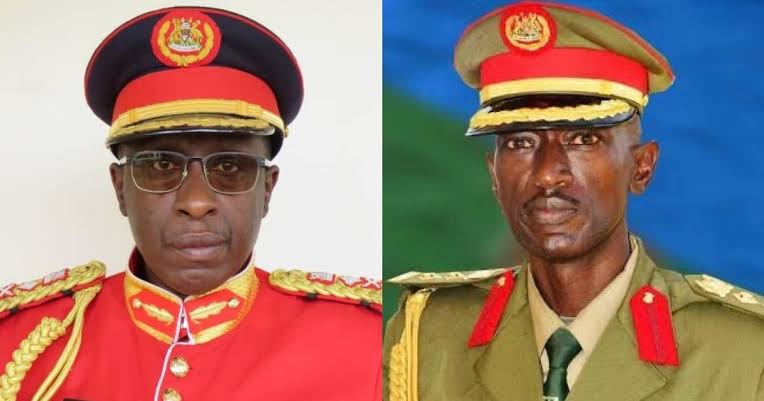
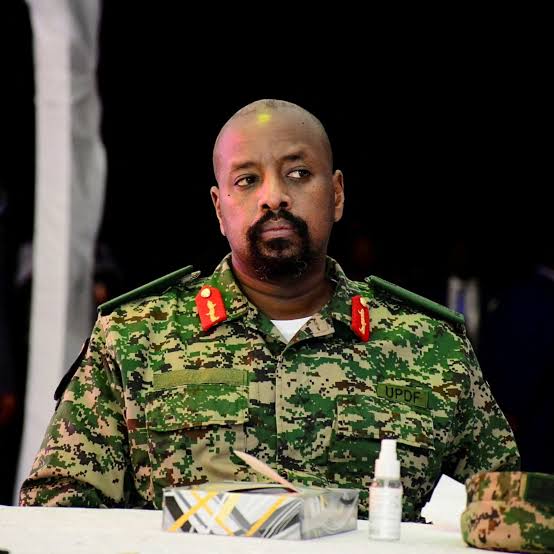
Two of the men who ran Uganda’s military intelligence apparatus for the better part of a decade are now in custody, swept up in an inquiry into the alleged manufacture of false intelligence reports that has already reached at least four senior officers and is being driven personally by the Chief of Defence Forces, Gen Muhoozi Kainerugaba.
Retired Maj Gen Abel Kandiho and retired Brig Gen Charles Bakahumura, both former commanders of the Chieftaincy of Military Intelligence (CMI), were detained this week. Military sources cited by the Uganda Radio Network said the two were picked up on Tuesday morning; other outlets reported the arrests on Wednesday, 9 September. Security operatives took Kandiho from his farm in Gomba district. Where Bakahumura was held, and which agency carried out the operation, had not been established by press time. The Uganda People’s Defence Forces had issued no official statement, and the acting defence spokesperson, Col Chris Magezi, could not be reached.
The arrests came three weeks after both men were among 19 generals retired from the UPDF on 20 August 2026 — and, more immediately, after Gen Kainerugaba publicly declared that he would detain retired officers who had been filmed dancing at their farewell ceremony at State House.
Who Kandiho and Bakahumura are
Abel Kandiho is among the most recognisable figures in Uganda’s security establishment. He was appointed head of CMI in January 2017 while still a colonel, was promoted to brigadier in November that year while running the directorate, and later rose to major general. His tenure at CMI coincided with the most contested period of Uganda’s recent political history, and in December 2021 the United States Treasury imposed sanctions on him over alleged human rights abuses committed by personnel under his command — a designation Kampala rejected at the time.
Charles Bakahumura headed military intelligence from 2012 to 2017, immediately before Kandiho. He then served as chief of logistics and engineering for seven years, making him the longest-serving officer in that post, and at one point represented Uganda as defence attaché in Turkey. Between them, the two men supervised CMI — since reorganised as Defence Intelligence and Security (DIS) — for well over a decade.
That is what gives the arrests their weight. This is not a disciplinary action against junior operatives. It is the detention of the institutional memory of Uganda’s military intelligence, on allegations that go to the core of what that institution is supposed to produce: accurate information for the commander-in-chief and the army high command.
A widening inquiry
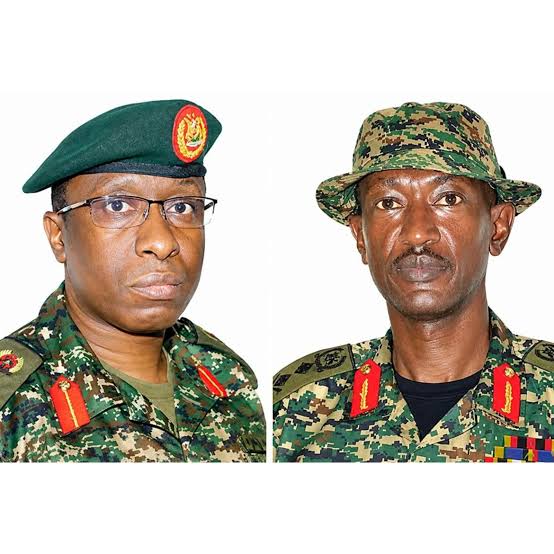
Kandiho and Bakahumura bring to four the number of senior intelligence officers reported detained in connection with allegedly fabricated intelligence reporting. Before them, the former DIS chief Maj Gen James Birungi, the director of counter-terrorism Col Peter Ahimbisibwe, and the director of special operations Lt Col Ephraim Byaruhanga were taken in.
Birungi and Byaruhanga have since been charged with treachery before the General Court Martial and remanded to Makindye Military Police Barracks. Treachery is among the gravest offences in Uganda’s military justice system. The circumstances of Ahimbisibwe’s reported detention, and whether he has been formally charged, remained unclear.
Birungi was reportedly arrested after appearing before a board chaired by the Deputy Chief of Defence Forces, Lt Gen Samuel Okiding, which was itself instituted by Gen Kainerugaba. The board appears to be the procedural spine of the whole exercise: officers are summoned, questioned about intelligence products attributed to them, and in some cases arrested on the way out.
Gen Kainerugaba has not concealed his role. He had earlier warned security personnel against feeding him false intelligence, without naming anyone. On the night before the latest arrests he posted on X that one of the officers was on the run at a farm in Gomba and might attempt to cross into Rwanda, adding that he would be captured wherever he went. In a separate post he said one of the “dancing Generals” had been captured and another would follow, and suggested others might be sheltering at the home of the presidential adviser Gen Salim Saleh.
Why it matters
Uganda is eight months past a presidential election that returned President Yoweri Museveni to a seventh term with 71.65 per cent of the vote against the National Unity Platform’s Robert Kyagulanyi (Bobi Wine) on 24.72 per cent. That vote, held on 15 January, was conducted amid a nationwide internet shutdown and drew criticism from the United Nations and international rights organisations over the treatment of the opposition. Kyagulanyi has been outside the country since March and now describes himself as an opposition leader in exile.
With the electoral contest settled, attention has shifted to a second question that has hung over Ugandan politics for years: how power inside the security establishment is being reorganised, and by whom. Gen Kainerugaba, the president’s son, became Chief of Defence Forces in 2024 and has since used his personal social media account as an instrument of command, announcing decisions and threats there before the army confirms them — or, in this case, while the army says nothing at all.
The August retirement of 19 generals in a single tranche was already a substantial turnover of the senior officer corps. The arrests that followed suggest the retirements were not a graceful exit but the first step in a reckoning. Read one way, the inquiry is an overdue attempt to clean up an intelligence system whose reporting has been unreliable and, by implication, has caused real harm — including to the many Ugandans who passed through CMI’s hands. Read another way, it is a consolidation exercise in which the charge of “false intelligence” becomes the mechanism for removing officers whose loyalties belong to an earlier configuration of the military.
Both readings can be partly true at once, and neither is testable from outside. What is testable is process. The General Court Martial’s jurisdiction over such cases has itself been the subject of extended legal argument in Uganda, and the treachery charge carries severe penalties. Whether these proceedings are conducted transparently, with defined charges and access to counsel, will say more about the exercise than any post on X.
What to watch
Three things over the coming weeks. First, whether the UPDF issues a formal account of the arrests and the terms of reference of the Okiding board — the continuing official silence is itself a data point. Second, whether Kandiho and Bakahumura are charged before the General Court Martial like Birungi and Byaruhanga, or held without charge; the timing of any arraignment will indicate whether the inquiry has evidence or is still assembling it. Third, how far the net extends. Gen Kainerugaba’s reference to officers hiding at Gen Saleh’s home was almost certainly rhetorical, but it named, however obliquely, one of the most senior figures in the president’s inner circle. Where an inquiry of this kind stops is usually more informative than where it starts.
Published By | Political News Editor