Written By | International News Agencies
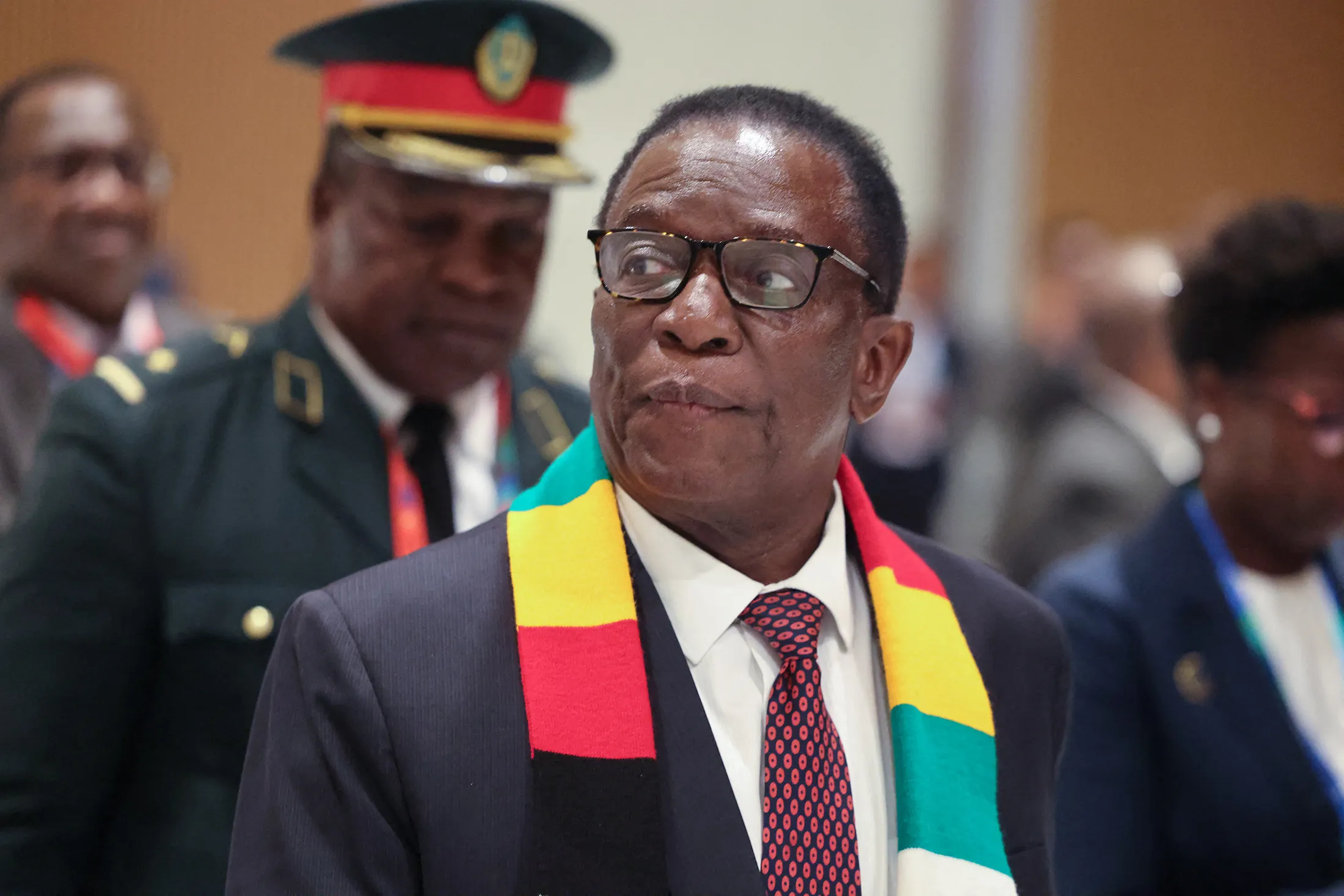
Mnangagwa, who came to power in a 2017 military-backed removal of longtime ruler Robert Mugabe and was re-elected in 2023, was due to leave office after his second term expired in 2028
Harare
Zimbabwe's already fraught battle over how long President Emmerson Mnangagwa will remain in office has taken an unexpected turn in recent weeks, moving from a constitutional amendment that pushed elections back to 2030 toward a fringe but increasingly debated proposal to abolish the republic altogether and install Mnangagwa as the country's first monarch. The escalation, coming just over two months after Mnangagwa signed a term-extending amendment into law, has drawn a blistering rebuke from one of Zimbabwe's most prominent opposition figures and revived questions about how far the ruling ZANU-PF is willing to go to keep its 83-year-old leader in power.
How Zimbabwe got here
The dispute traces back to Zimbabwe's 2013 constitution, which capped presidential terms at two five-year periods and mandated direct popular election of the head of state. Mnangagwa, who came to power in a 2017 military-backed removal of longtime ruler Robert Mugabe and was re-elected in 2023, was due to leave office after his second term expired in 2028. Instead, ZANU-PF structures resolved in October 2025 to pursue a constitutional change extending his tenure, arguing the move was necessary "to ensure continuity, stability and the sustained transformation of the nation."
That effort took legislative form as the Constitution of Zimbabwe Amendment (No. 3) Bill, which passed Zimbabwe's National Assembly on June 18 and the Senate on June 24. The bill replaced direct presidential elections with selection by a joint sitting of Parliament, extended future presidential terms from five to seven years, and — through transitional provisions — allowed Mnangagwa to remain in office until 2030 rather than face the ballot box in 2028. President Mnangagwa signed the measure into law on July 7, formally enacting Constitutional Amendment No. 3.
Opposition politicians and legal scholars objected on constitutional grounds even as the bill moved through Parliament. Section 328(7) of Zimbabwe's constitution bars term-limit extensions from benefiting a sitting president unless approved in a referendum — a requirement the government argued did not apply because the amendment altered the method of election rather than the term limit itself. Human Rights Watch, in a July 8 statement, said it had documented "attacks and arbitrary arrests" against civil society groups and activists opposed to the changes, warning that "intensified repression of human rights ... raises grave concerns about the future of democracy and the rule of law in Zimbabwe."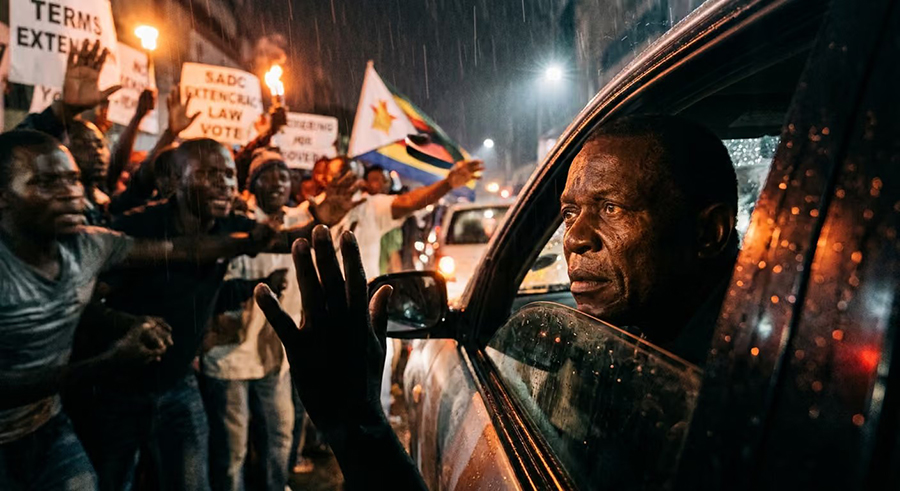
Chamisa's comeback, and a call for a transitional government
The amendment's passage helped draw Nelson Chamisa, Zimbabwe's best-known opposition leader, back into frontline politics after roughly two years on the sidelines following his acrimonious split from the Citizens Coalition for Change. Announcing his return in early June under the banner "Agenda 2026," Chamisa urged lawmakers to scrap the amendment entirely. "The wisest thing is to withdraw this #CAB3 from parliament and constitute a transitional government that will address all the challenges our country faces," Chamisa said on June 5, grounding his proposal in his long-standing claim — disputed by the electoral commission and unproven in court — that his party had "defeated Zanu PF comprehensively and conclusively" in the 2023 elections. Some political analysts, including commentator Tadini Masaya, criticized the timing and vagueness of Chamisa's intervention, arguing it offered no legal mechanism for how a transitional government would actually assume power and risked undercutting more procedurally grounded resistance to the bill inside Parliament.
Mnangagwa's "2035" remark
Any expectation that the term-extension fight would settle once Amendment No. 3 became law was upended on September 9, when Mnangagwa, speaking at the Sanganai/Hlanganani Tourism Expo in Masvingo, appeared to suggest his hold on power would extend well beyond the newly legislated 2030 horizon. Discussing plans to rotate the annual tourism showcase among Zimbabwe's provinces, the president told the audience: "After nine years, when we will be rotating provinces to host this event, I will still be in power" — arithmetic that points to 2035, seven years past his original 2028 exit date and five years beyond the extension he had just signed into law. Mnangagwa offered no explanation of what constitutional or political mechanism might allow him to remain in office that long. According to local reporting from the Masvingo Mirror, expo attendees reacted with surprise rather than shock, many recalling that Mnangagwa's earlier campaign for the 2030 extension had itself initially been dismissed by skeptics as rhetorical posturing before it became binding law.
A monarchy on the table
The remark landed amid a separate, more outlandish proposal already circulating in Harare: Constitutional Amendment Bill No. 4, championed by Joshua Maponga, a figure known for advocating what he calls indigenous political restoration. Maponga's plan, first floated publicly in July, would convert Zimbabwe from a republic into a monarchy, installing the sitting president as the country's inaugural "Mwene Mbire," or sacred king. Under the proposal, democratic elections would be replaced by a system organized around 16 traditional "Totemic Houses," state land would be transferred to a newly created Mutapa National Trust, and Roman-Dutch common law — the foundation of Zimbabwe's legal system since the colonial era — would be substituted with indigenous customary law. Maponga has framed the plan as "a bold act of intellectual courage: a rejection of failed Western democracy and a return to indigenous political forms," and supporters have cast it as a decolonization project reclaiming African governance traditions.
The government lent the framing at least symbolic weight on September 15 — Mnangagwa's birthday — when it designated the date "Munhumutapa Day" under Statutory Instrument 148 of 2026, a reference to the historical Mutapa Empire that Maponga's proposal invokes. It remains unclear whether CAB4 has been formally tabled before Parliament or whether it enjoys any meaningful backing within ZANU-PF's senior leadership, as opposed to circulating as an outside advocacy campaign; Nehanda Radio, an independent Zimbabwean outlet, described the proposal on September 14 as raising the question of whether the country was being "prepared for Mnangagwa rule beyond 2030."
Biti's rebuke
The proposal drew a sharp public response on September 17 from Tendai Biti, a former finance minister and one of Zimbabwe's most prominent opposition lawyers. "The regime and its odious crew of unpalatable cymbals is readying itself for CAB4," Biti said, arguing the plan "signifies the death of ZANU-PF, the death of common sense and the death of the Republic." Biti framed opposition to the monarchy proposal in existential terms for Zimbabwe's constitutional order: "The biggest fight now on our hands is defence of the Republic. Nothing more. Nothing less." He was joined in criticism by lawyer Thabani Mpofu and social commentator Tendai Ruben Mbofana, both of whom argued the plan would marginalize Zimbabwean communities with no historical connection to the Mutapa Empire, whose influence was concentrated in the north and northeast of the country and excludes large swaths of Matabeleland and other regions.
Separately, Manyara Muyenziwa, president of the small opposition FORUS party, petitioned Parliament on September 18 to block any further constitutional tinkering, describing what she called the "ED 2030" campaign — a reference to Mnangagwa's initials — as "constitutional defiance" and urging lawmakers to "reject any attempt to amend Sections 91 and 328 for the benefit of the incumbent." Her petition underscores that, even with Amendment No. 3 already in force, opposition figures regard the door to further changes as very much open.
Analysis: a pattern of ratcheting, not a single fight
What distinguishes Zimbabwe's current political moment is less any single proposal than the pattern now visible across the year: an October 2025 party resolution, a June parliamentary vote, a July presidential signature, a September presidential remark implying yet another extension, and a competing September proposal to dispense with elections entirely. Each step has been defended by ZANU-PF as addressing a narrow technical or cultural question — continuity of governance, or restoration of indigenous tradition — while critics argue the cumulative effect is the systematic dismantling of the term-limit and electoral protections written into the 2013 constitution after Mugabe's own 37-year rule. Whether CAB4 represents a genuine trial balloon for extending Mnangagwa's rule indefinitely, or a fringe proposal that ZANU-PF's mainstream will ultimately distance itself from, may become clearer in the coming months.
What to watch next
Analysts and opposition figures are watching several markers: whether CAB4 is formally introduced in Parliament or remains an outside advocacy campaign; whether Mnangagwa or senior ZANU-PF officials clarify or walk back the September 9 "2035" remark; how the Southern African Development Community and international partners respond if a formal monarchy bill advances; and whether Chamisa's relaunched opposition movement and smaller parties like FORUS can coordinate a unified legal and political challenge rather than pursuing separate, competing strategies, as they did over CAB3 earlier this year.



