NEW YORK
At 11am New York time this morning, Supreme released the collaboration that a certain generation of skaters has been arguing about online for a fortnight: a full Fall/Winter 2026 range built around Larry Clark, the photographer and filmmaker whose work has been making people uncomfortable for fifty-five years and shows no sign of stopping.
The collection lands globally today through Supreme's website and physical stores, with Asia following on September 5. It spans outerwear, hoodies, T-shirts, a sequin top, skateboard hardware, an oversized photographic bean bag, and a 48-page zine with an exclusive poster insert. The imagery is drawn from Clark's archive — principally "Tulsa," the 1971 photobook that made his name — alongside new portraits shot for the project.
It is, on paper, another drop. In practice it is something closer to a museum acquisition with a resale market.
Who Larry Clark is, and why this is not a neutral choice
Between 1963 and 1971, Clark photographed his own friends in Tulsa, Oklahoma: teenagers shooting amphetamines, handling guns, drifting through a version of American adolescence that the culture at the time preferred not to look at. He did not observe from a distance. He lived with his subjects, used with them, and put himself in the frame.
That refusal of journalistic distance is what made "Tulsa" detonate when it was published in 1971. It scandalised the photographic establishment and simultaneously reset it, opening the door to autobiographical documentary work and influencing a generation of photographers and filmmakers who came after. Clark went on to direct "Kids" in 1995 — the film that put New York's downtown skate scene on cinema screens and launched Chloë Sevigny, Rosario Dawson and screenwriter Harmony Korine.
None of this is comfortable material, and the collection does not pretend otherwise. Among the pieces are a Gun Tee and a Neighbor Tee, each carrying Clark's portraiture across several seasonal colourways.
A thirty-year relationship, not a one-off licence
What separates this from the standard artist-collaboration formula is that Supreme and Clark are not strangers doing business. They are two nodes of the same scene.
In the early 1990s Clark spent years around the young skaters of lower Manhattan, hanging around Washington Square Park and the newly opened Supreme store on Lafayette Street. Many of the kids in "Kids" worked at or orbited that shop. The brand and the film emerged from the same few blocks at the same moment.
The two formalised it in 2015 with a "Kids" 20th-anniversary capsule, whose skate decks each carried a still from the film and now trade as collectors' items. Today's release, then, is the third act of a relationship stretching back more than three decades — which is why it reads less like a licensing deal and more like an archive being handed back to the community it came from.
What is actually in the drop
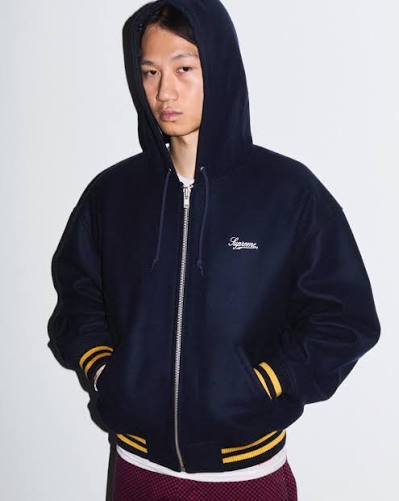
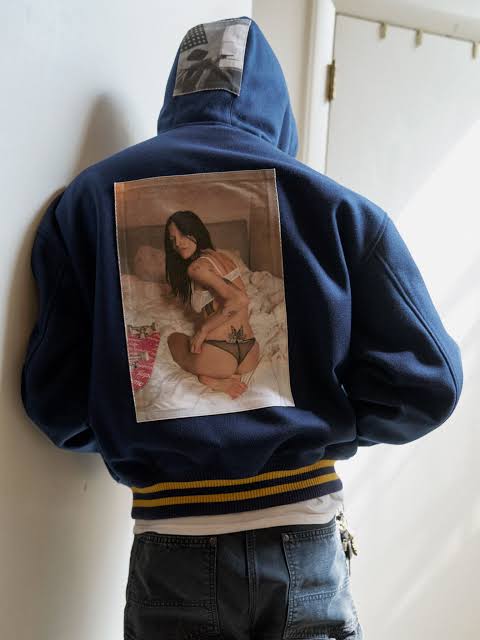
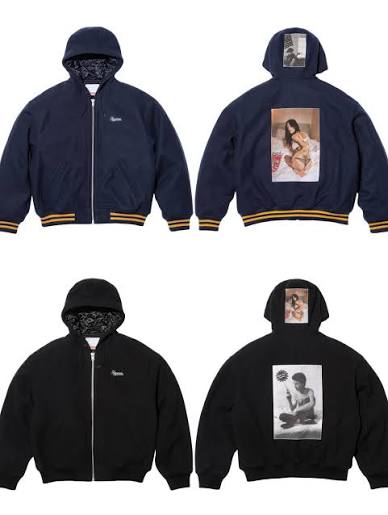
The anchor piece is a Hooded Varsity Jacket that treats Clark's archival photographs as full-placement print, running images across the entire garment rather than confining them to a chest hit or a back panel. It is the sort of piece that will look wildly different in a shop photograph and on a body, and it is already the most discussed item in the range.
Beneath it sit a Sequin Raglan Long Sleeve Top — an unusual and slightly perverse surface for documentary photography — and a Zip Up Hooded Sweatshirt extending the graphics across a third texture. The Gun Tee and Neighbor Tee handle the portraiture. Skate hardware and a co-branded deck round out the hard goods.
The 48-page zine is the piece most likely to matter in ten years. It presents material from Clark's visual archive with a poster insert, and Supreme zines have a long history of appreciating faster than the garments they accompany.
The campaign centres on Gabbriette, the model and musician, with new Clark portraits of her running through both the collection and the printed zine — a deliberate bridge between the 1960s Tulsa material and the present.
The uncomfortable question
Putting photographs of teenage drug use and firearms onto a $500 varsity jacket is not a neutral act, and the objection writes itself: this is the aestheticisation of harm, sold at a margin, to people who will never meet its subjects.
The counter-argument, which Clark's defenders have made for half a century, is that "Tulsa" was never a warning poster. It was an insider's record made without moral framing, and the discomfort it produces is the point. Sanitising it for commerce would be the actual betrayal; reproducing it faithfully, on garments worn by a subculture with genuine lineage back to the work, is at least honest about what it is.
Readers will land where they land. What is not really arguable is that this drop connects more timelines than most fashion releases manage: 1960s Oklahoma, 1970s documentary photography, 1990s downtown skateboarding, the birth of Supreme, independent publishing and contemporary streetwear, all in one rail.
If you are buying
Practical notes. The global release is today; Asia is Saturday. Supreme drops of this profile typically sell through online within minutes, and the resale premium on collaboration outerwear tends to settle within a fortnight rather than spiking indefinitely.
If you are buying to wear, the sweatshirt and the tees are the pieces with real wardrobe life. If you are buying to keep, the zine is historically the smarter object — smaller outlay, no sizing risk, and a track record of holding value.
And if you are buying because the images move you, the original book is still in print, and considerably cheaper than the jacket.
Published By | Features Editor