BUSINESS
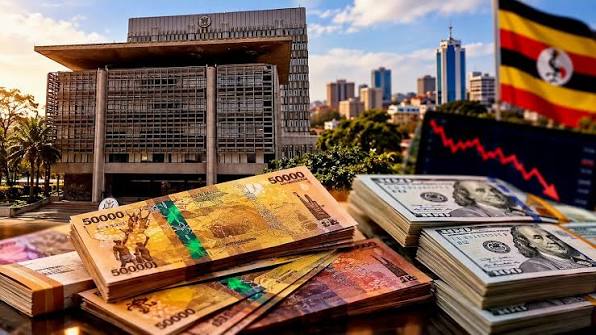
Uganda's currency has fallen to its weakest level in more than two years, forcing the central bank into its most aggressive defensive move of 2026 and putting fresh pressure on an economy that is otherwise posting some of its strongest growth numbers in years.
The shilling traded at around 3,925 per US dollar in mid-September, its softest level since February 2024, as demand for foreign currency surged among manufacturers and energy-sector firms scrambling to cover higher fuel import costs. That spike in fuel prices has been driven largely by conflict-related disruption to oil markets in the Middle East, which has pushed up the cost of the refined products Uganda — a landlocked country with no domestic refining capacity yet — must import by road and rail from coastal ports in Kenya and Tanzania.
In response, the Bank of Uganda raised the cash reserve requirement for commercial banks from 11.0% to 13.5%, a 250-basis-point increase that took effect on September 24. The cash reserve ratio dictates the share of deposits that commercial banks must hold rather than lend out, so raising it drains shillings out of circulation, tightens liquidity in the banking system, and — in theory — makes the currency more attractive by reducing the supply of shillings chasing scarce dollars.
Central bank executive director Adam Mugume framed the move as a technical liquidity measure rather than a currency intervention, saying it was designed to "support prudent liquidity management and enhance the effectiveness of monetary policy transmission." Notably, Mugume explicitly ruled out direct central bank sales of dollars into the market to prop up the shilling, calling that kind of intervention "policy inconsistency" with the bank's broader inflation-targeting framework. He insisted, however, that policymakers still have "sufficient tools at their disposal to contain exchange-rate volatility" if pressure on the currency continues.
The reserve ratio hike follows a period of relative calm at the Bank of Uganda, which had held its benchmark Central Bank Rate steady at 9.75% at its most recent policy meeting in mid-August, judging that it needed "time to assess evolving conditions before making further policy adjustments." At that meeting, Governor Michael Atingi-Ego flagged that headline inflation had already climbed to 4.0% in July, up from 3.7% in June, with energy, fuel and utilities inflation surging to 14.9% — more than triple the rate of core inflation, which was steadier at 3.4%. Food crop prices, which had been a source of disinflation, turned positive again as well. Atingi-Ego warned at the time that risks to the inflation outlook "remain heavily tilted to the upside," citing geopolitical conflict, adverse weather, and global interest-rate pressures — a warning that the subsequent currency slide has now partly borne out.
The timing is awkward for a government eager to showcase economic momentum. Uganda's economy expanded 6.4% in the 2025/26 fiscal year and is officially projected to grow 7.0–7.5% in 2026/27, among the fastest rates in East Africa, with the Bank of Uganda also reporting a $2.4 billion balance-of-payments surplus. A weakening currency complicates that story in two ways: it raises the local-currency cost of imported fuel, machinery and other inputs — feeding directly into the energy inflation officials are already watching closely — and it increases the shilling cost of servicing Uganda's dollar-denominated public debt, a persistent concern for a government that has leaned heavily on external borrowing to fund infrastructure, including the oil sector build-out.
That oil build-out is itself part of the currency story. Uganda has been racing to bring its Lake Albert oil fields into commercial production via the roughly $5.6 billion East African Crude Oil Pipeline (EACOP) to the Tanzanian coast, alongside TotalEnergies' Tilenga and CNOOC's Kingfisher upstream projects. The government unveiled its "Pearl Sweet" export crude blend earlier this month as a marketing step ahead of first exports. But the timeline keeps slipping: officials confirmed on September 14 that first commercial oil production has been pushed back again, from an earlier target around mid-2026 to a new target of June 2027, according to multiple Ugandan and regional outlets. Until that oil starts flowing and generating export earnings and royalties, Uganda continues to import 100% of its refined fuel needs in dollars, which is precisely the pressure now showing up in the shilling.
Analysts say the central bank's approach — tightening liquidity rather than directly selling reserves — reflects a desire to preserve Uganda's foreign exchange buffers rather than burn through them defending a specific exchange rate, a strategy that requires patience and carries its own risk: if FX demand from fuel importers stays elevated through the final quarter of the year, the reserve ratio increase alone may not be enough to stabilize the currency, and businesses that rely on imported inputs — from manufacturers to construction firms to hospitality operators serving Uganda's tourism sector — are likely to see costs continue rising in the meantime. Some local commentary has also flagged a broader tension in the economy: strong headline GDP growth and a healthy external surplus on one hand, set against a weakening currency and accelerating fuel-driven inflation on the other, a combination that leaves ordinary households more exposed to imported price pressure even as the official growth numbers look strong.

For now, the central bank's message to markets has been one of reassurance without commitment to a specific defense line for the shilling. The Uganda Broadcasting Corporation reported that the Bank of Uganda has been actively briefing the financial sector to "assure" it of shilling stability, even as officials decline to rule in or out further reserve requirement increases. The next scheduled Bank of Uganda monetary policy announcement, along with fresh inflation data due in the coming weeks, will be the first real test of whether the September liquidity squeeze has taken the pressure off the currency — or whether Kampala will need to reach for additional tools before the year is out.
The episode is also a reminder of how exposed Uganda remains to events far outside its borders. A landlocked economy that imports all of its refined fuel and prices much of its trade in dollars will always feel external shocks quickly, whether the trigger is a Middle East conflict, a shift in global interest rates, or delays to its own long-awaited oil industry. Ordinary Ugandans are likely to feel the shilling's slide first at the fuel pump and in the price of imported goods, well before any of the technical language coming out of the central bank — cash reserve ratios, liquidity transmission, balance-of-payments surpluses — means much to household budgets. How quickly that pass-through happens, and how the Bank of Uganda calibrates its next move, will shape the inflation conversation heading into the final months of the year.
Published By | Business News Editor