Written By | International News Agencies
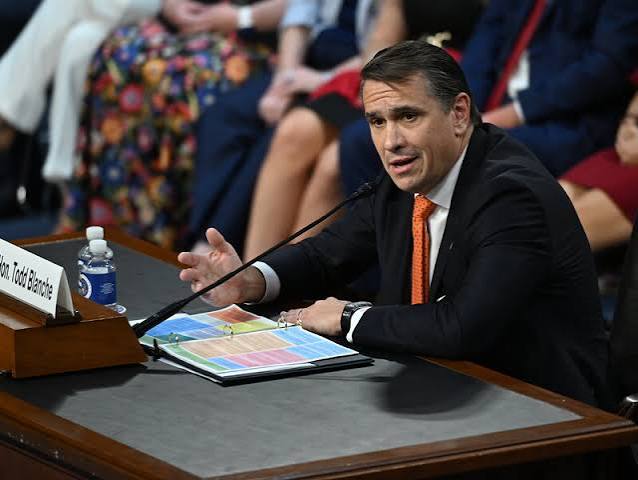
Blanche was Trump's lead attorney in the New York hush-money prosecution, the case that ended in May 2024 with a jury convicting Trump on all 34 felony counts of falsifying business records
Background
Todd Blanche has spent the past two years moving through an unusually compressed arc of American legal and political life: from criminal defense lawyer to the sitting president, to the country's chief law enforcement officer. Before entering Donald Trump's orbit, Blanche built a conventional prosecutorial résumé, serving as a chief in the U.S. Attorney's Office for the Southern District of New York, where he handled gang and organized-crime cases, before moving into private practice. He clerked for two federal judges and graduated with honors from law school. That background gave him credibility when he pivoted, in 2023, to leading Trump's criminal defense team.
Blanche was Trump's lead attorney in the New York hush-money prosecution, the case that ended in May 2024 with a jury convicting Trump on all 34 felony counts of falsifying business records. He also represented Trump in the federal classified-documents case in Florida and in the federal election-interference case in Washington, giving him an unusually intimate view of the legal jeopardy Trump faced across three jurisdictions. When Trump returned to office in January 2025, he rewarded that loyalty by nominating Blanche to be deputy attorney general. The Senate confirmed him in a party-line 52-46 vote, with every Democrat opposed, and Blanche has since served as acting attorney general, effectively running the Justice Department's day-to-day operations while a permanent nominee for the top job worked through the confirmation process.
The nomination fight that came to a head this week is inseparable from a controversy that first became public in mid-July: a federal judge's finding that the Trump administration acted in bad faith in a $10 billion lawsuit Trump filed against the IRS. Judge Kathleen Williams ruled that the lawsuit and a resulting settlement — which included a $1.8 billion "Anti-Weaponization Fund" intended to compensate people the administration deemed victims of politically motivated IRS scrutiny, alongside a broad audit-immunity provision — were the product of collusion between Trump's lawyers and DOJ officials rather than a genuine legal dispute. Williams sanctioned attorneys involved, referred Trump lawyer Alejandro Brito to the Florida Bar for discipline, and forwarded her findings to boards reviewing the conduct of Blanche himself and Associate Attorney General Stanley Woodward. That ruling turned what might have been a routine confirmation into a referendum on DOJ independence under Blanche's leadership.
Key Developments
The Senate Judiciary Committee had originally scheduled a vote to advance Blanche's nomination for late July, but it was abruptly postponed after two Republican members of the panel, John Cornyn of Texas and Thom Tillis of North Carolina, said they had not received the written assurances they were seeking from the Justice Department about winding down the Anti-Weaponization Fund and narrowing the IRS settlement's scope. Their public break with the administration was notable: both are institutionalist Republicans who rarely cross Trump on nominations, and their holdout threatened to strip the fragile committee majority Republicans need to move nominees to the floor.
Trump responded angrily. On July 30, he suggested he might pull Blanche's nomination altogether rather than accept conditions from his own party, a threat that intensified pressure on Cornyn and Tillis even as it underscored how personally invested Trump was in seeing his former defense lawyer confirmed. Over the following days, negotiations between the holdout senators and the Justice Department continued out of public view. On August 2, Blanche's Justice Department issued a formal, binding order terminating the $1.8 billion Anti-Weaponization Fund outright and separately clarified in writing that the audit-immunity terms of the original IRS settlement applied only to the specific plaintiffs in that case — Trump personally — and did not extend to a broader class of taxpayers, as critics had feared.
That concession proved sufficient. On August 3, Cornyn's office confirmed that an agreement had been reached, and both Cornyn and Tillis announced they would back Blanche's nomination when the Judiciary Committee reconvened. Some reporting on the deal noted that it fell short of the senators' original demands in certain respects — the agreement addressed the fund's existence and the settlement's scope, but did not resolve every accountability question raised by Judge Williams' bad-faith finding. Still, it was enough to clear the procedural logjam. On August 4, the Senate Judiciary Committee met to formally advance Blanche's nomination, sending it to the full Senate for a final confirmation vote.
Because Republicans control the Senate with 53 seats, Blanche's path to confirmation on the floor is now considerably smoother than it looked a week earlier, though the episode revealed real fissures within the GOP conference over how far the administration should go in shielding Trump and his allies from legal exposure using the machinery of the Justice Department itself.
Reactions
Democrats have remained united in opposition throughout the process, and nothing about the Cornyn-Tillis deal changed that calculus. Senate Judiciary Committee ranking member Dick Durbin has been among the most vocal critics, arguing that Blanche "has disregarded that call and erased that line — placing loyalty to President Trump above all else," and suggesting that whatever professional independence is expected of an attorney general had been sacrificed to advance Blanche's career. Senator Sheldon Whitehouse of Rhode Island went further, warning that if confirmed, "Blanche — once Trump's personal criminal defense attorney — will wield the Department of Justice against the president's personal and political enemies, at the expense of the American people." House Democratic Leader Hakeem Jeffries has repeatedly accused Blanche of "acting like Donald Trump's lawyer" rather than the nation's chief law enforcement officer, a framing Democrats have used consistently since Blanche's initial nomination to be deputy attorney general in late 2024.
Opposition has not been confined to elected Democrats. More than 1,200 former Justice Department employees, spanning multiple administrations of both parties, have signed statements opposing Blanche's elevation, arguing that his career-long identification with Trump's personal legal interests disqualifies him from a role built around institutional independence. The Washington Post's editorial board published a piece in late July arguing that Blanche's nomination "deserves a Senate rejection," and the advocacy group Democrats Abroad has organized similar public opposition.
Republicans, by contrast, have largely rallied around Blanche, treating the Cornyn-Tillis episode as evidence that the confirmation process worked as intended rather than as a sign of deeper trouble. Judiciary Committee Chairman Chuck Grassley has repeatedly stated that Blanche is "the right man" to lead the department, pointing to his prosecutorial background in the Southern District of New York as evidence of substantive qualifications independent of his work for Trump. A coalition describing itself as focused on public safety issues has also submitted letters of support for Blanche's nomination, emphasizing his record on gang prosecutions.
What's Next
With the Judiciary Committee vote complete, Blanche's nomination now heads to the Senate floor, where Majority Leader John Thune is expected to schedule a confirmation vote in the coming weeks. Given the Republican majority and the resolution of the Cornyn-Tillis standoff, most observers expect Blanche to be confirmed largely along party lines, absent a fresh controversy. Even so, several threads from the underlying dispute remain unresolved. Judge Williams' referral of the IRS settlement matter to disciplinary boards reviewing Blanche's own conduct, as well as that of Associate Attorney General Stanley Woodward, is still pending and could resurface regardless of how the Senate vote turns out. The Florida Bar's review of Trump attorney Alejandro Brito likewise continues on a separate track.
More broadly, the fight over Blanche's nomination has sharpened a debate in Washington over whether the Justice Department under Trump's second term is being used as an instrument of personal protection rather than impartial law enforcement — a concern that predates this nomination but has been amplified by the Anti-Weaponization Fund episode. Even Republican senators who ultimately supported Blanche did so only after extracting written, binding commitments limiting the department's discretion, suggesting that scrutiny of DOJ conduct under his eventual leadership is unlikely to fade once he is sworn in. Democrats have signaled they intend to use oversight tools, including the anti-corruption working group Senate Democrats launched in late July, to continue probing the department's independence long after the confirmation vote is behind them.



