Written By | International News Agencies
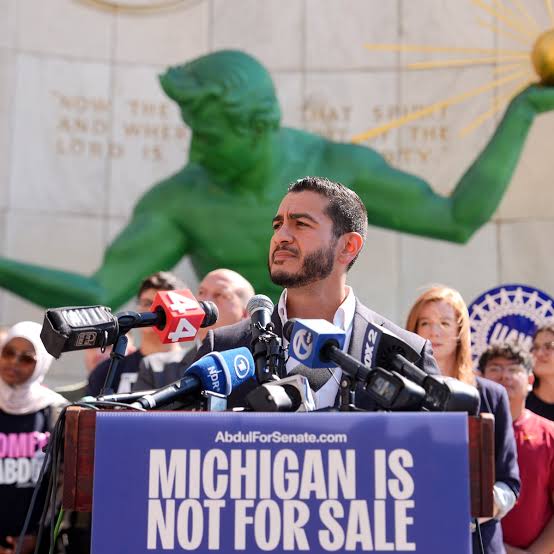
Abdul El-Sayed
Background
Michigan's U.S. Senate seat, held for over a decade by Democrat Gary Peters, opened up when Peters announced he would not seek re-election in 2026, transforming the swing state into one of the most closely watched Senate races in the country. Democrats view Michigan as essential to retaking a Senate majority in November's midterms, and the party's primary contest to succeed Peters quickly became a proxy fight over the direction of the Democratic Party itself, months into Donald Trump's second term and amid a foreign-policy landscape reshaped by the 2026 Iran war and the fragile Gaza ceasefire.
On one side stood Rep. Haley Stevens, a member of Congress representing suburban Detroit, who ran as a pragmatic, establishment-aligned candidate emphasizing economic stability and criticizing what she called the "chaos" of Trump's tariff policy. On the other stood Abdul El-Sayed, a physician and former Detroit health director who first rose to statewide prominence with an unsuccessful 2018 run for governor and has since built a national profile as a progressive commentator and podcast host. El-Sayed entered the race with the backing of the party's left flank and quickly positioned himself as a critic of both Trump's economic agenda and, more controversially, of the Israeli government's conduct in Gaza and broader U.S. support for Israel.
The primary drew national attention and national money. Outside groups poured close to $65 million into the race, with the single largest force being the United Democracy Project, a political action committee affiliated with the American Israel Public Affairs Committee. The group ran a sustained advertising campaign promoting Stevens while attacking El-Sayed over his record on Israel and Gaza, making the race one of the clearest tests yet of AIPAC-aligned spending's power within a Democratic primary electorate that has grown increasingly divided over the Gaza war's legacy. Michigan's large Arab- and Muslim-American population, concentrated around Dearborn, made the contest especially sensitive on these questions, with both campaigns aware that the community's turnout and enthusiasm could prove decisive in a race expected to be close.
The contest also became a proving ground for two competing theories of how Democrats should approach the 2026 midterms after a bruising 2024 cycle. Stevens and her allies argued that a moderate, kitchen-table-economics message focused on tariffs, inflation, and manufacturing jobs was the party's best path back to power in a state Trump had carried before. El-Sayed and his backers countered that the party needed to offer a sharper, more combative alternative — on both economic populism and foreign policy — to energize younger and more progressive voters who they argue have grown disillusioned with establishment Democrats. That debate over AI-driven data-center development in Michigan, and its implications for energy costs and blue-collar jobs, also became an unexpectedly prominent flashpoint between the two campaigns, with El-Sayed casting himself as more skeptical of unchecked corporate investment than Stevens.
Key Developments
Voters went to the polls on August 4. The race stayed too close to call through election night, with El-Sayed and Stevens locked within a percentage point of each other as returns trickled in from across the state. The Associated Press finally called the race for El-Sayed at 9:56 a.m. Wednesday, August 5, with him ahead by roughly one point once nearly all ballots — 99 percent — had been counted. The narrow margin underscored how close El-Sayed came to being overwhelmed by both Stevens' institutional support and the historic outside-spending campaign arrayed against him.
The campaign's final weeks were marked by controversies that tested El-Sayed's standing even among sympathetic Democratic voters. Leaked audio surfaced of El-Sayed declining to directly celebrate the killing of Iran's Supreme Leader Ali Khamenei earlier this year, with El-Sayed citing sensitivity toward Dearborn's Arab- and Muslim-American community rather than offering a direct answer; critics, including Fox News and Stevens-aligned Democrats, characterized his response as an evasive "word salad" that dodged a straightforward question about whether the world was better off without the ayatollah. Separately, El-Sayed's decision to campaign alongside the left-wing streamer Hasan Piker — who has faced accusations of antisemitism over past comments, including a remark that "America deserved 9/11" and statements that he would "vote for Hamas over Israel every single time" — drew sharp criticism from Jewish Democratic groups and some of El-Sayed's own primary rivals. At one point, El-Sayed had to publicly ask his own supporters to stop mocking Stevens at campaign events, an unusual intervention that reflected how heated the intraparty contest had become.
Despite the controversies, El-Sayed's coalition held together through Election Day. He secured the backing of national progressive figures including Sen. Bernie Sanders and Rep. Alexandria Ocasio-Cortez, along with an endorsement from the United Auto Workers, one of the most influential labor unions in a state built on the auto industry. His victory extends a string of recent wins for the Democratic Party's progressive wing in contested primaries nationally, and it represents one of the most significant electoral setbacks yet for AIPAC-aligned spending in a Democratic primary — a storyline Al Jazeera and other outlets explicitly framed as a "blow to AIPAC," given the scale of the United Democracy Project's investment and its ultimate failure to stop El-Sayed.
Reactions
The result prompted a rapid, if somewhat guarded, consolidation of establishment support behind El-Sayed. Stevens congratulated her former rival, saying she was "proud to offer my support," while stopping short of an enthusiastic embrace of his candidacy or agenda. Michigan state Sen. Mallory McMorrow, who had been viewed as a possible bridge figure between the party's competing factions, was among the first elected officials to formally endorse El-Sayed once the race was called, and she called for Democratic unity heading into the general election. Outgoing Sen. Gary Peters struck a similar note, urging Democrats to rally around their nominee while also cautioning that El-Sayed needed to begin building bridges with skeptical parts of the party "immediately" if he hopes to win in November — a pointed acknowledgment that not all Democrats are yet comfortable with their new nominee.
Republicans, for their part, moved quickly to cast El-Sayed as unelectable in a general election, seizing on the Piker controversy and his comments about Khamenei's death as evidence that he is out of step with Michigan's broader electorate. His now-confirmed general election opponent, former Republican congressman Mike Rogers — who narrowly lost a competitive 2024 Senate race to Democrat Elissa Slotkin — has begun framing the contest as a choice between an "extreme" progressive and a steady, security-focused Republican, betting that the same controversies that nearly cost El-Sayed the primary will do more damage in a general electorate that skews less progressive than the Democratic primary base.
What's Next
El-Sayed now heads into a general election battle that polling suggests will be a genuine toss-up, though with warning signs for Democrats. A Glengariff Group survey conducted July 22–24 for the Michigan Education Association and Business Leaders for Michigan found Rogers leading El-Sayed by 10 points, with 11 percent of voters undecided, and showed Rogers holding a roughly 28-point advantage over El-Sayed among independent voters — even though Rogers and Stevens had polled almost identically among that same group, suggesting El-Sayed himself, not just his party label, may be a drag on Democratic support among swing voters. A separate Data for Progress poll taken earlier, June 15–22, found the race essentially tied, with El-Sayed narrowly ahead 47 to 46 percent. The RealClearPolitics polling average currently puts Rogers ahead by just 0.3 points, rating the race a toss-up overall — a reminder that the surveys taken so far disagree substantially and that the true state of the race remains unsettled just three months before the general election.
The coming months will test whether El-Sayed can broaden his coalition beyond the progressive base that carried him through the primary without alienating it, and whether Democratic leaders — including some who quietly favored Stevens — campaign for him with genuine enthusiasm or merely perfunctory support. National Democrats view Michigan as one of a handful of seats that will decide control of the Senate, making the race a bellwether for whether a Sanders-aligned progressive can win a competitive swing-state general election in the current political climate, and for how much continued influence AIPAC-aligned spending will retain in Democratic primaries after this high-profile defeat. Both national parties are expected to pour substantial additional resources into Michigan between now and Election Day, and the state's large Arab-American electorate, labor unions, and suburban independent voters are all likely to be treated as pivotal constituencies in the fight to come.
The race will also be watched closely as a data point in the national argument over whether the Democratic Party's leftward-shifting primary electorate is out of step with the general electorate it needs to win over. El-Sayed's advisers argue his primary win, achieved despite the largest outside-spending campaign the state has seen in a Senate primary, shows genuine grassroots enthusiasm that can translate into a general-election turnout advantage. Republicans and skeptical Democrats counter that primary electorates are structurally more progressive than general ones, and that the same positions that thrilled progressive activists — including his rhetoric on Gaza and his association with Piker — could cost him decisive support among independents and moderate Democrats in the fall. With control of the Senate plausibly hinging on a handful of states including Michigan, both parties' national committees are expected to treat the race as a top-tier priority through November.



