LONDON
Most festival pavilions are built to be photographed. This one is built to be read.
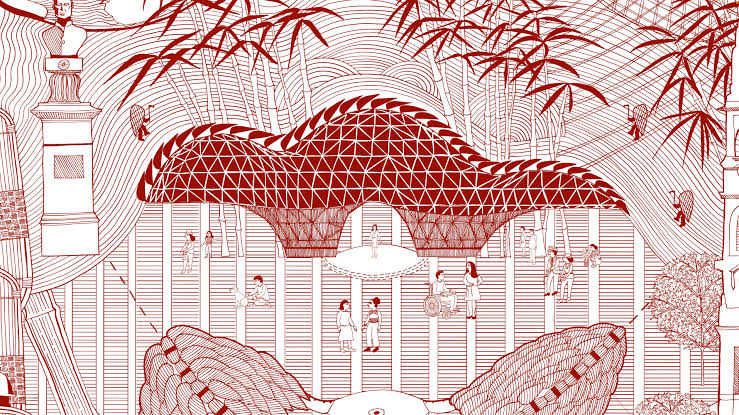
When London Design Festival opens on Saturday, its Landmark Project will be a bamboo structure sitting in the pedestrianised stretch of Strand Aldwych, its surface layered with overlapping shields like the scales of an animal. It is called The Pangolin Shield, it is the work of Studio Saar with structural engineers Atelier One, and almost every material decision in it is an argument.
The animal
The pangolin is the world's most trafficked mammal. Its defence is a coat of overlapping keratin scales that lets it curl into an armoured ball — a protection system so effective against predators and so useless against humans that it has become the direct cause of the species' decline. The thing that keeps it alive is the thing people want.
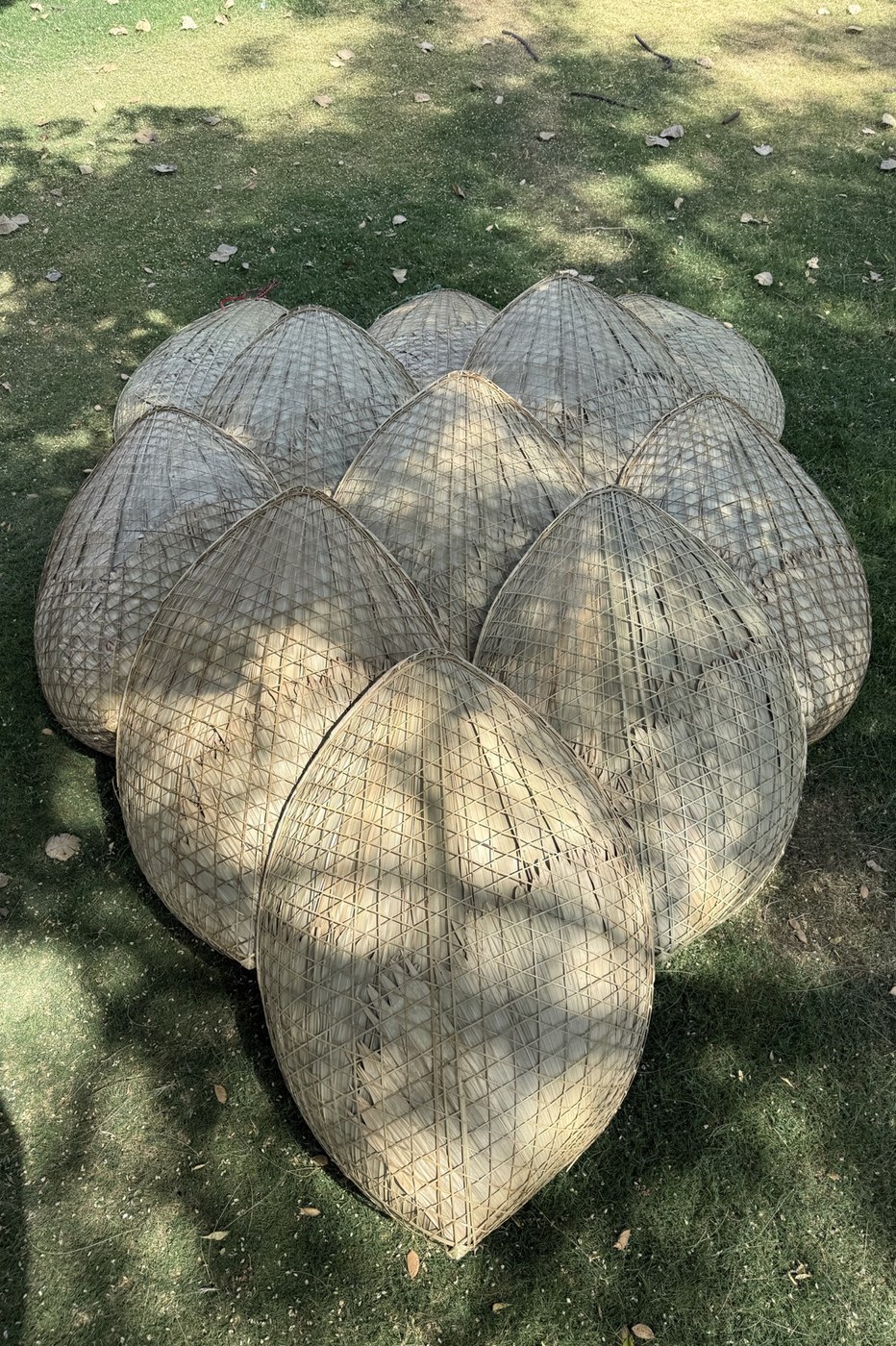
Studio Saar has taken that paradox as the pavilion's organising idea: vulnerability and protection as the same gesture. The structure is a bamboo grid shell, clad in two kinds of object borrowed from Indian material culture. The first are traditional bamboo police shields — instruments of crowd control and state authority. The second are knups, the woven rain shields worn by farmers across north-eastern India, essentially a portable roof for a working body.
Layered together across the shell like scales, the two become a single canopy: an armour of authority and an armour of labour, doing the same job, filtering light onto whoever stands underneath.
The address
The siting is not incidental. The pavilion is oriented towards the bust of Jawaharlal Nehru, India's first prime minister, which stands outside the Indian High Commission on Aldwych. That alignment turns a temporary structure into a sentence about colonial legacy, the movement of people and species across borders, and where objects acquire their meaning.
A shield made for a police line in India, re-erected as a roof on the Strand — a few hundred metres from Somerset House, the former home of the tax and naval administration of an empire — is doing something more pointed than decoration. The festival's own framing lists colonial histories, ecological exploitation and displacement among the themes. It is an unusually explicit brief for a landmark installation, which are more often abstract sculptural gestures placed in tourist sightlines.
The practice
Studio Saar was founded in 2019 by Ananya Singhal and Jonny Buckland, and it operates from two places at once: Frome in Somerset and Udaipur in Rajasthan. That geography is the practice's entire method rather than a biographical detail. The studio's work tends to involve craft traditions that are still alive in one place being brought to bear on problems in another, with the transfer itself treated as the subject rather than an inconvenience.
Working with Atelier One — the engineering firm with a long history of making experimental, low-carbon and temporary structures actually stand up — gives the bamboo shell the technical credibility it needs to survive a London September and a large public crowd. Bamboo grid shells are structurally elegant and unforgiving; they depend on precise geometry rather than mass, which is what makes them light enough to be a reasonable material choice for a nine-day installation.
The festival around it
London Design Festival runs from 12 to 20 September, spread across eleven Design Districts including a newly introduced Soho, plus museums, galleries and showrooms across the city. The Global Design Forum, its three-day talks programme, runs 12 to 14 September. Shoreditch Design Week, the largest district, runs 15 to 20 September with more than sixty showrooms and creative spaces participating.
At the V&A, this year's programme is titled Awakenings, co-curated by Carrie Chan and Kristian Volsing, with new commissions including one from Playfool, named V&A Emerging Designer 2026, whose game reflects on human labour in the age of artificial intelligence. Nina Davies presents work on how human bodies have begun to imitate AI-generated movement — a strange and specific observation that will probably turn out to be the sleeper hit of the week.
Elsewhere, Wapping Hydraulic Power Station hosts Max Cooper's Feeling Is Structure, a twenty-minute piece turning a musical composition into an architectural experience, alongside Chris Watson's Trent Falls. Kartell debuts its Savoia chair, Cassina and Porro open their showrooms with new launches, and Aram stages a group show of 102 emerging designers.
What this means for you
If you are in London, the Pangolin Shield is free, outdoors and on a street you can walk to from three Underground lines. Go in the late afternoon: the whole point of a scaled canopy is what it does to light, and a flat midday sun will waste it. Stand under it and look up before you look at your phone.
If you are not in London, the more portable idea is the one about materials. The pavilion argues that objects carry their histories with them — that a police shield does not become neutral when you turn it into a roof, and that this is a feature rather than a problem. Designers spend a lot of energy stripping context out of materials to make them universal. This does the opposite, and gets something richer for it.
There is also a quieter point about temporary architecture. A structure that exists for nine days can say things a permanent building cannot: it can be argumentative, specific, even uncomfortable, because nobody has to live with it for thirty years. Festivals are one of the few places where architecture is allowed to have a thesis.
This one has several, stacked like scales.
Published By | Features Editor