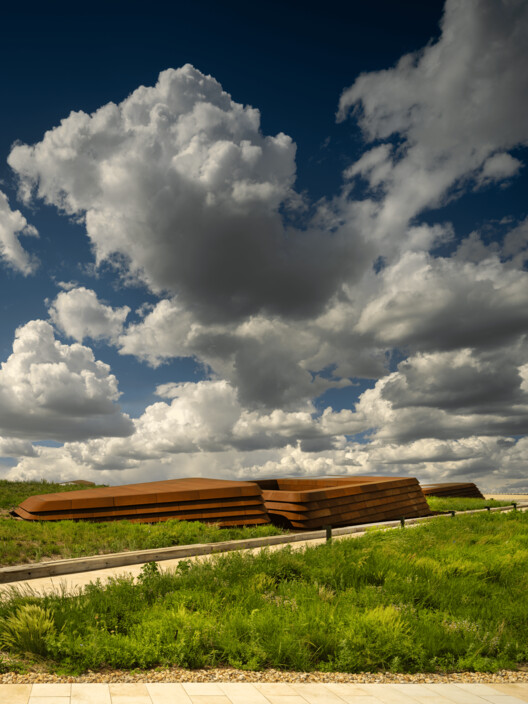
In the North Dakota Badlands, a new presidential library buries itself under 121,000 square feet of living prairie — and quietly aims to become the most environmentally ambitious cultural building in the Americas.
MEDORA, NORTH DAKOTA
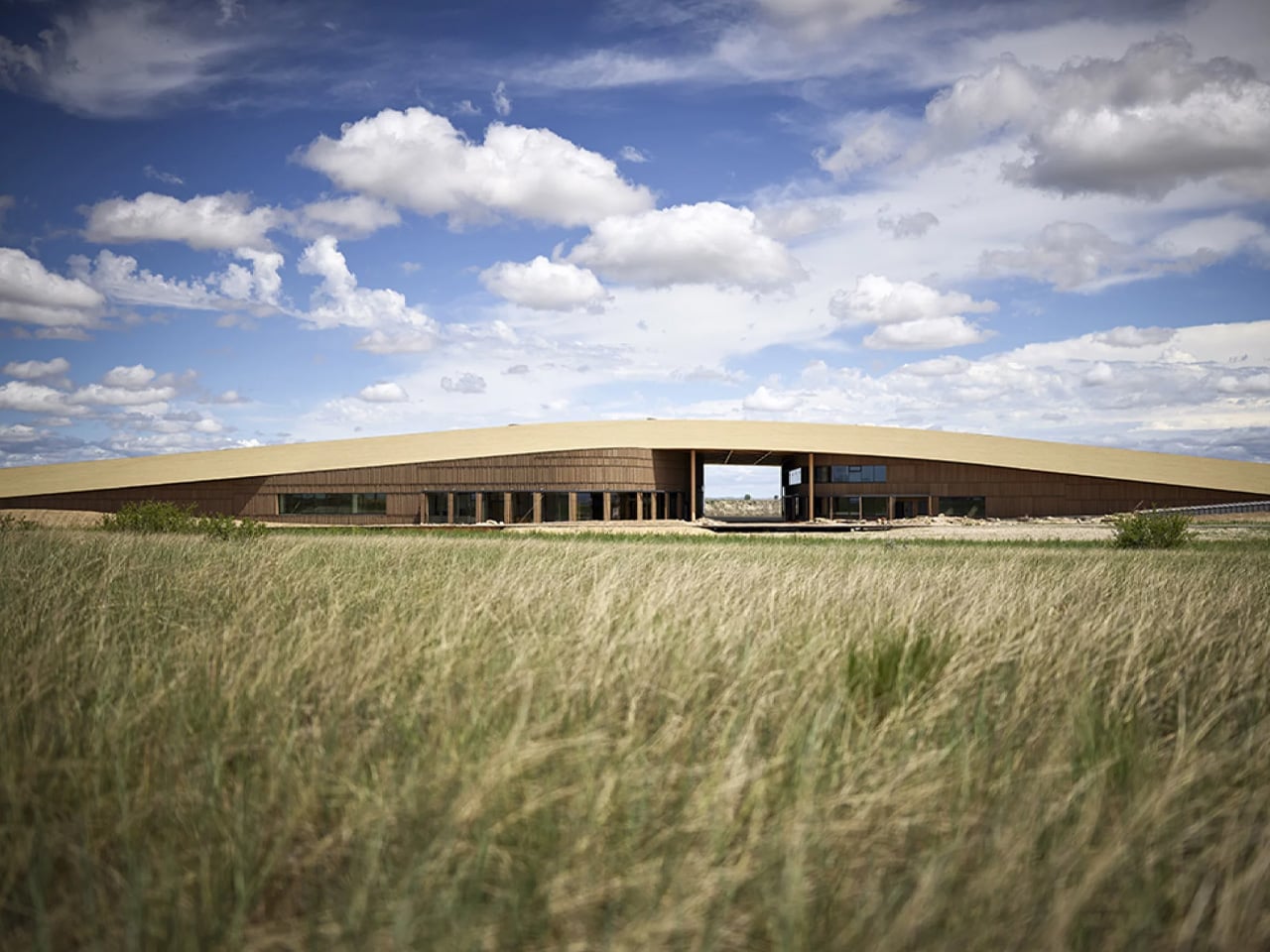
Most presidential libraries announce themselves. Marble facades, soaring atriums, the architectural vocabulary of institutional permanence — buildings designed to look, unmistakably, like monuments. The Theodore Roosevelt Presidential Library, which opened to the public on July 4 and is still generating fresh coverage and visitor buzz nearly two weeks later, does almost the opposite. Designed by Norwegian-American firm Snøhetta, it is a building engineered to vanish into the landscape it sits beside — and in doing so, it may have created one of the most quietly radical pieces of civic architecture built in America this decade.
"The Library Is the Landscape"
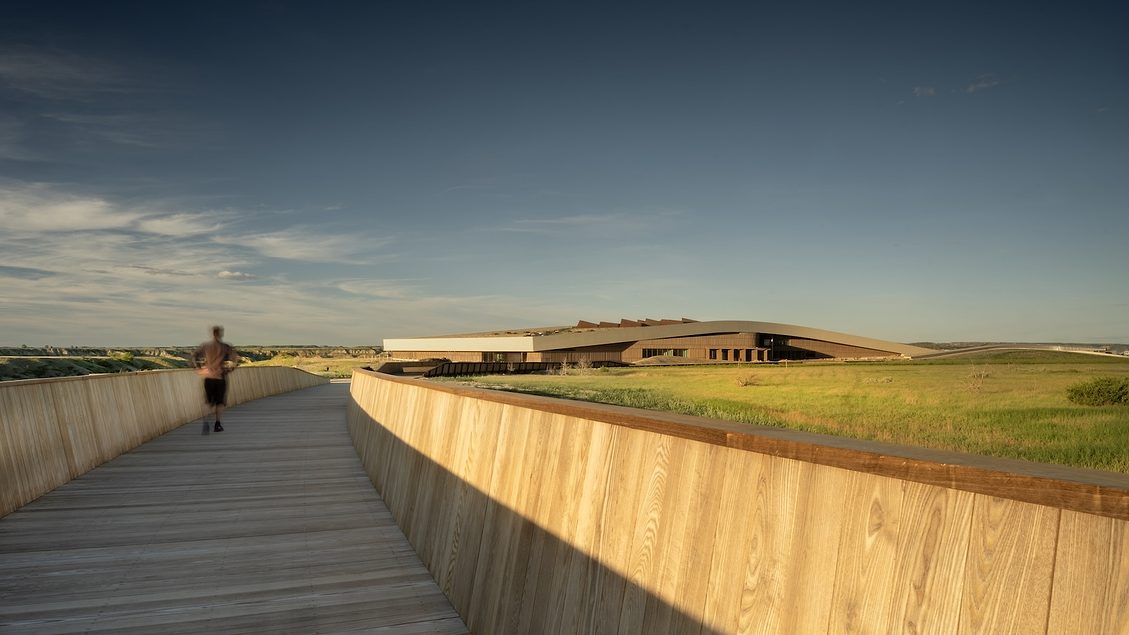
The 95,000-square-foot building sits on a 93-acre site in Medora, North Dakota, directly adjacent to Theodore Roosevelt National Park — appropriate territory for a president whose legacy is inseparable from American conservation. Snøhetta's guiding design principle, repeated in nearly every account of the project, is deceptively simple: "The Library is the Landscape." Rather than placing a building on the prairie, the architects effectively grew one out of it. The structure rises from a butte, its roof an accessible, 121,000-square-foot expanse of living prairie grass that visitors can walk across, planted with more than 200 native species cultivated in partnership with Resource Environmental Solutions and North Dakota State University.
The material choices reinforce the same instinct toward disappearance and rootedness: mass timber, reclaimed regional wood, low-carbon concrete, and rammed-earth walls built from soil sourced directly from the site, their natural striations deliberately left visible so the walls themselves read like geological cross-sections of the surrounding badlands. Inside, the library houses climate-controlled galleries for its collections and an auditorium substantial enough to host presidential debates, alongside infrastructure built to support growing digital archives — a nod to the fact that this is meant to function as a working research institution, not simply a static memorial.
A Bid for the World's Most Rigorous Green Certification
What separates the Roosevelt library from the wave of other prestige cultural buildings opening this year is its environmental ambition. The project is pursuing full certification under the Living Building Challenge — widely regarded as the most demanding sustainability standard in the built environment — alongside the highest tiers of LEED and SITES certification. The framework guiding the design is described as "Four Zeros": zero energy, zero water, zero emissions, and zero waste, paired with a commitment to full ecological restoration across the entire 93-acre site, not merely the building's footprint.
If and when certification is achieved, the Theodore Roosevelt Presidential Library will become the only Living Certified presidential library in the country, and reportedly the largest and most complex Living Certified cultural institution anywhere in the world — a distinction that puts a North Dakota prairie building in conversation with some of the most technically ambitious green construction projects on the planet, cultural or otherwise.
Built to Be Reached, Not Just Visited
Perhaps the detail that best captures the project's underlying philosophy is access. The library is reportedly the first presidential library designed to be reached not just by car, but by hiking trail, mountain bike, or horseback — a set of arrival options that would be almost comic for, say, a downtown institutional building, but that make complete sense here, given the site's direct connection to more than 3,000 acres of adjoining National Grasslands. Visitors aren't simply meant to park, tour, and leave; the building assumes some of them will arrive the way Roosevelt himself might have preferred, on foot or on horseback, treating the surrounding badlands as part of the experience rather than a scenic backdrop glimpsed through gallery windows.
Early capacity projections suggest the library expects to welcome more than 200,000 visitors annually — a substantial number for a site in a town of roughly 130 year-round residents, underscoring how much the project is banking on destination tourism, not just regional foot traffic, to sustain it.
A Statement Beyond One President
There's an argument to be made that the building's environmental ambitions say as much about Roosevelt's legacy as its exhibits will. Roosevelt is remembered, above almost anything else, as the president who established the modern American conservation movement — the national parks, the forest reserves, the sense that the federal government had some obligation to protect wild land from unchecked development. A library that tries to achieve net-zero everything while restoring, rather than displacing, its own site isn't just a design choice; it's architecture attempting to argue a thesis about its subject before a single exhibit panel is read.
What This Means for Design Watchers
For anyone following where high-profile cultural architecture is heading, the Roosevelt library is worth watching as a bellwether. Living Building Challenge certification remains rare specifically because it is so difficult to achieve at scale — most buildings that pursue it are far smaller than a 95,000-square-foot public institution expecting hundreds of thousands of annual visitors. If Snøhetta and its partners pull off certification here, it will meaningfully expand what's considered achievable for large, publicly accessible cultural buildings, potentially giving future museum and library commissions a concrete precedent to point to when clients ask whether this level of environmental ambition is actually feasible outside a boutique project.
The Bottom Line
Nearly two weeks after its Independence Day opening, the Theodore Roosevelt Presidential Library continues to draw architecture critics and design publications back for a second look — not for its galleries, necessarily, but for the sheer audacity of a public building that spends more energy trying to disappear into a North Dakota butte than announcing its own presence. In an era when major cultural buildings often compete to be the most visually spectacular, Snøhetta built something that succeeds by doing almost the opposite: making the strongest possible statement by trying, as hard as architecturally possible, not to make one at all.
Published By | Features Editor