Written By | Fashion and Design Desk
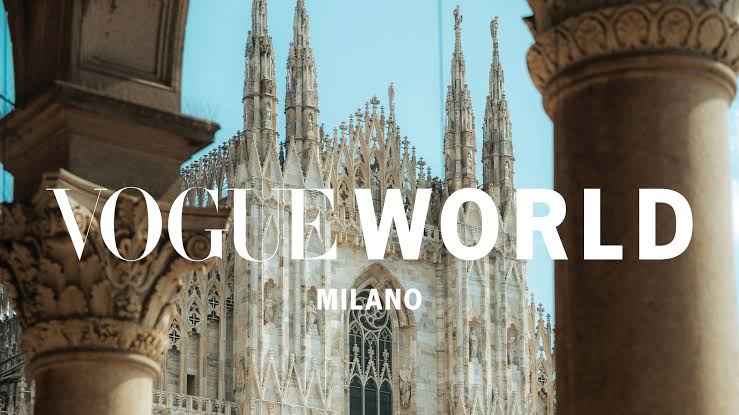
Vogue World lands in Italy for the first time on Tuesday, turning Milan's grandest arcade into a stage — and picking the fight the entire industry has been avoiding.
MILAN
By Tuesday evening, the Galleria Vittorio Emanuele II will not be a shopping arcade. The nineteenth-century glass-and-iron cathedral that sits between the Duomo and La Scala — the space Milanese call the city's living room — becomes a runway, a theatre and a proving ground, all at once.
Vogue World: Milano is the fifth edition of the travelling spectacle Anna Wintour launched in 2022, and the first to be staged in Italy. It has been to New York, London, Paris and Los Angeles. It has never gone anywhere with quite this much at stake for the host city, because the theme is not a mood. It is a question.
The title is "Where The Future Is Made By The Hand."
A theme with an argument inside it
Most fashion spectacles choose themes that cannot lose — a decade, a colour, a city. Milan has chosen to stage a confrontation between Italian artisanal tradition and artificial intelligence, and then to hold it in front of the international press during fashion week.
The production is structured as a sequence of choreographed thematic acts built on what organisers describe as a continuous dialogue between hand and machine: Renaissance-era techniques set against industrial wool, screen-based imagery and AI, with master artisans appearing alongside leading Italian houses and international talent.
The creative team is unusually heavyweight for an evening event. Juan Costa Paz is creative director. Lady Amanda Harlech — Karl Lagerfeld's longtime collaborator, and one of the last people alive who can credibly claim to have shaped the grammar of the modern runway — is leading the fashion segment. Judith Clark, the exhibition-maker whose curatorial work has reframed how museums display clothing, is curator. Marco Balich, who has produced Olympic ceremonies, is executive producer.
The sponsor list tells its own story about the tension being staged. Lead sponsors include ALO, eBay, Eli Lilly and Meta Glasses, with additional support from FedEx — and OpenAI.
Why Milan, and why now
The choice of city is not neutral. Italy is where a disproportionate share of global luxury is physically made: the tanneries of Tuscany, the knitwear workshops of Umbria, the shoemakers of the Marche, the embroidery ateliers that supply houses headquartered in Paris. It is the part of the industry that does not appear in the show notes.
That supply chain has spent several years under scrutiny — over ageing workforces, over succession, over the gap between what a finished garment sells for and what the hands that made it earn. Staging a celebration of craft in Milan, sponsored in part by an AI company, is either a brave framing or an extremely conspicuous one, depending on how the evening is handled.
The charitable component suggests the organisers understand the optics. Proceeds are directed to the library in Quarto Oggiaro, a working-class district in the north-west of the city, with a commitment of at least €2 million to convert it into a cultural hub for creativity and community. Vogue has also pledged a separate donation to the City of Milan to support cultural and social initiatives of public interest. The money is going to the periphery, not the Quadrilatero.
The week it opens
Vogue World lands on the first day of one of the densest Milan Fashion Weeks on record. The Spring/Summer 2027 season runs September 22 to 28 with roughly 218 appointments across physical shows, digital presentations and events.
Prada opens the week at 2 p.m. CET on Tuesday, moving up from its traditional Thursday slot — a scheduling change that says a good deal about which house the Camera della Moda is building the calendar around. Diesel, Fendi and Bottega Veneta follow, along with the debut of Moschino's new creative direction and Giorgio Armani. The CNMI Sustainable Fashion Awards also take place on Tuesday, which makes the day's through-line about as unsubtle as it could be.
The absences are as notable as the additions. Versace is not showing, with Pieter Mulier's runway debut pushed back. Ferrari has decamped to New York. N.21, a Milan regular, is off the schedule. The week is simultaneously bigger and thinner than it looks.
What it means for anyone who buys clothes
The honest answer is that nothing you can buy will change on Wednesday morning. But the argument being staged on Tuesday is the one that decides what "made in Italy" means in ten years.
If AI is absorbed into the design process — pattern-making, colourways, sampling, the unglamorous iterations that currently eat weeks — the artisan's role narrows to execution, and execution is the part that historically gets offshored. If instead it is confined to the front end while the hand keeps authority over the object, the workshops survive as workshops.
The practical consumer signal to watch is provenance labelling. Expect the next two years to bring a wave of houses making increasingly specific claims about which human did what, because specificity is the only defence a craft economy has once machines can approximate the result. Treat vague heritage language accordingly.
There is a second, slower signal: price behaviour at the middle of the market. Genuine hand-finishing is expensive because it is slow, and it has historically justified the gap between a €400 bag and a €4,000 one. If that gap begins to close from below — if mass-market pieces start arriving with finishing quality that used to require a workshop — then the artisan premium stops being a manufacturing fact and becomes a marketing one. That shift would not announce itself. It would simply show up, quietly, in what a mid-priced coat feels like in the hand.
The Galleria was completed in 1877 by workers who did not live to see the mosaic floors finished, in a building designed to prove that industry and beauty were not opposites. Staging this particular argument under that particular roof is, at minimum, a good joke.
Whether it is also an answer is what Tuesday is for.