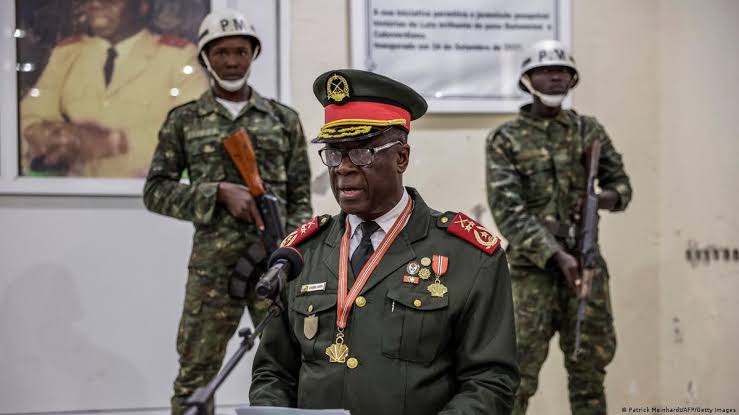
BISSAU, Guinea-Bissau
Nine months after soldiers overthrew Guinea-Bissau's elected government, the military-led transitional authorities are pressing ahead with a Aug. 30 referendum that would fundamentally rewrite the country's constitution to concentrate power in the presidency — even as the Community of Portuguese-Speaking Countries opened a week-long ministerial meeting in Dili, Timor-Leste, this week that has the West African nation's unresolved crisis near the top of its agenda.
The referendum, unanimously approved by the transitional government, would convert Guinea-Bissau's semi-presidential system into a full presidential one. Under the proposed changes, the president would become head of government as well as head of state, gaining the power to appoint the prime minister and cabinet regardless of election results or whether a supporting majority exists in parliament, and the authority to dissolve the legislature. The Human Rights Foundation, a U.S.-based advocacy group, has condemned the planned vote as a "sham referendum" designed to manufacture legitimacy for what it called a coming dictatorship, while legal experts and opposition figures in Bissau have separately questioned whether institutions created after the coup have any constitutional authority to rewrite the constitution at all.

A crisis nine months in the making
Guinea-Bissau's latest upheaval began on Nov. 26, 2025, when senior military officers ousted President Umaro Sissoco Embaló just days after a disputed presidential election and installed a transitional government under Gen. Horta N'Tam, who took the title of transitional president. The takeover was the country's fourth reported coup or attempted coup since 2022 in a nation that has endured chronic political instability since gaining independence from Portugal in 1974. A transitional charter published in early December barred N'Tam from standing in future elections, and the transitional government subsequently set Dec. 6, 2026, as the date for new presidential and legislative elections meant to restore constitutional order.
The Community of Portuguese-Speaking Countries, known by its Portuguese acronym CPLP and comprising Portugal, Brazil and several former Portuguese colonies including Guinea-Bissau, suspended Bissau from all bloc activities in December 2025, citing a breakdown of constitutional order under Article 7 of its founding statutes. That suspension remains in force and was reaffirmed as CPLP foreign ministers gathered this week — Aug. 12 through 19 — in Dili for the bloc's 31st Ordinary Meeting of the Council of Ministers. Joaquim Fernandes, coordinator-general of Timor-Leste's CPLP presidency commission, told reporters in Dili on Tuesday that Guinea-Bissau "is an indispensable member. It is a founding member," and said the suspension was intended not as punishment but as pressure to encourage a return to constitutional government. The Dili meeting is also expected to resolve a separate, unrelated dispute between Brazil and Equatorial Guinea over which country will hold the CPLP's rotating presidency for 2027-2029, after the two failed to reach consensus a year ago.
The regional bloc most directly engaged on the ground, the Economic Community of West African States, has struggled to present a united front. ECOWAS leaders, notably Senegal and Sierra Leone's Julius Maada Bio, who currently chairs the bloc's Authority of Heads of State and Government, have been accused by regional commentators of tacitly siding with the junta rather than pressing for a swift restoration of civilian rule, while the ECOWAS Stabilisation Support Mission deployed in the country has been criticized as functioning more as protection for the transitional government than as a stabilizing force. A visit by ECOWAS defense chiefs from Ghana, Nigeria, Senegal and Sierra Leone in late June — intended to negotiate the mission's mandate and eventual withdrawal — was overshadowed by allegations, which the defense chiefs' committee has firmly denied, that one member of the delegation was offered a bribe of 15 million CFA francs by an aide to a senior junta official. The transitional authorities have since opened criminal proceedings against the journalist who first reported the allegation, accusing her of spreading "fake news."

The opposition leader caught in the middle
The most closely watched figure in the standoff is Domingos Simões Pereira, president of Guinea-Bissau's National People's Assembly and leader of the African Party for the Independence of Guinea and Cape Verde, or PAIGC — the party that has refused to recognize the legitimacy of the post-coup transitional order and has accused the junta of governing in violation of the constitution. A military court ordered Pereira held in pretrial detention on July 10 over allegations tied to an attempted coup in October 2025, a move ECOWAS publicly condemned while calling for his unconditional release. Twelve days later, a Regional Military Court in Bissau suspended his detention for 90 days on medical grounds after a military hospital assessment concluded his condition could not be adequately treated in the country, and Pereira flew to Lisbon for treatment on July 24, greeted at the airport by dozens of supporters. He is barred from engaging in political activity during his authorized absence and has said he intends to return to Guinea-Bissau to continue what he has described as his fight for the country's constitutional order.
Pereira's detention, and the appeal for his release by the government of Cape Verde — a nation bound to Guinea-Bissau by a shared independence struggle against Portugal between 1961 and 1974 and by the historic links between the PAIGC and Cape Verde's ruling party — triggered a diplomatic rupture between the two countries. Guinea-Bissau's National Transition Council announced in mid-July what it called a "practical freezing" of political relations with Praia, accusing Cape Verde of interference in its judicial and political processes, of violating national sovereignty, and of aligning its foreign policy with European rather than African interests. Council spokesperson Fernando Vaz said Cape Verde had no legitimate standing to comment on Guinea-Bissau's internal affairs. The freeze stopped short of severing diplomatic ties outright or closing embassies, but it marked a rare public breach between two countries whose post-colonial histories have been closely intertwined since the 1970s.
Analysis: a referendum designed to outlast the transition
The timing of the Aug. 30 referendum is central to understanding the junta's strategy. Coming three months before the Dec. 6 elections that are supposed to return Guinea-Bissau to civilian, constitutional rule, the vote would lock in a fundamentally more powerful presidency before voters even choose who holds that office — meaning that whichever candidate wins in December would inherit greatly expanded authority to appoint and dismiss the government and to dissolve parliament, regardless of the composition of the legislature elected alongside them. Critics argue this sequencing effectively pre-determines the character of the post-transition government irrespective of the December election's outcome, embedding the junta's preferred institutional architecture into the constitution before any elected authority exists to contest it.
That strategy also helps explain why international pressure on Bissau has so far yielded limited results. With N'Tam barred from running in December, the junta's leadership has less incentive to resist institutional changes that constrain a future elected president, since none of its current leaders are positioned to occupy that office themselves. A restructured presidency that concentrates power regardless of parliamentary arithmetic would, in practice, most directly benefit whichever political or military faction can secure the presidency in December — potentially including figures aligned with the very interests that engineered the November 2025 takeover. Guinea-Bissau's history offers little reassurance on this point: the country has experienced repeated coups and attempted coups since independence, and previous transitional periods have not reliably produced durable civilian governance.

The broader regional dynamics compound the problem. With ECOWAS internally divided and its stabilization mission drawing criticism as ineffective, and with the CPLP's leverage limited to suspension and diplomatic statements from a meeting taking place thousands of miles away in Dili, Guinea-Bissau's junta faces relatively modest external constraints on its timeline. Analysts tracking the region have noted that of ECOWAS's 15 member states, four are currently under military rule and three others have withdrawn from the bloc altogether to form the rival Alliance of Sahel States — a pattern that has visibly eroded the regional body's capacity, and perhaps its appetite, to enforce constitutional norms in Guinea-Bissau or elsewhere.
What to watch next
The Aug. 30 referendum itself is the most immediate marker: a "yes" vote would hand whoever wins December's presidential election sweeping new authority before they even take office, while a contested or low-turnout result could complicate the junta's claim to a legitimate mandate for the constitutional overhaul. Also worth watching is whether Pereira, still barred from political activity while abroad, attempts to reengage politically ahead of his scheduled return, and how the transitional authorities respond if he does. The outcome of the CPLP's Dili meeting — including whether the bloc signals any softening or hardening of its suspension of Guinea-Bissau — will indicate whether the Lusophone world intends to exert more concerted pressure ahead of December, or whether, as with ECOWAS, internal divisions will continue to blunt any unified response. And as the Dec. 6 election date approaches, the central question remains whether the junta intends to hand over power to a genuinely elected civilian government at all, or whether the redesigned presidency approved this month is intended to ensure that whoever inherits the office answers, in practice, to the military figures who installed the system in the first place.
Published By | News Editor