Written By | Business Experts
Demand for air travel across Africa is rising faster than anywhere else, but taxes, trapped cash, a fuel shock and fragmented skies mean airlines keep only cents per passenger
Economic & Social Transformation
Air transport sits in an odd place in Africa's development story. It is the fastest way to move people, perishable exports and high-value goods across a continent of 54 countries, poor road links and long distances. It feeds tourism, diaspora travel, business and the trade ambitions of the African Continental Free Trade Area. Yet the industry that is supposed to carry this integration agenda earns some of the thinnest margins in the world. In 2026 that gap between economic importance and financial health has grown wider, and it explains why African governments have spent the year arguing about taxes, open skies and trapped airline revenue.
Growth without profit
The headline numbers point in two directions. In its June 2026 Global Outlook for Air Transport, subtitled "Energy in Crisis", the International Air Transport Association (IATA) projected that passenger demand on African airlines, measured in revenue passenger kilometres, would grow by 10.0% in 2026, faster than the 9.8% recorded in 2025 and faster than any other region. Capacity was forecast to rise by only 7.7%, so planes are expected to be fuller.
Profits move the other way. IATA cut its forecast for the combined net profit of African carriers to US$100 million for 2026, half the US$200 million it had projected in December 2025 and down from about US$300 million in 2025. The net margin is expected to shrink from 1.6% to 0.2%. Per passenger, African airlines are expected to earn about US$0.40 in 2026, against US$2.10 in 2025. Put plainly, an African carrier selling a several-hundred-dollar ticket keeps less than half a dollar of it.
The African Airlines Association (AFRAA) is more upbeat about volumes. Speaking at IATA's Focus Africa 2026 conference, Secretary General Abdérahmane Berthé said traffic on African carriers was expected to grow by 21.5% in 2026. That figure is far above IATA's estimate and probably reflects AFRAA's own member sample and method, so it is best read as a sign of momentum rather than a precise forecast. Both bodies agree on the main point: demand is not the problem.
The 2026 fuel shock
The immediate reason for the profit downgrade is fuel. Conflict in the Middle East and disruption around the Strait of Hormuz pushed up jet fuel prices and refining margins in the first half of 2026. IATA said North West Europe jet fuel crack spreads reached as much as US$121 a barrel. Most African airlines hedge little or not at all, so they feel price spikes almost at once.
The two biggest East African carriers show how this played out. Kenya Airways reported first-half 2026 revenue of about KSh81.25 billion, up 9%, helped by an 18% rise in cargo income to KSh8.77 billion. But operating costs rose about 14% to KSh91.9 billion, its fuel bill rose 32% and it flew 9% less capacity. Its loss after tax widened from KSh12.2 billion to KSh16.1 billion, even though its cabin factor improved by 3.9 points to 76.3%.
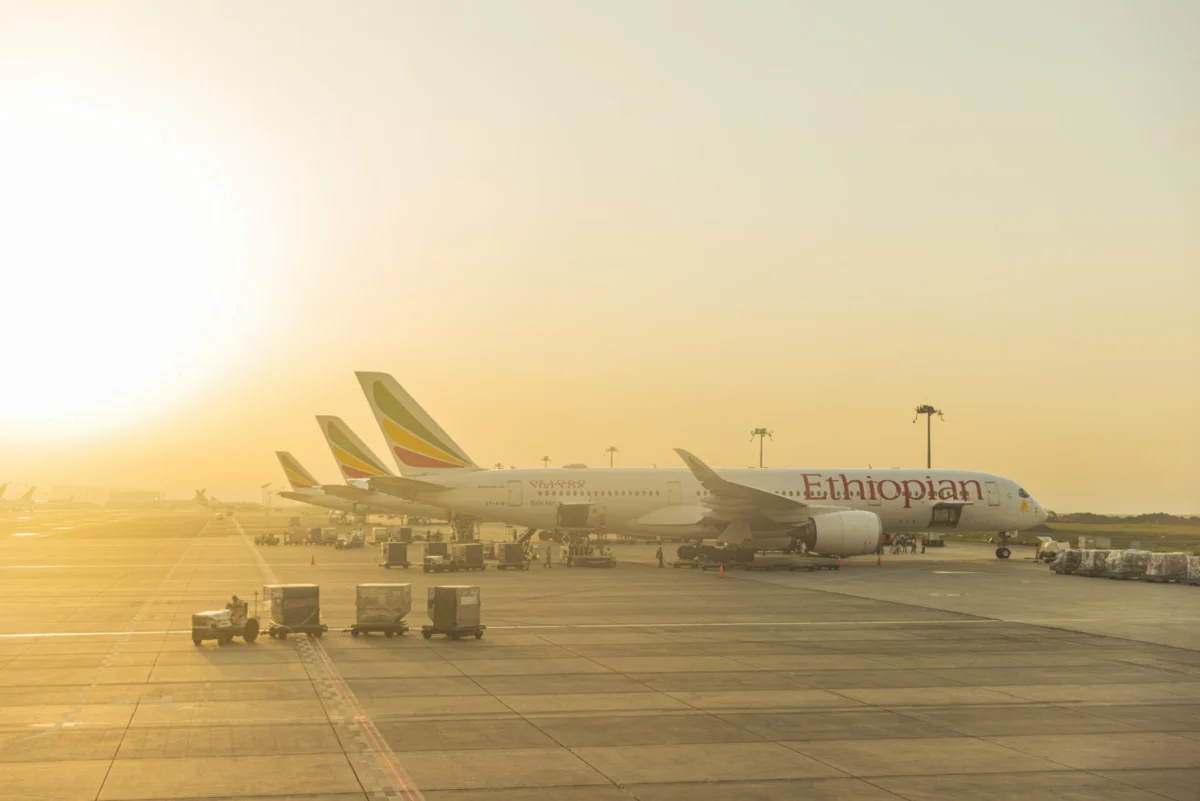
Ethiopian Airlines, the continent's largest group, grew strongly but felt the same pressure. For the fiscal year to July 2026 it reported revenue of about US$9.1 billion, up roughly 20%, carried 20.7 million passengers (up 10%, and 98% of its target) and moved 897,000 tonnes of cargo (up 16%). Operating costs rose about 25%, and the airline did not publish a profit figure. It cited cancelled Gulf flights, a shortage of wide-body aircraft, and travel restrictions linked to conflict and the Ebola outbreak that began in the Democratic Republic of Congo. In Nigeria, the Airline Operators of Nigeria said Jet A1 prices had jumped from about ₦900 a litre to more than ₦3,000 at the peak. The federal government responded in April with a 30% cut in statutory airline charges and an indicative Lagos price band of ₦1,760–₦1,988 a litre.
Structural costs: the taxes and charges
Fuel explains 2026, but it does not explain why African margins were the world's lowest before the shock. The deeper problem is the cost of operating. AFRAA estimates that taxes, charges and fees across Africa are on average 15% higher than the global norm, even though incomes and living costs in most African markets are far lower. When ECOWAS transport ministers met in Lomé in November 2024, they noted that charges, taxes and fees made up almost half of the total price of an air ticket in West Africa.
This is why the ECOWAS decision matters. Under a Supplementary Act on aviation charges, taxes and fees, member states agreed to abolish taxes on air transport and cut passenger and security charges by 25% from 1 January 2026. By July 2026 ECOWAS had adopted an implementation strategy and monitoring framework, and Côte d'Ivoire was reported as the first member state to apply the policy in full. The experiment will show how much demand is held back by price. In a region where many travellers pay for flights themselves, lower fares can bring in new passengers rather than just making existing trips cheaper.
The fiscal trade-off is real. Airport and aviation fees fund regulators, airport operators and, in some countries, general budgets. Finance ministries under IMF programmes or debt pressure will be wary of giving up revenue. The case for the cuts is that a larger, more frequent network brings wider gains in tourism spending, business travel, cargo and jobs that outweigh the lost fees. Whether that holds will depend on how many ECOWAS states follow Côte d'Ivoire. The regional bloc now has 12 members after the 2025 exit of Burkina Faso, Mali and Niger, so the Sahel states are outside the scheme altogether.
Trapped cash
A second structural cost is money airlines cannot take home. IATA's data show that, as of 31 March 2026, African governments were holding back about US$774 million in airline revenues because of foreign-exchange controls or shortages. Algeria alone accounted for about US$258 million and Mozambique for about US$82 million. Both had fallen from US$307 million and US$91 million at the end of October 2025, but they remain large. AFRAA credits Nigeria's FX reforms with releasing most of its earlier backlog, which helped carriers' cash flow. For a foreign airline, trapped funds work like a tax and a risk premium, and they lead to fewer flights or higher fares on affected routes.
Fragmented skies and the Lomé Declaration
The third issue is market access. The Yamoussoukro Decision of 1999 was meant to open African skies, and the Single African Air Transport Market (SAATM), launched in 2018, was meant to put it into practice. In June 2026 the African Civil Aviation Commission (AFCAC) counted 38 SAATM states, of which 26 had signed the memorandum of implementation and 21 were taking part in the pilot implementation programme. AFRAA's message was that "signatures alone do not create connectivity". African airlines still carry only about 35% of intercontinental traffic to and from the continent, and many intra-African trips still route through Europe or the Gulf.
The inaugural African Air Transport Convention in Lomé (15–19 June 2026) tried to move the agenda from principle to practice. Togo's President Faure Gnassingbé, the AU's SAATM champion, said progress had fallen short of what African citizens and businesses expected. Rwanda's President Paul Kagame urged leaders to go beyond rhetoric, pointing out that Africa has nearly a fifth of the world's population but a much smaller share of global air traffic. On 16 June, transport, tourism, trade and finance ministers adopted the Lomé Declaration and Implementation Matrix. It calls for restrictive market-access rules to be removed, for bilateral agreements to be brought in line with SAATM, and for AFCAC to draw up a post-Lomé roadmap with set actions, timelines and reporting. It also launched an AFCAC Solidarity Commitment for 2026–2028 to fund the commission's work. Including finance ministers was a deliberate step, since taxes and charges are ultimately set by treasuries, not aviation authorities.
Hubs, airports and the capital question
Liberalisation helps carriers that already have scale, and that is a source of political tension. Ethiopian Airlines, with a Pan-African network, a large cargo business and a new mega-airport planned at Bishoftu, is best placed to benefit from open skies. The Bishoftu project is estimated at about US$10–12.5 billion for the first phases, with a target capacity of up to 110 million passengers when fully built. The African Development Bank (AfDB) is lead arranger and has earmarked up to US$500 million, the Bank of China has held talks on the financing structure, and Ethiopian Airlines plans to fund about 20% itself. Contractor selection has slipped from August 2026 to early 2027 while bidders secure funding.
Smaller national carriers fear open skies will let stronger rivals take their routes. Yet the evidence from the 2026 numbers is that protection has not made them profitable either. A more sensible path for smaller states may be to treat their airports as connecting points for regional traffic, keep fees competitive, and let private and regional airlines serve routes that flag carriers cannot afford to fly. Mozambique's plan, presented in October 2026, to spend about US$420 million on aviation and logistics capacity around its extractive industries is one example of governments linking airport investment to specific economic sectors.
What would change the picture
The 2026 data point to a clear set of priorities for policymakers who want aviation to support growth rather than depend on subsidies:
Conclusion
African aviation in 2026 is not short of passengers. It is short of the conditions that let airlines turn passengers into profit: affordable fees, convertible revenue, open markets and stable fuel costs. The fuel shock cut margins to almost nothing this year, but the deeper costs were set by policy, and policy can change them. ECOWAS's tax cut and the Lomé Declaration are the most concrete steps in years. If they are carried through, they could make air travel cheaper for Africans and give the continent's airlines a sound footing. If they stay on paper, Africa will keep its record as the world's fastest-growing air market that hardly makes money.



