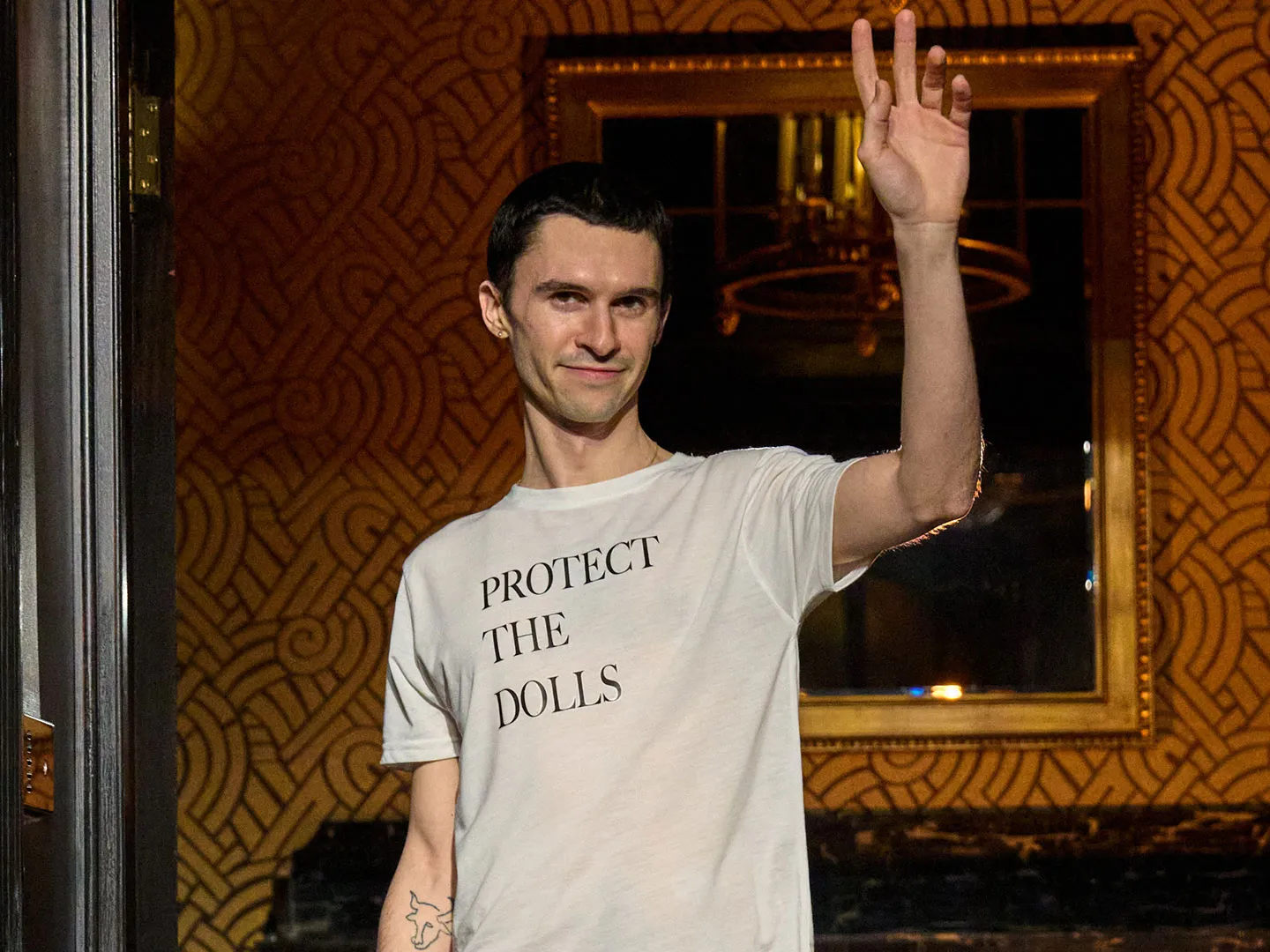
Conner Ives — the New Yorker whose "Protect the Dolls" T-shirt became a global emblem — makes his official New York Fashion Week debut this afternoon, five years after leaving Central Saint Martins and building a label out of other people's discarded clothes.
NEW YORK
At 12:30 this afternoon, in the middle of a New York Fashion Week crowded with legacy revivals and corporate creative-director reshuffles, a 30-year-old designer from Westchester will show a collection in the city he grew up in for the first time. Conner Ives has been making clothes professionally for five years. Every one of his previous runway shows has taken place in London.
That detail is the whole story. Ives builds his work out of American iconography — cheerleader jackets, souvenir sweatshirts, prom dresses, the visual debris of a suburban American childhood — and he has spent his entire career presenting it three thousand miles away, to an audience that reads it as exotic. Today he shows it to the people it was made from.
A career assembled from scraps
Ives graduated from Central Saint Martins in 2020, into a fashion industry that had just shut down. He launched his own label in 2021 and staged his first runway show in February 2022, in London, on the schedule that had taken him in. The founding idea was unfashionable at the time and has since become one of the defining practices of his generation: he does not start with fabric. He starts with garments that already exist.
Vintage pieces, deadstock rolls, dead brands' overruns — Ives takes what the supply chain has already rejected and rebuilds it into something with a designer's silhouette and a thrift store's memory. A single Ives dress may contain half a dozen previous lives. The technique means no two pieces are truly identical, which is a nightmare for wholesale and a gift for the kind of customer who wants to own the only one.
The aesthetic that results has been described, accurately, as kitsch Americana: rhinestone and jersey and nostalgia, executed with a level of finish that stops it from being a joke. It has attracted a specific and useful clientele. Rihanna has worn it. So have Zoë Kravitz, Kate Moss, Charli XCX and Adwoa Aboah. That is not a random list — it is a list of women whose personal style is read as authorship, which is exactly what an upcycled one-off garment requires.

The T-shirt that changed the size of the brand
In February 2025, Ives walked out for the finale of his autumn show wearing a plain T-shirt printed with three words: PROTECT THE DOLLS. "Dolls" is longstanding ballroom and trans community slang for trans women. The shirt was a response to a political climate in which trans rights were being rolled back on both sides of the Atlantic, and it was not a marketing plan. It was a finale bow.
Within weeks it had escaped the fashion press entirely. Pedro Pascal wore one to a London film premiere, days after a UK court ruling on the legal definition of a woman, and the photograph travelled around the world. Troye Sivan, Haim and a long list of others followed. The shirt became one of the rare pieces of protest clothing that functions as both a statement and an object people genuinely want — which is much harder than it looks, and which most slogan merchandise fails at.
Crucially, Ives routed the proceeds to Trans Lifeline, the peer-support hotline for trans people, rather than to his own margin. That decision is the reason the shirt survived scrutiny. The fashion industry has a long and ugly record of converting activism into product; Ives built the accountability in on day one, and has since spoken repeatedly about the gap between wearing the shirt and doing anything about what it says.
A small business with a large signal
The commercial reality behind the cultural moment is more modest, as it almost always is. Ives runs a small independent label without a conglomerate behind it — the kind of business that makes headlines and struggles with cash flow in the same quarter. The past two years have been about converting attention into infrastructure.
In May 2025 he won a British Fashion Council award, the institutional stamp that opens doors with retailers. In September 2025 he produced a capsule collection with Jimmy Choo, built around animal prints and the playful motifs that run through his own work — his first serious move into footwear and accessories, which is where independent labels of this scale typically find the margin that ready-to-wear cannot provide.
Moving the show to New York is the next move in that sequence. American buyers, American press, American money — and a home-market narrative that London could never supply. For a designer whose entire vocabulary is American, showing on the New York schedule is less a relocation than a correction.

The week he is arriving into
Ives lands in a Spring/Summer 2027 season that runs 10 to 15 September with roughly 70 shows and presentations on the official CFDA calendar. He is showing on the same day as Prabal Gurung at 5 p.m. and Khaite at 7 p.m., which places a self-funded upcycler between two of the most commercially established names on the calendar — a reasonable summary of where New York fashion is in 2026.
What this means if you buy clothes
Two things, practically. The first is that the upcycling argument has moved from moral position to business model. When a designer working almost entirely from existing garments graduates to the main New York schedule and lands a luxury footwear collaboration, it stops being a sustainability gesture and starts being a viable way to build a fashion house. Expect more of it, and expect the bigger brands to attempt versions of it.
The second is about slogan clothing, which is having an enormous commercial moment and mostly deserves your suspicion. The "Protect the Dolls" shirt worked because the money went somewhere verifiable and the designer kept talking about the cause after the news cycle moved on. That is the test worth applying to every printed T-shirt you are sold this autumn: not what it says, but where the money goes, and whether anyone involved is still saying it in six months.
The show starts at 12:30. Whatever walks out, the more interesting fact is already settled — the Americana came home.
Published By | Features Editor