Written By | Torch Media Africa
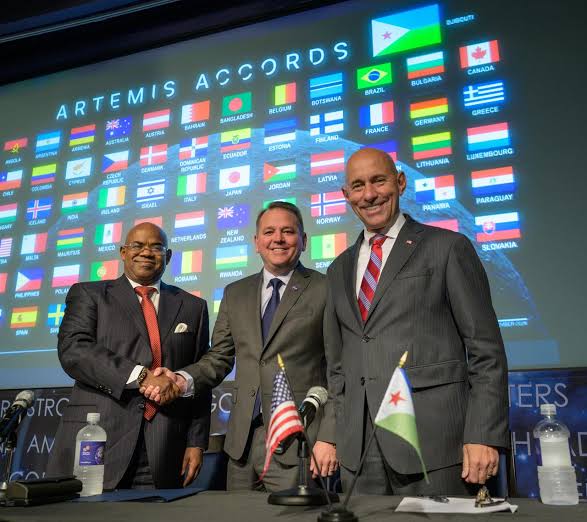
Today at NASA Headquarters, Djibouti became the 72nd nation to sign the Artemis Accords
SCIENCE & TECH
At 11 a.m. Eastern this morning, in a room at NASA Headquarters in Washington, a diplomat from a country of roughly a million people put his name to a document about how human beings should behave on the Moon.
Ambassador Mohamed Siad Douale, the Republic of Djibouti's envoy to the United States, was hosted by NASA Deputy Administrator Matt Anderson and by Frank Garcia, the US State Department's Assistant Secretary for African Affairs. With that signature Djibouti became the 72nd country to sign the Artemis Accords — and the eighth African nation to do so.
On paper, this is a small ceremony about a small country. In practice, it may be one of the more revealing things to happen in space diplomacy this year. Because of all the places on Earth that Washington might want inside its lunar coalition, Djibouti is arguably the single most strategically loaded.
Djibouti sits on the Horn of Africa at the Bab-el-Mandeb strait, the pinch point between the Red Sea and the Gulf of Aden. A very large share of the world's seaborne trade squeezes through that gap on its way to and from the Suez Canal. If you control the coastline there, you have a hand on one of the planet's main arteries.
Everyone has noticed. Djibouti hosts Camp Lemonnier, the largest permanent US military installation on the African continent. France maintains a base. Japan maintains a base — its only overseas military facility. And since 2017, so does the People's Republic of China: the PLA Navy's support base at Doraleh is Beijing's first and, to date, only overseas military base anywhere in the world.
American and Chinese forces are stationed a few kilometres apart. They have been for nearly a decade. It is the most crowded piece of strategic real estate in Africa.
And in January 2023, Djibouti announced it was going to build a spaceport.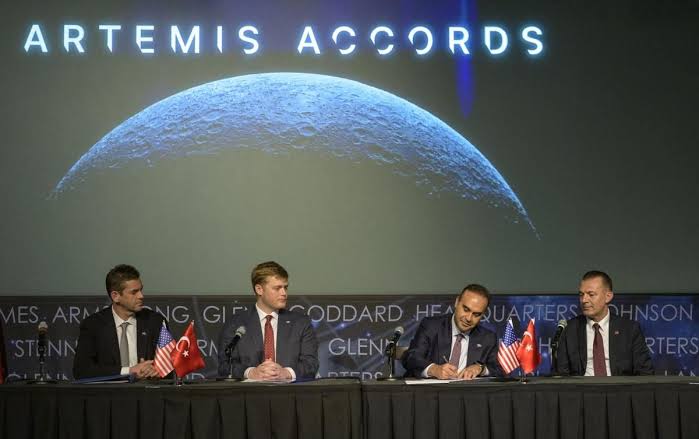
The plan, set out in a memorandum of understanding signed with the Hong Kong Aerospace Technology Group in partnership with Touchroad International Holdings, was ambitious to the point of eyebrow-raising: a commercial spaceport in the northern Obock region, seven satellite launch pads and three rocket testing pads, at an estimated cost of one billion US dollars.
The Djiboutian government committed to supply a minimum of ten square kilometres of land on a lease of at least 35 years, with the infrastructure eventually reverting to Djibouti after 30 years of co-management. The project was framed as a five-year build.
The geography is genuinely excellent for it. Djibouti sits at roughly 11 degrees north — close to the equator, where Earth's rotation gives a rocket a free velocity boost, and with open water to the east for downrange safety. It is the sort of latitude that launch engineers dream about and that Kourou, Cape Canaveral and Baikonur all envy to varying degrees.
The politics were more complicated. Analysts in Washington and Brussels raised immediate questions about a Chinese-linked firm operating launch infrastructure a short drive from a Chinese naval base and a shorter drive from an American one, and about how liability under the Outer Space Treaty — which makes the launching state responsible for what goes up — would work when the launching state has never launched anything.
Progress on the ground has been slower than the 2023 announcement implied. But the intent was never in doubt, and today's signature at NASA Headquarters lands squarely inside that context.
This is worth getting right, because the Accords are routinely misdescribed as a treaty. They are not.
The Artemis Accords are a set of non-binding political commitments, established in 2020 under the first Trump administration, when the United States — led by NASA and the State Department — joined with seven other founding nations to write down some practical ground rules. As NASA frames it, they introduced "the first set of practical principles aimed at enhancing the safety, transparency, and coordination of civil space exploration on the Moon, Mars, and beyond."
In plain terms, signatories agree to things like: register your spacecraft, publish your scientific data, render assistance to astronauts in distress, avoid harmful interference with other missions by declaring "safety zones" around your operations, preserve historic sites such as the Apollo landing gear, and mitigate orbital debris.
Nothing in the Accords is enforceable in the way a treaty obligation is. What they do is build a club, and establish that the club's norms — rather than somebody else's — are the default. Russia and China have both declined to sign, and have pursued their own framework through the International Lunar Research Station programme. That is the actual contest here: two overlapping visions of lunar governance, each recruiting.
NASA moved on the transparency side just last week, announcing on 12 September a push to strengthen open science and data sharing across the Accords signatory group — a signal that the framework is meant to deliver something concrete to members, not just a photo opportunity.
The African column of the signatory list has filled in remarkably quickly.
Nigeria and Rwanda went first, in December 2022, at the inaugural US–Africa Space Forum. Angola followed in November 2023. Senegal signed at NASA Headquarters in July 2025. Then came a rush: Morocco in April 2026, Botswana in June, Mauritius in July as the 70th global signatory and seventh African one. Türkiye took the 71st slot on 31 August, hosted by NASA Administrator Jared Isaacman. Djibouti makes 72.
Notably absent from that list: South Africa, the continent's most developed space science establishment, home of the MeerKAT radio array and a partner in the Square Kilometre Array. Its hesitation — which has drawn commentary in the South African press — is a reminder that signing is a foreign-policy choice, not a technical one.
Here is the part that gets lost in the geopolitics, and it is the part that is actually rather moving.
Djibouti's space programme launched in 2020 with an unglamorous goal: teach Djiboutians to build satellites. Under a partnership with the University of Montpellier in France, ten Djiboutian students were sent to the Montpellier University Space Centre for training that began in October 2020.
They came home and built a satellite. DJIBOUTI-1A is a 1U CubeSat — a ten-centimetre cube, about the size of a large coffee mug — assembled by that team of ten Djiboutian engineers and technicians. It launched on 11 November 2023 and is operational. A second, DJIBOUTI-1B, followed.
Its mission, HYDROSAT, is not lunar and not glamorous. It collects data from climate, rainfall and water-level monitoring stations scattered across Djiboutian territory and relays it back, so that the Centre d'Études et de Recherche de Djibouti can track environmental change in one of the hottest and driest countries on Earth — a place where average summer temperatures routinely exceed 40 degrees Celsius and water is the binding constraint on almost everything.
That is the Djiboutian space programme in its honest form: a shoebox in orbit, counting rainfall, built by ten people who went to France and learned how.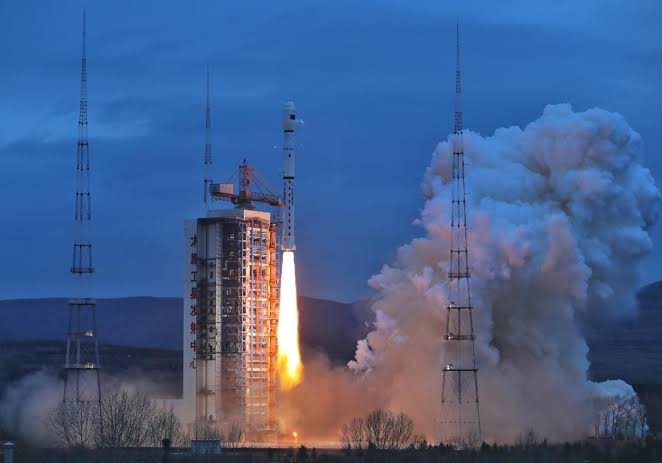
It is easy to be cynical about a country with one CubeSat signing a Moon agreement. The cynicism misses how coalitions actually work.
The Accords are a norm-setting instrument, and norms are established by breadth rather than by capability. A rule that only spacefaring superpowers endorse is a superpower policy. A rule that 72 countries across every inhabited continent endorse starts to look like customary practice — and customary practice is how international law gets made when nobody can agree on a treaty.
There is a second, more practical dimension. Ground stations, tracking assets and launch corridors are geographic, not technological. A spacefaring coalition needs partners in the right latitudes and longitudes, and it needs them to be inside the tent. Djibouti's position near the equator, on the Red Sea, with existing port and military infrastructure and good undersea cable connectivity, makes it useful in ways that have nothing to do with whether it ever builds a rocket.
And there is the plainly competitive dimension, which nobody involved will say out loud in a press release. Beijing has a naval base in Djibouti and a Hong Kong firm holding a spaceport MoU there. Washington has Camp Lemonnier and, as of this morning, a signature on the Artemis Accords. Both capitals are cultivating the same small country, in the same decade, for overlapping reasons.
The counter-argument deserves airing too. Critics of the Accords argue that a US-authored framework, promoted bilaterally and outside the United Nations Committee on the Peaceful Uses of Outer Space, risks fragmenting space governance rather than unifying it — and that the "safety zone" concept edges uncomfortably close to a resource claim on a Moon the 1967 Outer Space Treaty says nobody can appropriate. Signatories would answer that the alternative to imperfect rules is no rules at all, with landers converging on the same handful of ice-rich craters at the lunar south pole. Both positions are held in good faith.
Context matters, because the Artemis programme has been restructured underneath all this diplomacy.
Artemis II flew. On 1 April 2026, astronauts Reid Wiseman, Victor Glover, Christina Koch and Jeremy Hansen launched on the first crewed flight to the Moon since 1972, swung around the far side at a distance of about 6,545 kilometres on 6 April, and splashed down on 10 April. That happened. It worked.
What comes next changed shape in February 2026, when NASA reorganised the sequence. Artemis III, now targeted for 2027, is no longer the landing mission. Instead, Orion and a crew of four will spend roughly two weeks in low Earth orbit rehearsing rendezvous and docking with the commercial landers — a Blue Origin Blue Moon test article and a SpaceX Starship pathfinder — before returning home. The actual south-pole landing, the first human steps on the Moon since December 1972, has moved to Artemis IV, planned for 2028.
NASA has identified nine candidate landing regions near the lunar south pole, chosen for their combination of "peaks of eternal light" where solar power is nearly continuous and neighbouring permanently shadowed craters where water ice may be locked in the regolith. That ice is the prize. Water means drinking water, breathable oxygen and rocket propellant, and there is not much of it in not many places.
Which is precisely why a rulebook about who may operate where, and how close is too close, stopped being a hypothetical.
If you live anywhere on the African continent, the direct answer is that the pipeline into the global space economy is widening and it is widening fastest for countries that decide to walk through it. Djibouti's route — send ten people abroad to train, build a CubeSat, use it for something locally useful, then sign into the international frameworks — is a template that costs a fraction of what a national space agency is usually assumed to cost. Nigeria, Rwanda, Angola, Senegal, Morocco, Botswana and Mauritius have all made some version of the same bet.
If you live anywhere else, the relevance is slower-burning but larger. The rules being written now, in ceremonies like this morning's, will govern what happens when multiple nations and several private companies start operating machinery around a small number of ice deposits at the lunar south pole in the 2030s. Whether that becomes a managed shared endeavour or a scramble depends substantially on whether frameworks like the Accords acquire enough members to count as the default. Seventy-two is a meaningful number. It is not yet everyone.
And there is the quieter point that a CubeSat counting rainfall in one of the hottest countries on Earth makes better than any communiqué: space programmes in developing countries are overwhelmingly about the ground. Water. Crops. Floods. Coastlines. The Moon is the headline. The river gauge is the job.
A country the size of Wales, wedged between a US base and a Chinese one on the world's busiest shipping chokepoint, holding a billion-dollar spaceport MoU with a Hong Kong firm and one working CubeSat in orbit, has just signed the United States' rulebook for the Moon. Nothing about that is binding. Everything about it is deliberate.
Seventy-two down. The Moon is getting crowded, and the paperwork is racing to keep up.



