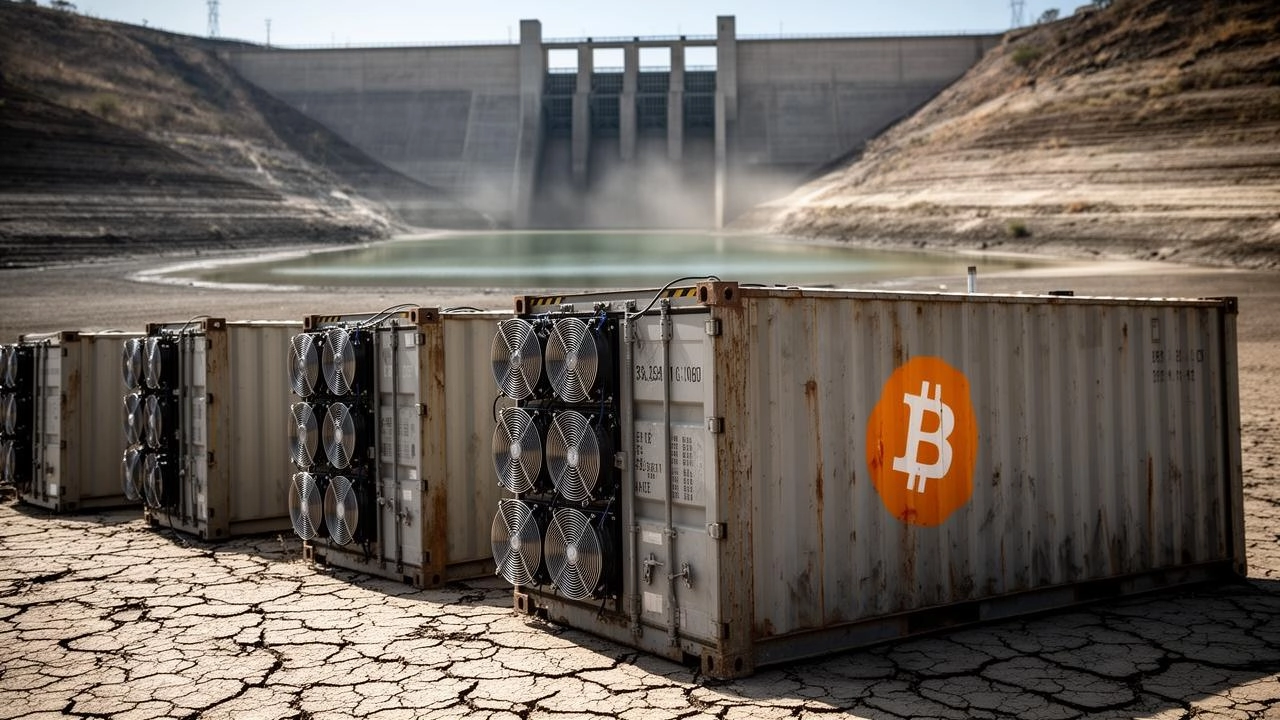
Ethiopia made its huge hydropower build-out pay by selling it to bitcoin miners. A 77 percent power cut in September shows the risks in that model, just as Addis Ababa starts pitching the same electricity to AI data centres.
East Africa: Ethiopia
The Customer That Paid the Bills
Few African countries have moved as quickly from power scarcity to power surplus as Ethiopia. The Grand Ethiopian Renaissance Dam (GERD), inaugurated in September 2025 with a design capacity of 5,150 megawatts, helped lift national installed capacity to about 9,760 MW, according to figures cited by Birr Metrics in September 2026, with hydropower making up roughly 96 percent of the generation mix. In fiscal 2024/25, GERD alone generated about 9,798 gigawatt-hours, a third of national output, ahead of the Gibe III dam's 7,148 GWh.
The difficult question was always who would buy all that electricity. The domestic grid cannot yet absorb it, because distribution is limited and tens of millions of Ethiopians remain unconnected or poorly served. Exports to Djibouti, Kenya and Sudan are growing but limited by transmission links. Into that gap came an unusual buyer: bitcoin miners, many of them relocated from China, attracted by a flat tariff of about 3.1 US cents per kilowatt-hour. Ethiopian Electric Power (EEP) signed power-purchase agreements with 39 mining companies, 31 of which are operating, and promised to deliver at least 98 percent of contracted volumes.
The financial effect was large. Bloomberg reported that miners accounted for about 35 percent of EEP's revenue in the past financial year and consumed nearly a third of the country's electricity output. Local reporting put their payments to the utility at about 50 billion birr. Shega estimated that miners contributed about US$220 million in electricity revenue in 2024/25, almost double Ethiopia's earnings from electricity exports that year. EEP's turnaround reflects this: Addis Fortune reported revenue of about 119 billion birr for 2025/26, up 57.8 percent, and a gross profit of 39.5 billion birr after years of losses. Bitcoin mining had become a major part of how the dam paid for itself.
September's Reversal
In September 2026 the weather changed the picture. With El Niño cutting inflows into the hydropower reservoirs by about 20 percent, EEP chief executive Ashebir Balcha said the utility had reduced deliveries to miners in stages, from 75 percent of contracted volumes to 50 percent and then to 23 percent, to protect supply for households and manufacturers. EEP said it would reassess in October. If reservoir levels stay weak, miners could face further cuts, and electricity exports to neighbouring countries could also be restricted. Reporting has also pointed to a 40 percent cut in EEP's export revenue forecast, to about US$279 million.
This cut came on top of earlier pressure. From 1 December 2025, EEP replaced the flat rate with a two-part tariff: a base rate of 4.00 US cents per kWh, rising to 6.00 cents during the 6pm–10pm peak and to 6.50 cents by the third year, plus an availability-based component that gives discounts during curtailment but makes miners' costs less predictable. EEP also stopped issuing new mining permits. Miners warned at the time that the increases could eventually force up to 90 percent of operations out of business by 2027. EEP's energy-trading leadership called the overhaul a 'national necessity.'
The reason it matters is scale. One industry estimate cited in regional coverage puts the electricity needed to mine a single bitcoin in Ethiopia at about 6.4 million kWh, roughly the annual consumption of 14,950 Ethiopian households. When reservoirs are full and the grid cannot absorb the surplus, that comparison does not matter much. In a drought, it becomes a direct trade-off between miners and households.
Why the Model Was Rational — and Why It Is Fragile
Selling surplus hydropower to miners made economic sense. Miners can be built quickly, need no long transmission lines, pay in hard currency and, in principle, can be switched off when power is needed elsewhere. That last feature is why grid operators from Texas to Paraguay value them as 'flexible load': they absorb surplus when supply is abundant and step back when it is scarce. For a utility with heavy debts from dam construction and a country short of foreign exchange, this was an attractive arrangement.
Ethiopia's version had two weaknesses. First, the contracts were written as if mining were baseload demand, with a 98 percent delivery commitment, rather than interruptible demand priced to match. When the drought arrived, EEP had to break those commitments instead of applying terms both sides had expected. That damages Ethiopia's reputation with investors in any power-intensive sector. Second, the price was low. Under a power supply agreement signed in July 2026, Kenya pays about 24 birr (roughly US$0.15) per kWh including capacity charges, according to Capital Ethiopia. Miners, even after the new tariff, pay a few US cents. Every kilowatt-hour that can reach Kenya, where Ethiopia plans to double exports to about 400 MW from December 2026, or a domestic factory, is likely worth more than one sold to a miner. Mining made sense as a buyer of last resort. It became a problem once it was treated as a core customer.
The Next Pitch: AI Compute
Even as miners lose power, Ethiopia is trying to sell the same electricity to a more valuable kind of computing. The Ethiopian Artificial Intelligence Institute is courting high-performance computing, cloud and AI-infrastructure investors, pitching renewable power as the main attraction. The timing is deliberate. Power has overtaken connectivity as the main constraint on African data centres: by Birr Metrics' count, the continent has about 360 MW of operational data-centre capacity, with 238 MW under construction and 656 MW planned. Competitors are moving too. In Kenya, Amaco Energy Group has proposed a US$1.5 billion AI data centre in Mombasa with its own LNG-fired power plant, precisely because the developers do not want to rely on the national grid.
Ethiopia does have some infrastructure in place. Raxio operates a carrier-neutral Tier III facility in Addis Ababa, RedFox Solutions Group has built capacity at the Ethio ICT Park, and a February 2026 count found 94 private companies registered for data-centre, cloud and crypto-mining activity. But no international hyperscaler has publicly committed. The gaps are well known: the country is landlocked and reaches submarine cables through Djibouti; large AI campuses need dedicated substations and highly reliable transmission; and investors need predictable import rules for GPUs and freedom to move earnings across borders.
September's cuts sharpen these concerns. An AI operator running training or inference workloads cannot accept power at 23 percent of contracted volumes. Its business depends on the near-constant availability that EEP has just shown it cannot guarantee in a drought year. If Ethiopia wants to move from bitcoin to AI, the curtailment has shown what that requires: firmer supply through a more diverse generation mix, such as solar, wind and geothermal alongside hydro, and contracts that state honestly what is firm and what is interruptible.
What a Better Bargain Would Look Like
There is a workable version of this strategy. It would treat crypto mining as an explicitly interruptible, low-priority load: cheap when water is plentiful, cut first in a drought, with that order of priority written into the contract and priced in. It would reserve firm, higher-priced capacity for data centres, industry and exports, backed by transmission investment and a non-hydro buffer. And it would link the export of compute to domestic benefits, including local cloud hosting for government and fintech, skills pipelines, and a requirement that some revenue goes toward expanding household connections, so that selling power abroad or to computers is not seen as coming at the expense of Ethiopians still without electricity.
The government formed after this year's elections now has to make these choices. EEP's October review will decide whether miners' allocations recover or fall further, and whether export commitments are protected. The longer-term decision is strategic: Ethiopia has built enough generating capacity to become East Africa's computing hub, but in a drought year it has shown it cannot yet supply that power reliably. Closing that gap will matter more than any further increase in installed megawatts.
What to Watch
Key signals over the coming months include the outcome of EEP's October reassessment of miner allocations; whether the Kenya export expansion to about 400 MW goes ahead in December 2026; any signed, named power agreement between EEP and an AI or cloud operator; whether the tariff schedule for miners is revised again; and whether non-hydro generation projects advance fast enough to give Ethiopia's growing digital economy firm power.
Published By | Tech Wiz