Written By | Torch Media Africa
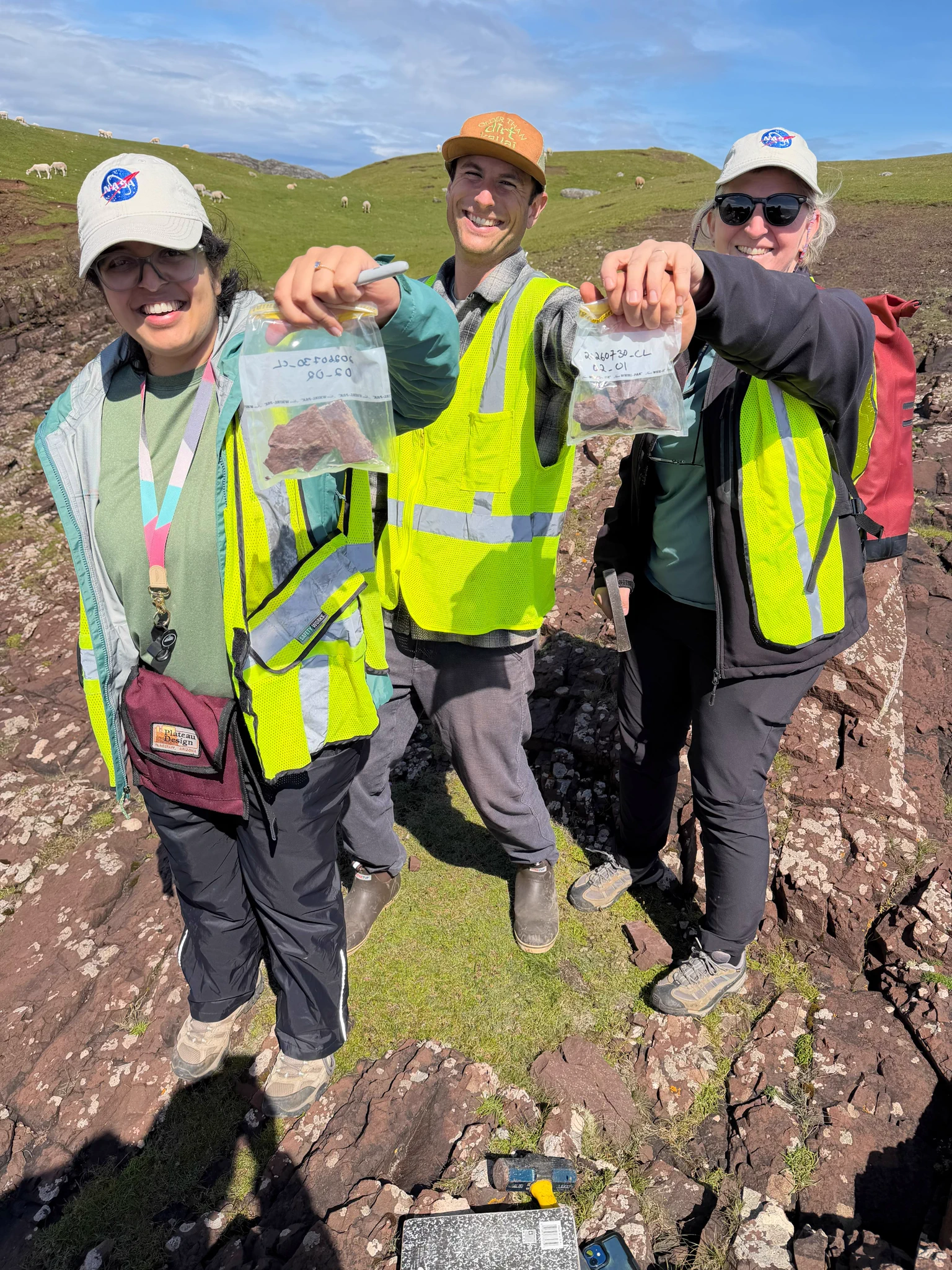
Scientists trekked to the rugged Highlands coast to study 1.2-billion-year-old rocks that look eerily like those Perseverance found in Jezero Crater
CLACHTOLL, SCOTTISH HIGHLANDS,
To find out whether life ever existed on Mars, a team of NASA scientists did not look to the red planet's dusty plains this summer. They flew to north-west Scotland. On the wind-lashed Highlands coast near Clachtoll, researchers spent weeks studying a sliver of ancient red sandstone dotted with odd grey-green blotches, because those blotches look uncannily like markings that NASA's Perseverance rover has photographed on Mars.
The mission, reported in recent days, is about answering one of the biggest questions in science: when you see a strange pattern in a Martian rock, how do you tell whether it was made by living things or by plain old chemistry?
Spots on Two Worlds
The markings in question are called reduction spots. They are pale, grey-green patches in otherwise rusty-red rock. The colour change happens when iron in the rock is chemically altered, a process known as reduction. Crucially, the process can sometimes be driven by microbes feeding on organic matter, but it can also happen with no life involved at all. As the research team put it, reduction spots "are sometimes evidence of ancient microbial life interacting with the rock, but they can be formed in other ways, too."
That sentence captures the whole dilemma. Perseverance, which has been exploring Jezero Crater since 2021, has documented reduction spots in the rocks there. Mars today is a frozen desert, but Jezero was once a lake fed by a river, and the rocks around it include mudstones and siltstones rich in clay minerals — just the kind of muddy, watery setting where microbial life would have thrived on Earth. Among the rover's most talked-about finds was a rock nicknamed Cheyava Falls, which contains features that scientists have flagged as potential biosignatures, meaning possible chemical or physical clues to past life. Potential is the operative word: no one has claimed proof.
Why Scotland?
Enter the Stoer Group, a sequence of rocks exposed along the Scottish coast near Clachtoll. These layers are around 1.2 billion years old, which makes them far older than any land plant. Back then, Earth's continents were barren, and the only living things in rivers and lakes were microbes. The Scottish rocks preserve ancient lake and river environments together with evidence of that microbial life, a combination that is rare and that makes them a natural lab for Mars science.
In other words, the Highlands offer something Mars researchers badly want: a place where they know what kind of life was around, can see the rocks it lived in, and can study how those rocks changed. If similar spots in the Scottish rock turn out to be tied to microbes, that gives scientists a template for what real biological fingerprints look like. If the Scottish spots have more than one possible cause, that teaches them just as much about the dangers of jumping to conclusions.
The Field Team
The expedition, carried out in summer 2026, was led by NASA's Goddard Instrument Field Team, which takes space-flight style instruments into the field to test how they perform on real rocks. Researchers from NASA's Johnson Space Center joined the effort, alongside academics from the University of Glasgow, the University of Maryland, Purdue University, Stony Brook University and the University of Cambridge.
The team collected samples and examined them with advanced analytical tools. The goal is to work out which signatures of microbial activity actually survive over geological time, and how to tell biological signatures from those created by non-biological processes. That is the pivotal skill for interpreting anything Perseverance sends home, and for deciding what to demand from future missions.
The Detective Problem
Why is this so hard? Because rocks are terrible witnesses. Over hundreds of millions or billions of years, heat, pressure and chemical fluids can erase evidence of life, or create patterns that mimic it. The classic example from the history of Mars science is the 1996 claim that a meteorite from the planet contained fossil-like structures, an announcement that sparked a decade of fierce argument and is still not universally accepted.
Scientists have learned from that episode. The modern standard is to build an overwhelming case from several independent lines of evidence — texture, mineral chemistry, organic molecules, and geological setting — and to rule out every non-living explanation first. The Scottish fieldwork feeds directly into that approach, by giving researchers a real-world case where the answer can be checked, because the rocks can be sampled in detail, cut up, and analysed in laboratories far more thoroughly than anything yet returned from Mars.
A Timely Week for Mars and the Moon
The Scotland story landed in a busy week for space. According to a weekly recap from Starlust covering 26 September to 2 October 2026, NASA selected three experiments, LEMS-SP, GIMLI and DISCO, under its PRISM programme to help locate resources and plan safety for a future lunar outpost. NASA's Nicky Fox said the selections "will directly help NASA minimize risks to our astronauts." The twin solid rocket boosters for Artemis III have been fully stacked, and Blue Origin's New Glenn rocket was added to NASA's Launch Services II contract through June 2030.
That backdrop matters, because the same agency is trying to do two things at once: build a lasting presence on the Moon, and answer the question of whether Mars ever hosted life. Field campaigns on Earth are a cheap and effective way to prepare for both. A rock hammer in Scotland costs far less than a rocket, and the lessons from it determine what the next robotic or human explorers should look for.
What Perseverance Has Already Shown
It helps to remember what the rover has achieved. Perseverance landed in Jezero Crater, the site of an ancient lake and river delta, to hunt for signs of ancient life and to collect rock samples for possible return to Earth. It has been sealing samples in titanium tubes, including those from the rocks that show reduction-style features. Those samples remain on Mars, and the question of when and how they might be brought back has been among the most debated issues in planetary science.
That is exactly why the Scotland work is valuable now. If samples do come home one day, labs will have a short, precious window to run the right tests. The more researchers learn today about how real biological spots behave, the better they can design the analysis plan. And if samples stay on Mars for a long time, the Scottish rocks provide the best available stand-in for working out what the rover's own instruments are really telling us.
Expert Perspective: Caution Is the Point
The researchers themselves are careful. Their key message is not that Mars had life, but that distinguishing life from lookalikes requires understanding how biology leaves its mark in rock, and how long those marks last. The framing in published accounts is cautious: reduction spots are one clue among many, they can arise by several routes, and the aim is to sharpen the tools used to read them.
Independent scientists generally welcome that restraint. Extraordinary claims need extraordinary evidence, and the history of the field is littered with exciting announcements that later faded. By stress-testing the methods on rocks that are billions of years older than any plants, and where the microbial setting is already understood, the team is trying to make sure that when a real discovery comes, nobody can credibly dismiss it.
What This Means for You
For most of us, the practical effect is not immediate, but it is profound. If we ever find evidence that life existed on another world, it would rank among the most important discoveries in human history, reshaping our view of our place in the universe. Work like this is what stands between a thrilling rumour and a result the world can trust.
There is a more down-to-earth benefit too. The techniques used to detect faint chemical traces of ancient microbes also feed into medicine, environmental science and the study of how life first took hold on our own planet. Understanding how microbes alter rock helps geologists find ore deposits, track pollution and read Earth's earliest history.
And for anyone who loves a good science story, there is a delicious irony here. The place that may help us answer whether Mars once had life is a windswept patch of Scottish coastline, where sheep outnumber scientists and the rocks have been quietly waiting for a billion years to be asked the question.
What Happens Next
The samples gathered in Scotland will now be analysed in laboratories across the participating institutions, and the results will be compared against data from Perseverance. Researchers hope to identify which chemical and structural signs of microbial activity persist through immense spans of time, and which are easily erased or faked. Those findings will guide how the rover's next targets are chosen, how any returned samples are examined, and how scientists word their conclusions.
No timetable has been announced for publication of results. Given the care this field demands, expect papers and conference talks to follow over months rather than days, and expect the language to remain measured.
The Bottom Line
Somewhere beneath Mars's rusty surface, or perhaps just in the rocks Perseverance has already tucked away, there may be a message about whether we are alone. Reading it correctly depends on first learning the language of ancient microbes here on Earth. This summer, NASA sent its detectives to one of the best textbooks on the planet. The spots on a Scottish cliff will not tell us whether Martians existed, but they may tell us how to recognise the answer when it finally arrives.



