Written By | Torch Media Africa
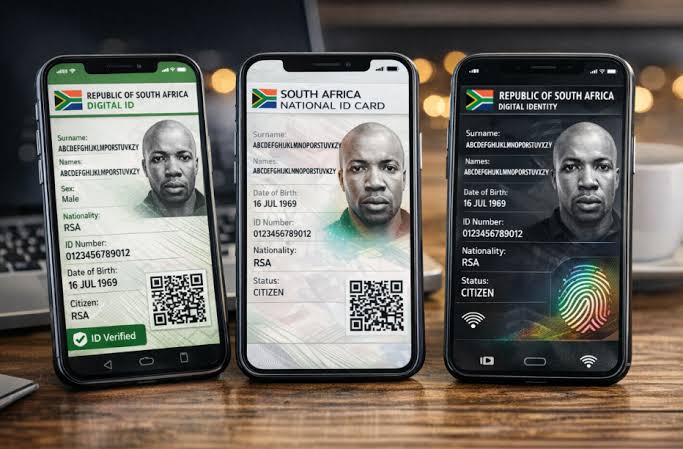
South Africa is attempting to build a national digital identity layer and to finish rewiring its payment rails at the same time — an identity-and-payments bet rather than a compute bet.
Technological Transformation
Most coverage of South African technology in 2026 has followed the money into concrete and fibre: hyperscale cloud regions, GPU clusters, submarine landing stations. That is the private-capital story. The state's story this year is different and, for the roughly 63 million people who have to deal with government, more consequential. South Africa is attempting to build a national digital identity layer and to finish rewiring its payment rails at the same time — an identity-and-payments bet rather than a compute bet. The two halves have moved at very different speeds, and the gap between them is the most useful thing to watch.
The commitment, and the legal machinery behind it
President Cyril Ramaphosa used his 2026 State of the Nation Address to commit the Department of Home Affairs to launching a national digital identity system during 2026, with digital driving licence support, delivered through MyMzansi — the government's unified digital services platform and the public face of the Roadmap for the Digital Transformation of the Public Service.
Home Affairs Minister Leon Schreiber then did the unglamorous part. Draft amended regulations under the Identification Act of 1997 were gazetted for public comment, with the window running to 6 June 2026, establishing the regulatory framework the digital identity system needs to exist in law rather than in a press release. The design choices embedded in those regulations matter more than the launch date. Citizens would be able to store and use secure digital versions of identity documents, birth certificates, marriage certificates and other Home Affairs products on a smartphone, and to confirm their identity remotely using biometric — specifically facial — verification. Crucially, adoption is optional, and Smart ID cards continue to exist in parallel. In a country where the digital divide is a distributional fact rather than a rhetorical device, that parallel track is not a hedge; it is the difference between a reform and an exclusion event.
The physical foundation: Smart ID at scale
A digital identity is only as good as the biometric enrolment underneath it, and this is where South Africa has quietly done the heavy lifting. Roughly 21 million people held Smart ID cards with associated biometrics by the end of 2023. Issuance then accelerated: 3,427,468 Smart IDs in 2024, itself a record, followed by a record four million in 2025 — a 17 percent increase and close to a doubling of historical annual throughput.
The mechanism for that acceleration is a channel change rather than a technology change. Home Affairs has pushed Smart ID services into commercial bank branches, expanding the number of locations where citizens can obtain replacement Smart IDs from 214 departmental offices to 541 sites. By mid-2026, 372 active branches across FNB, Standard Bank, Capitec and Absa were live; Schreiber reported 422,119 applications processed through the partnership in just over four months, and a 47 percent expansion in access within a two-month stretch. More than half a million South Africans have applied for Smart IDs through banks. The target is at least 750 bank branches by the end of 2026, with passports and first-time adult and minor Smart ID applications expected to become available through the same channel. FNB alone is targeting 240 branches by December 2026. Reported turnaround inside a branch is measured in minutes.
Using retail bank footprints as state service counters is an unusually pragmatic answer to a capacity problem, and it is the sort of arrangement that is easy to admire and easy to under-scrutinise. It shifts a core civic function into premises where access is conditioned on being a bank customer — or at least on being comfortable walking into a bank — and it gives four large private institutions an operational role in identity issuance. Neither of those is disqualifying. Both deserve the oversight that a 90-day pilot rarely receives.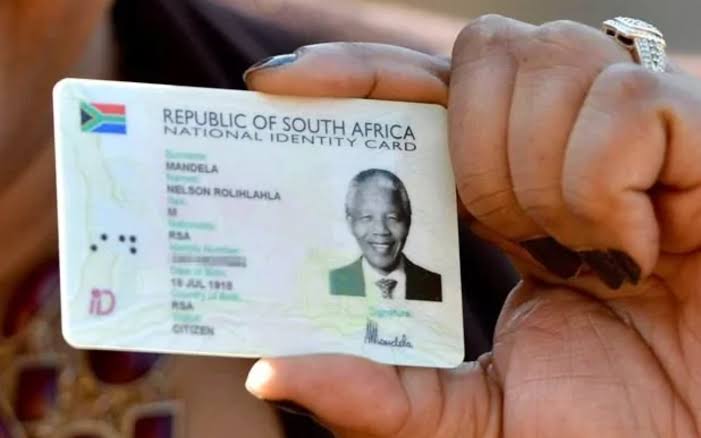
What the roadmap actually promises, and when
MyMzansi's published roadmap is specific enough to be held to. Initiative 1 covers functional digital identity. Project 1.1 sets Phase 1 milestones running from the first quarter of 2025 to the fourth quarter of 2027: a Smart ID drive for citizens still holding green ID books and passports (fourth quarter 2025), launch of a functional digital ID for remote authentication into government services (fourth quarter 2025), Smart ID drives for permanent residents and for grant recipients (both second quarter 2026), and stabilisation of internal departmental systems by the fourth quarter of 2027. The second phase targets 90 percent Smart ID uptake among all citizens by the end of 2028 and the establishment of an independent identity management entity, including custody of biometrics, by the end of 2030.
Project 1.2 is the more interesting half: verified document sharing and a government credentials wallet. Milestones include building the systems for digital verification of information and a wallet capable of carrying education certificates, driving licences and identity documents (second quarter 2026), piloting integration with job search and placement platforms to test whether verified credentials can be used in employment applications (also second quarter 2026), access to 15 additional verified credential sources by the end of 2027, and 30 more by 2030. The stated design principle is selective disclosure — sharing that one is over 18, or holds a particular qualification, rather than handing over a full document — and the architecture explicitly anticipates banks, mobile networks and fintechs offering competing wallets against a government-backed standard. Extending the roadmap beyond Home Affairs, the government has committed to digitising driving licences, matric certificates and Master's Office services, and to accepting police statements online.
The first substantive delivery landed on 12 August 2026, when Ramaphosa launched South Africa's Electronic Travel Authorisation at OR Tambo International Airport after a pilot run during the country's G20 presidency. The ETA combines biometric verification and machine learning with an upgraded Electronic Movement Control System, eMCS 2.0. It is a narrow use case with a well-defined user population — exactly the right place to prove an identity stack before pointing it at 63 million residents.
The payments rail is further along than the identity rail
While digital ID is still moving from regulation to rollout, South Africa's instant payments system has already crossed into ordinary use. PayShap, born out of the South African Reserve Bank's Rapid Payments Programme under its national payment system modernisation strategy, launched on 13 March 2023. From launch to the end of March 2026 it processed over 839 million transactions worth R774 billion. The monthly trajectory tells the real story: 60 million transactions worth R62 billion in December 2025 alone, with monthly volumes averaging roughly 89 million across the first five months of 2026. Absa's PayShap volumes rose 70 percent year-on-year; Standard Bank reported 76 percent. In October 2025 the Reserve Bank acquired a 50 percent stake in PayInc, the entity governing PayShap — a central bank taking direct ownership of the country's retail instant-payment scheme rather than regulating it at arm's length.
On the revenue side of the state, the digital investment is already showing up in the fiscus. The South African Revenue Service collected R2.01 trillion in net revenue in 2025/26, breaking the R2 trillion barrier for the first time on an 8.4 percent increase. Compliance initiatives accounted for R316.4 billion of that, comprising R164.6 billion in direct collections and R151.8 billion in prevented leakage. SARS's Modernisation 3.0 strategy leans further into artificial intelligence and data science, expanded auto-assessment, and — notably for the theme of this article — a unique digital identity for taxpayers. That the agency's long-serving commissioner, Edward Kieswetter, left office at the end of April 2026 makes institutional continuity a live question for a programme whose gains have been closely associated with one executive.
Who gets left out
Every identity-first strategy runs into the same hard constraint: it presumes a device, a connection and a level of digital confidence that is unevenly distributed. ICASA's State of the ICT Sector Report of March 2026 and Statistics South Africa's household data together sketch the boundary. There were 51.7 million internet users in South Africa at the end of 2025, an online penetration rate of about 79.6 percent. Some 82.1 percent of households had internet access from any location in 2024, but only 17.4 percent had a regular fixed connection at home. More than 75 percent of South Africans reach the internet via mobile data, ranging from 80 percent in KwaZulu-Natal down to 65.3 percent in the Northern Cape.
Affordability is split along the same seam. ICASA finds mobile broadband broadly affordable, with a 2GB basket at R152, comfortably inside the 2 percent of gross national income benchmark, while entry-level fixed broadband at R309 sits well above it. Handsets are the quieter problem: 93.8 percent of households reported having a cellphone only in 2025, but that figure does not distinguish a feature phone limited to voice and SMS from a smartphone capable of running a credentials wallet with facial verification. Roughly 740,000 households have no phone at all. A system that assumes a camera-equipped smartphone and intermittent data will work for most South Africans and will silently fail a minority concentrated in precisely the provinces and income deciles that depend most heavily on state services and grants.
The bet, stated plainly
Data centres and GPU clusters buy capability. An identity and payments layer buys reach. South Africa in 2026 is spending its scarce state execution capacity on the second, and the sequencing is defensible: a functional digital ID with a credentials wallet is the input to almost every other digital public service, from remote bank onboarding to healthcare records to verified job applications, whereas compute capacity without an identity layer mostly serves whoever already has an account.
Three risks deserve naming. The first is timetable slippage between the regulatory and the operational: draft regulations closing for comment in June 2026 leave little runway for a same-year launch of a facial-verification system at national scale, and a rushed launch is worse than a late one. The second is data protection. Centralised biometrics plus remote facial verification is the highest-stakes configuration in digital public infrastructure, and the promised independent identity management entity to house biometrics is scheduled for the end of 2030 — four years after the system it is meant to govern. The third is the optionality promise. Parallel physical documents protect the excluded only for as long as parallel channels are genuinely funded and staffed; the history of digitisation programmes is that the analogue queue degrades quietly once the digital one works.
The honest scorecard at the end of 2026 will be simple. Four million Smart IDs a year and PayShap approaching a billion cumulative transactions are real, verifiable progress. A digital identity that exists in gazetted regulations, a wallet pilot, and one working travel-authorisation system is a foundation rather than a transformation. South Africa has built the floor. Whether it has built a building is a question for 2027.



