Written By | Torch Media Africa
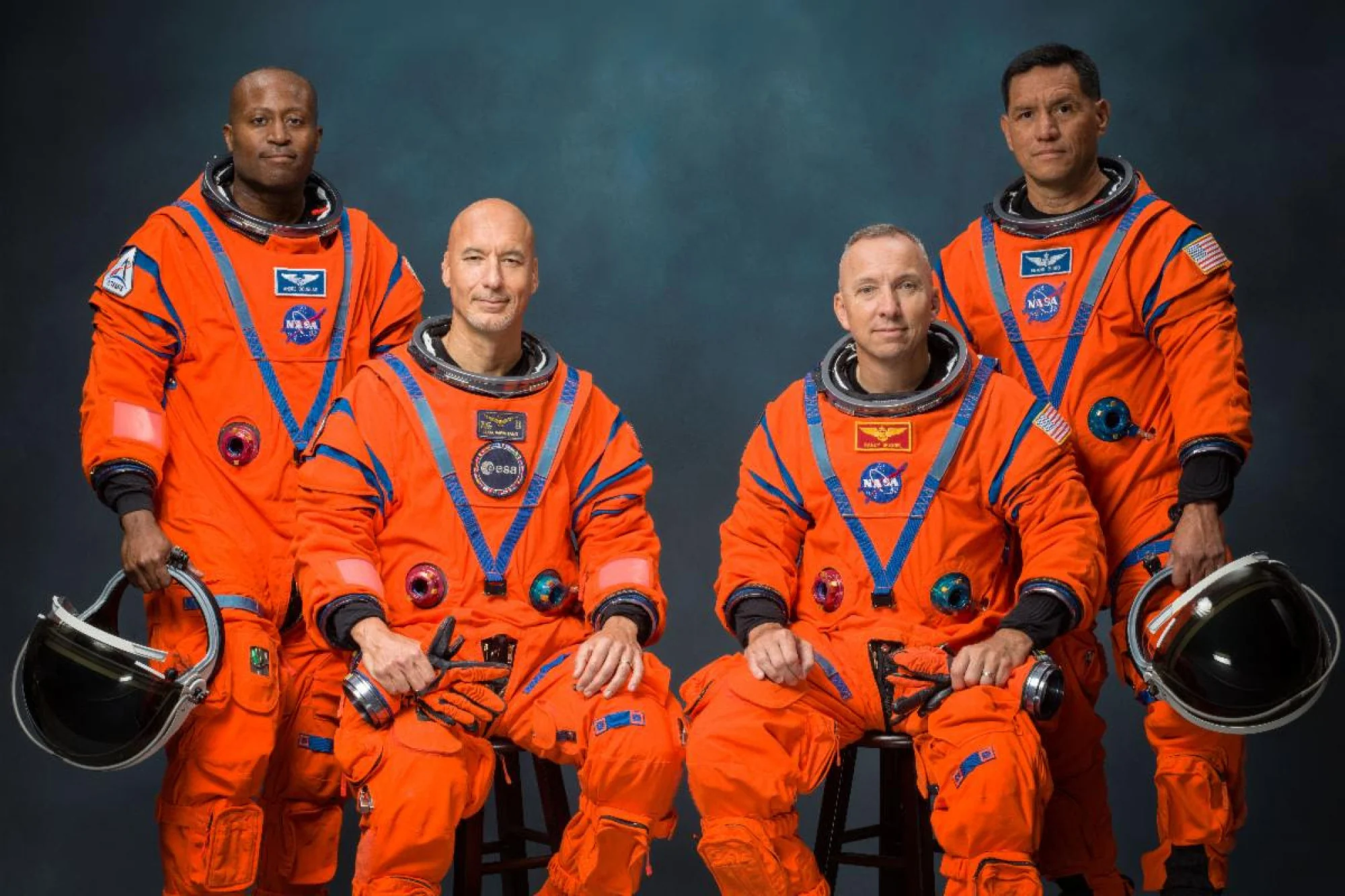
The Artemis III crew just shook hands with the President. Next summer they'll dock with the spacecraft America hopes will put boots on the lunar surface in 2028 — and China is watching every move.
TECH & SCIENCE DAILY
They posed for the cameras in the Oval Office, grinning beside the President of the United States. But the four astronauts who visited the White House on Wednesday 28 October are not heading for a victory lap. They are preparing for what may be the most consequential test flight since Apollo 9 — a roughly two-week mission in low Earth orbit that will decide whether America's plan to return to the Moon in 2028 is a bold schedule or a pipe dream.
The Artemis III crew — NASA commander Randy Bresnik, NASA mission specialists Andre Douglas and Frank Rubio, and European Space Agency pilot Luca Parmitano — were joined at the White House by NASA Administrator Jared Isaacman and backup crewmember Bob Hines. Afterwards Isaacman wrote on X: "It was a great day at the White House with President Trump and the talented crew of Artemis III."
The photo op was the easy part. The hard part starts in a few months, when engineers stack the Space Launch System, run a year-end fueling rehearsal, and aim for a launch window that NASA says opens in the summer of 2027. And hanging over all of it is a rival with its own Moon rocket, its own deadline and, if Isaacman is to be believed, the power to end his career.
Not a landing — a rehearsal
Here is the part that surprised many space fans: Artemis III is no longer a Moon landing. In February, Isaacman disclosed that NASA was changing the mission from a lunar touchdown to a low-Earth-orbit demonstration, saying the Artemis programme was simply not ready to attempt a landing yet. The mission now serves as a dress rehearsal, which Aerospace America compared to Apollo 9, the 1969 flight that tested the lunar module in Earth orbit before anyone dared go to the Moon.
The logic is as old as spaceflight: before you land, you test. The mission is designed to resolve the biggest unknowns while the crew is still only a few hundred miles from home, where a bad day can end in a quick trip back to Earth rather than a catastrophe in deep space.
The catch is that nobody yet knows exactly what the astronauts will be docking with. NASA has selected two commercial landers — SpaceX's Starship and Blue Origin's Blue Moon — and wants to test both. Whether both will actually be ready by next summer is an open question, and the agency has said it is not yet clear which lander or landers will fly.
The two-week itinerary
According to details NASA laid out last month and reported by Aerospace America and Spectrum News, the mission is a tightly choreographed ballet between spacecraft. Blue Moon launches first, followed by the crew in their Orion capsule atop NASA's Space Launch System, lifting off from Launch Complex 39B at Kennedy Space Center.
On flight day three, Orion docks with the Blue Moon test article. Over the next two days, two of the astronauts float into the lander's cabin to evaluate its life-support systems, software, flight computers, avionics and reaction control systems. Blue Moon is capable of staying in orbit for up to a month, but NASA wants to keep the stay short to protect the vehicle.
On day six, a Starship test article launches from Florida. Orion undocks from Blue Moon and then docks with Starship's nose-cone docking system for about two hours. The crew will not enter Starship; this one is about the choreography. Engineers want to learn how to control the attitude of two huge vehicles flying joined together. The rest of the flight is packed with additional tests, including evaluation of the Orion Crew Survival System suits the astronauts wear.
If that sounds like a lot for two weeks, it is. It also mirrors exactly what the real thing will look like: on a future landing mission, astronauts will launch in Orion, transfer to a lander, descend to the surface and come home again. Artemis III is the first time anyone will practise the hand-offs with the actual hardware.
Hardware: progress, and some scorched earth
There is real progress to report. The core stage has been joined with its solid rocket boosters inside the Vehicle Assembly Building at Kennedy, a milestone NASA had targeted for October. Isaacman says the assembly and integration schedule has been cut in half. A year-end "tanking test" — loading the rocket with propellant to check its systems — comes before launch, with a window between May and September 2027 shown on a chart at a recent press conference.
The commercial landers are a more mixed picture. Blue Origin's New Glenn rocket exploded on the pad in May, and the company is aiming to resume pad operations in November, with a return-to-flight launch to follow soon after. NASA says the design of the Artemis III Blue Moon test article is in good shape, but the rocket that must carry it is the schedule risk.
SpaceX, meanwhile, is analysing data from last month's flight, the first time Starship reached orbit, and is building the passive docking system for the Artemis III test lander. The company is targeting November for the next Starship flight. Programme manager Jeremy Parsons and his team will be watching both launches closely, because a slip at either company could ripple straight into the 2027 date.
The real prize: 2028
Artemis IV, planned for 2028, is slated to be the first mission to use a lander for an actual crewed lunar descent — the first American landing since Apollo 17 in 1972. NASA has not yet decided which lander will go first, and both companies are planning lunar landings that year. After that, NASA expects to fly crewed surface missions roughly once a year, with Artemis V targeted for late 2028 using the standard SLS configuration.
Isaacman has framed the goal as something bigger than a victory lap. Lunar terrain vehicles are already being built by Lunar Outpost and Venturi Astrolab, and he has said the aim is a permanent lunar base. "This will not be a repeat of the flags and footprints," he said. After the Moon, the stated next destination is Mars.
It builds on a successful start. Artemis II sent four astronauts around the Moon and brought them home safely, and later engineering analysis confirmed that the Orion heat shield performed as initially indicated — a relief after years of worry about that very component. That crew visited the White House on 29 April, 19 days after splashdown.
The dragon in the room: China
Every NASA schedule slip now comes with a geopolitical footnote. China has set a goal of landing astronauts on the Moon before 2030, and it is not just talking. On 11 February, the China Manned Spaceflight Agency carried out a low-altitude test of its Long March-10 rocket combined with an in-flight abort test of the Mengzhou crew capsule at the Wenchang site in Hainan. It was the first ignition flight for the rocket, which burns liquid oxygen and kerosene in seven parallel engines and is designed to be partially reusable.
The capsule passed the moment of maximum aerodynamic stress, and both the capsule and the first stage landed in their designated recovery zones, with the first stage retrieved from the ocean. A Chinese spokesperson counted five "first-times", including the first sea landing of a crewed return capsule. Mengzhou, whose name means "Dream Vessel", can carry six to seven crew.
Chinese state media describe the lunar plan as a two-rocket approach: one Long March-10 sends a lander into lunar orbit, a second launches the crewed spacecraft to dock with it, and two taikonauts then descend. Isaacman has been blunt about what is at stake. Reporting from USA Today on 29 October quoted him as saying: "If the Chinese beat us back to the moon, I'll be fired."
That is the kind of candour rarely heard from an agency chief. It is also a sign of how tight the race has become. Analysts have argued for months over who really leads, and the answer depends on who you ask and which milestone you count.
What the experts are really saying
The public record shows a clear pattern in how NASA is now talking. Officials stress risk reduction over speed: the Artemis III reboot to Earth orbit was a deliberate decision to find problems early. NASA engineers summed up the approach in four words: "Before we land, we test."
Outside commentators are more divided. Supporters say the shift to an orbital rehearsal shows maturity and protects lives. Sceptics, including voices in the Fox News opinion section, have argued that NASA is already hedging on a 2028 landing. Both camps agree on one thing: the lander programmes, not the rocket, are now the pacing item.
Our analysis: the biggest danger is not that any single piece of hardware fails. It is that three separate schedules — SLS and Orion at Kennedy, Starship in Texas and Florida, and Blue Moon on a New Glenn that is still recovering from May's explosion — all have to line up within a few months of each other. History says that is unlikely to go perfectly. The question is whether the programme has enough slack to absorb a slip without losing 2028.
What this means for you
If you are a taxpayer, this is the moment the Artemis programme starts to show whether it is worth the money. A clean Artemis III would give the public the first proof, with real astronauts and real docking ports, that the commercial-lander model works. A messy one would raise hard questions about cost and schedule right when the Moon race is at its most political.
If you are a space fan, the next few months are a calendar worth circling. Watch for the year-end fuelling test of the SLS, the return of New Glenn to the pad in November and Starship's next flight, also targeted for November. Each is a signpost telling you whether summer 2027 is realistic.
And if you are just curious about the future, consider this: the technology being tested — docking giant vehicles in orbit, keeping crews alive in lander cabins, and practising the hand-offs — is the same stuff needed for a permanent base and, eventually, Mars. The footprints may be a few years away. The groundwork is happening right now.
The bottom line
The Oval Office handshake made for a nice photograph, but the real story of Artemis III is the work that comes next. Four astronauts will spend two weeks in low Earth orbit practising a manoeuvre that has not been attempted with these spacecraft. If it goes well, America will be on track to walk on the Moon again in 2028, over half a century after Apollo 17. If it slips, the race with China gets a lot closer.
For now, NASA says it is on schedule. The crew is training. The rockets are stacking. And the clock, as Isaacman knows better than anyone, is ticking.



