Written By | Torch Media Africa
Kenya wants to host East Africa's artificial intelligence. Its constraint is not ambition — it is megawatts and money
Technological Transformation
Two numbers from 2026 describe Kenya's technology economy better than any strategy document. The first: Kenyan startups raised $126 million (about KSh16.3 billion) in the first half of the year, down 4.1 per cent year on year and the weakest first-half haul since early 2021, pushing Kenya to third place on the continent behind Egypt at $327 million and Nigeria at $254 million. The second: in May, the government suspended a $1 billion geothermal-powered data centre that Microsoft and the Emirati firm G42 had agreed to build at Olkaria, because the project's roughly 1 gigawatt power requirement could not be reconciled with a national installed capacity of about 3 gigawatts.
Taken together they mark a turn in what Kenya's digital economy is made of. For fifteen years the country exported software and product ideas — mobile money above all — on infrastructure it largely rented. The current ambition is heavier: to host compute, store regional data and sell cloud capacity to its neighbours. That is a capital-intensive, energy-intensive business, and Kenya is discovering that the binding constraints are physical.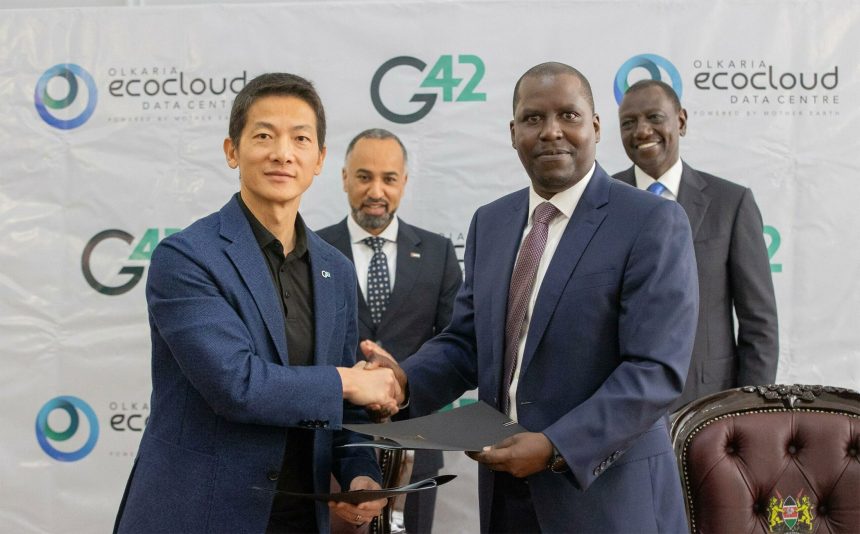
The gigawatt that did not fit
The Microsoft–G42 facility was announced as a flagship: a billion dollars, geothermal power, an AI campus at Olkaria that would have made Nairobi a genuine compute destination rather than a colocation market. It was originally due to be operational by May 2026, two years after signature. By August 2025 both government representatives and Microsoft executives understood the target would be missed, and in May 2026 the plan was suspended. The reported reasons are instructive and unromantic. A project drawing close to a third of national generating capacity cannot be guaranteed firm supply. Even a 100 MW first phase at Olkaria would require dedicated high-capacity transmission before a single rack could be energised, and a concept note seeking funding for that enabling infrastructure was declined by the National Treasury.
This is the ceiling of the title. Kenya's renewable endowment is real — KenGen accounts for roughly 75 per cent of installed capacity and supplied 57.2 per cent of the country's electricity as of September 2026 — but the pipeline is measured in tens of megawatts, not thousands. The utility is accelerating some 253 MW of projects towards 2030, including the Olkaria I rehabilitation, which is expected to add 63 MW on commissioning in December 2026, the 80.3 MW Olkaria VII plant, and roughly 58 MW of wellhead generation expected on the grid by 2027. Those are useful additions to a national system. They are not, on their own, an AI campus.
What is actually getting built
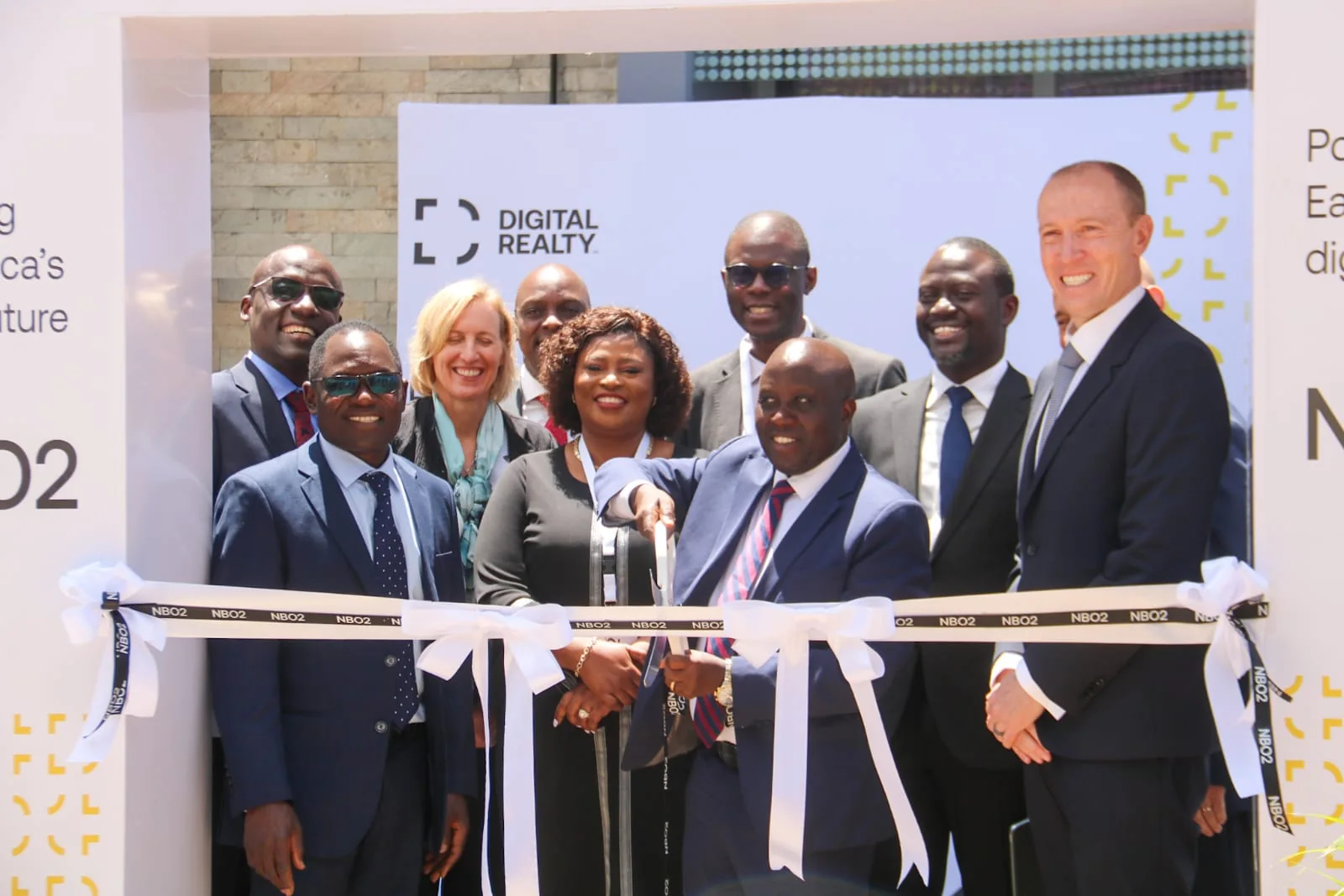
Scaled to the grid that exists, the build-out is proceeding. Kenya already hosts a cluster of carrier-neutral and enterprise facilities operated by iXAfrica, Africa Data Centres, Safaricom and Liquid Intelligent Technologies, alongside the state-owned Konza National Data Centre, which underpins government digital services. Oracle is establishing its first cloud region in the country. The National Treasury's public-private partnership unit has approved a proposal styled the Konza Data Centre, Cloud and Smart City Facilities Expansion, with the government's 2026 investment catalogue listing an expansion of roughly $23 million to add storage and processing capacity for government, business and international clients.
On 13 August 2026 the Konza Technopolis Development Authority signed an agreement with Amazon Web Services covering cloud adoption, skills development and infrastructure alignment. Its most consequential element is work towards an AWS Outposts deployment at Konza — hyperscaler hardware installed locally for hybrid workloads — together with a Startup and Innovation Centre of Excellence offering credits and technical mentorship to founders. It is a smaller commitment than a billion-dollar campus, and a far more probable one.
Policy arrives after the hardware question
The rulebook is being written in parallel. Kenya already had an AI Strategy for 2025–2030, a Digital Master Plan running to 2032 and the Data Protection Act of 2019. In July 2026 the State Department for ICT and the Digital Economy published a draft Kenya Artificial Intelligence and Other Emerging Technologies Policy, opening it to public comment until 4 August. Drafting began in November 2025 under a multi-stakeholder technical working group drawn from academia, government, startups and civil society, and the draft is explicitly framed as closing coordination gaps between the existing instruments.
Substantively, it classifies AI systems by risk level, requires registration for high-risk applications and provides for regulatory sandboxes — an approach recognisably borrowed from European practice but anchored to Vision 2030 and the Bottom-Up Economic Transformation Agenda. Its three working pillars are infrastructure, data and research; skills; and innovation. The ordering is telling. Kenya's policymakers have correctly identified that in an AI economy the scarce input is not regulation or even talent but hosting capacity, and hosting capacity is a power-sector question dressed up as a technology one.
The layer that already works
Beneath the compute debate, Kenya's incumbent digital economy had its strongest year on record. In results for the year to 31 March 2026, Safaricom reported service revenue up 11.1 per cent to KSh414.1 billion and group net income up 67.3 per cent to KSh99.7 billion. M-PESA grew 13.4 per cent to KSh182.7 billion, contributing 45.6 per cent of Kenyan service revenue, and processed 46.86 billion transactions worth KSh41.68 trillion. Active M-PESA customers rose 18.0 per cent to 43.69 million and group active customers 25.4 per cent to 71.56 million, while one-month active merchants grew 72.0 per cent to 3.2 million on the back of the Pochi La Biashara product. The launch of Ziidi Trader extended the platform from payments and savings into securities trading.
Connectivity is similarly mature by regional standards. Active mobile subscriptions reached 84.1 million in the third quarter of the 2025/26 financial year, a penetration rate of 157.7 per cent. Fixed data and internet subscriptions rose 7.4 per cent to 2.46 million, with fibre up 8.3 per cent to 1.38 million and accounting for 56 per cent of wired connections. The fastest-growing segment was satellite, up 11.4 per cent in the quarter: Starlink counted 24,999 subscribers in March 2026, a 12 per cent quarterly increase, ranking eighth among fixed internet providers with a 0.9 per cent market share — small in absolute terms, but the clearest signal that low-earth-orbit capacity is now a structural part of the market.
The continental stake
Why this matters beyond Kenya is set out in a Boston Consulting Group report, Advancing Africa's AI and Digital Economy, published in July 2026. Africa holds 18 per cent of the world's population but less than 1 per cent of global data centre capacity, and its digital economy contributes about 5 per cent of GDP against a global average of 15 per cent. On current trajectories the report projects that share reaching only 8.5 per cent by 2050, even as AI is expected to add an estimated $15.7 trillion to global output by 2030. "Our core challenge is no longer about technology adoption; it is about tech production," says BCG managing director and senior partner Hamid Maher. The risk it identifies is specific: African data is exported, models are trained abroad, and the resulting services are licensed back at cost. Fewer than 2 per cent of Africa's roughly 2,000 languages are adequately supported by large language models.
Kenya's upside if it resolves the constraint is quantifiable. GSMA estimates digital transformation could add around KSh662 billion to Kenyan GDP by 2028 and create roughly 300,000 jobs across agriculture, manufacturing, transport and trade. The IMF, meanwhile, has noted that sub-Saharan Africa continues to lag on AI readiness precisely because of unreliable electricity, limited internet access and inadequate digital infrastructure — the three things Kenya is better placed than most of its neighbours to fix.
The honest version
The honest reading of 2026 is that Kenya's technology story has become a capital and energy story. Venture funding fell not because Kenyan founders got worse but because global capital repriced risk, concentrating fewer, larger cheques in revenue-generating companies. Meanwhile the assets that would define the next decade — transmission lines, firm geothermal supply, hyperscaler regions, Outposts racks at Konza — sit on public balance sheets and multi-year procurement timetables rather than in seed rounds.
That is not a downgrade of Kenya's prospects. It is a different, slower and more consequential contest, and one in which Kenya's comparative advantages are unusually well matched: dispatchable renewable baseload, a functioning data protection regime, deep submarine cable landings, and a payments layer that processed KSh41.68 trillion last year without incident. The suspended gigawatt at Olkaria should be read not as a failure of ambition but as a pricing signal. The country that clears its transmission bottleneck first will host the region's models. On present evidence, Kenya knows exactly which bottleneck it needs to clear.