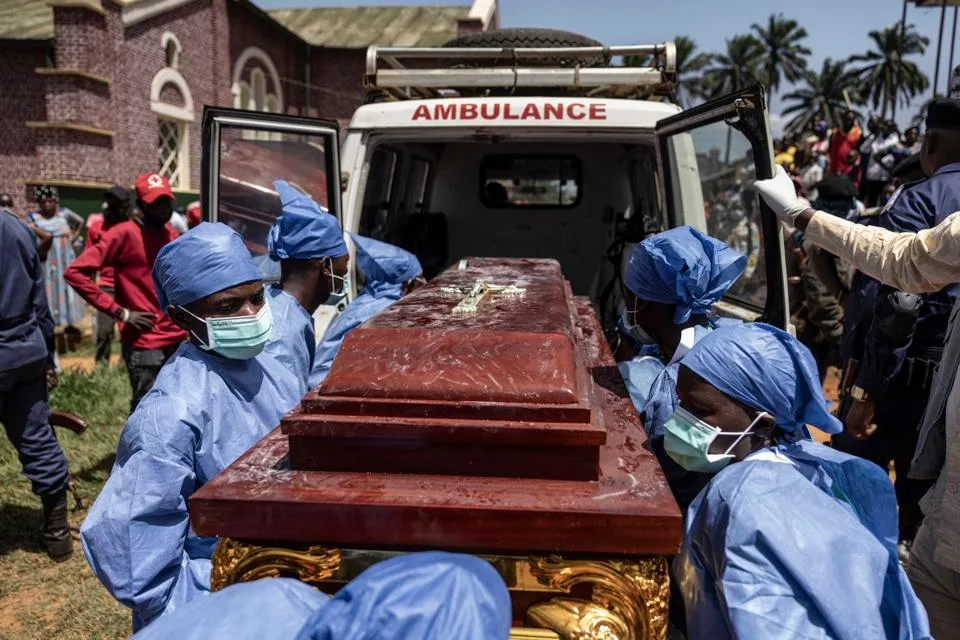
A Kenyan citizen who fell ill a month before travelling slipped out of Congo's outbreak zone, boarded a flight to Nairobi and died in isolation within days. Now 28 contacts and a planeload of passengers are being hunted, while the DRC death toll passes 4,200.
NAIROBI / KINSHASA
He was already sick when he set off. According to reports from Kenyan and international health officials, the man had fallen ill roughly a month before his journey, and in that time he had been treated at several health facilities in the Democratic Republic of Congo. Then, on 2 October, he travelled by road through the town of Beni to Kampala, Uganda. The next day, 3 October, he boarded a flight to Nairobi.
By the time Kenya confirmed on 6 October that he was carrying Bundibugyo virus, a close cousin of the Ebola strain that terrorised West Africa, he was dead. He had been isolated shortly after landing and died on the night of 5 October in a Nairobi isolation unit. He is now the first confirmed imported case of Bundibugyo virus disease in Kenya, and the fourth country to confirm the disease in this outbreak.
For a continent and a world that has been watching the Congolese outbreak with growing dread since May, this is the moment the nightmare scenario stopped being theoretical: an infected traveller, a commercial flight, a major international hub, and a virus for which there is still no licensed vaccine and no approved treatment.
A Journey Across Two Borders
The route the patient took reads like a map of everything public-health officials fear. Beni sits in North Kivu province, one of the hardest-hit regions of the Congolese outbreak, where 1,729 cases had been counted as of 4 October according to the DRC Ministry of Health. From there, the traveller crossed into Uganda and reached Kampala on 2 October. A flight to Nairobi followed the very next day.
Kenya's response was swift on paper. The patient was isolated shortly after arrival, and authorities have now listed 28 contacts, including family members and health workers who cared for him. Officials are also tracing 23 passengers and four crew members from the flight he took. Since May, Kenya says it has screened more than 652,000 travellers and tested 267 suspected samples. Until this week, none had come back positive.
Kenyan Health Cabinet Secretary Aden Duale was quick to reassure the public that the country does not have an outbreak, stressing that the case was imported. That distinction matters, and it is technically accurate: there is no evidence so far of any local transmission inside Kenya. But the next two to three weeks, the period in which contacts could develop symptoms, will determine whether that statement holds.
The World Health Organization has been supporting Kenya's response. Mohamed Janabi, WHO's Regional Director for Africa, put the priority plainly: "The priority now is to move swiftly to detect any further cases." The WHO has also repeated its standing advice against imposing travel or trade restrictions on the DRC, Uganda or Kenya, arguing that such measures tend to push travellers into informal crossings and make tracing harder.

The Numbers Behind The Panic
To understand why one traveller has rattled so many officials, you have to look at the scale of what is happening at the source. This is no small flare-up. According to the DRC Ministry of Health, as of 4 October there were 8,603 confirmed cases, 4,148 deaths and 2,235 recoveries, a case fatality rate of 48.2 per cent. By 6 October, the figures reported in the latest European surveillance update had climbed to 8,728 confirmed cases and 4,205 deaths, with 2,269 recoveries.
That is 63 more cases and 27 more deaths in the space of a single reporting window. The most recent daily report added 59 cases and 34 deaths, with North Kivu accounting for 33 of the new cases and Ituri province for 23.
Ituri remains the epicentre, with 6,450 cases across 28 of its 36 health zones. North Kivu carries 1,729 cases and the highest provincial fatality rate. Overall, cases have now been reported in 64 of the country's 167 health zones across seven provinces. At the time of the latest national report, 896 patients were being cared for in isolation, and 79.7 per cent of identified contacts were under follow-up.
If those figures sound reassuring, a second set of numbers is not. Wessam Mankoula, an epidemiologist at Africa CDC, has warned that contact follow-up currently covers only about 23 per cent of the volume that would be expected for an outbreak of this size. He also cautioned that the recent decline in confirmed cases may partly reflect underreporting caused by insecurity and community resistance. In other words, the apparent slowdown may be an artefact of what health workers cannot reach.
The European Centre for Disease Prevention and Control (ECDC) has gone further, stating that it suspects the outbreak is larger than what has been officially reported.
How We Got Here
The timeline of this crisis is short and brutal. On 5 May 2026, the World Health Organization received an alert about an unknown illness with high mortality in the Mongbwalu Health Zone of Ituri province. Four health workers had reportedly died within four days. On 15 May, laboratory testing at the INRB in Kinshasa confirmed Bundibugyo virus disease, and the DRC Ministry of Public Health declared the country's 17th Ebola outbreak the same day.
Within roughly 48 hours, the WHO Director-General had determined that the outbreak constituted a Public Health Emergency of International Concern, the agency's highest level of alarm. Uganda reported two imported cases, confirmed on 15 and 16 May, and went on to record 20 confirmed cases and two deaths before WHO declared its outbreak over on 25 August. France reported one imported case in June. And only last week, a DRC-based staff member of Médecins Sans Frontières tested positive on 29 September and was medically evacuated to the Netherlands on 1 October.
Each of those cases is a reminder of how mobile this disease has become. Ebola viruses spread through direct contact with the blood or body fluids of a sick or dead person, which is why health workers, caregivers and family members preparing bodies for burial are so often among the first infected. The Bundibugyo species, first identified in Uganda in 2007, has historically killed a smaller share of patients than the Zaire species, but at close to 48 per cent in this outbreak, it is far from mild.
No Vaccine, No Cure
The most frightening fact in this entire story is also the simplest: there is no specifically approved vaccine or treatment for Bundibugyo virus. The licensed Ebola vaccine, Ervebo, is approved for the Zaire species. The DRC has received 70,000 doses, and under a compassionate-use programme 7,775 frontline workers had been vaccinated as of 7 October. Whether it protects against Bundibugyo is unproven. A separate research protocol, known as BRAVO, vaccinated 848 frontline workers, but it is currently suspended because of supply shortages.
There is, however, movement on the science. According to Africa CDC, a Phase Ib trial of the University of Oxford's ChAdOx1 BDBV candidate began in Uganda on 6 October, following earlier Phase Ia trials in Britain that started in July. Moderna's candidate received ethical approval for Phase Ib trials in Uganda on 7 October, after Phase Ia trials began in Canada in early August. These are early-stage studies designed to assess safety and immune response, not to deliver a rapid shield for the people dying right now. But they are the first real glimmers of a purpose-built defence.
For ordinary Kenyans, the practical meaning is stark. If a case is missed, the tools to stop it are the oldest ones in the book: isolating the sick, tracing and monitoring contacts, protecting health workers, and conducting safe burials.
The Voices In The Room
Officials in Nairobi have been careful to stress that the system worked: a sick traveller was identified, isolated and tested. But the death of the patient within days of arrival, and the fact that he had been unwell for around a month and had passed through multiple health facilities in Congo before leaving, raise uncomfortable questions about how an infectious person was able to board a flight in the first place.
Mankoula's warning on contact tracing underlines the structural problem. A surveillance system that covers less than a quarter of the contacts it should be following is a system with holes, and the Kenyan case suggests that infected people can fall through them and keep moving.
The ECDC, meanwhile, maintains that the likelihood of infection for EU and EEA travellers to affected areas is low, and very low for people living in Europe. That assessment dates from its 21 May threat brief. But the agency has also noted that several patients have been medically evacuated to Europe, including to the Netherlands on 1 October and to Germany in July, a reminder that the virus is already being managed on European soil, in specialised units.
What This Means For You
If you live in Kenya, Uganda, or elsewhere in East Africa, the immediate advice from health authorities is to stay informed through official channels and report any fever, vomiting, unexplained bleeding or contact with a suspected case to health services right away. Do not handle the bodies of people who have died from suspected Ebola, and do not treat rumours on social media as medical guidance.
If you are planning travel to the affected areas of the DRC, check your government's current travel advisory and consider whether the trip is essential. The WHO does not recommend travel or trade bans, but it does urge heightened vigilance. If you have returned from an affected area and develop symptoms within 21 days, call ahead to a health facility before presenting yourself so staff can prepare, and tell them exactly where you have been.
If you are elsewhere in the world, the risk remains low. Ebola does not spread through the air like flu or measles. It requires close contact with an infected person's bodily fluids, and people are generally not contagious until they show symptoms. That is exactly why the 28 listed contacts in Kenya are the key to this story. If none of them falls ill during the monitoring window, this will go down as a contained import. If one does, it changes the calculation.
The Bottom Line
One man, one road trip, one short flight. That is all it took for a crisis that began in a remote health zone in Ituri to knock on the door of one of Africa's busiest travel hubs. Kenya has not lost control, and nothing so far suggests it has. But the case is a warning shot fired across a region where the virus is still spreading, tracing is thin, vaccines are experimental and the true size of the outbreak is, by the admission of several agencies, probably bigger than the official count.
For now the world is waiting on a list of 28 names and 27 airline passengers and crew. Their health over the coming weeks will tell us whether Kenya's first Ebola case is the end of a story, or just the first chapter of a much bigger one in East Africa.
This article is based on reporting and official statements from the DRC Ministry of Health, the World Health Organization, Africa CDC, the ECDC and Kenyan government sources, and is not medical advice. Readers who are concerned about possible exposure should contact their local health authority.
Published By | News Editor