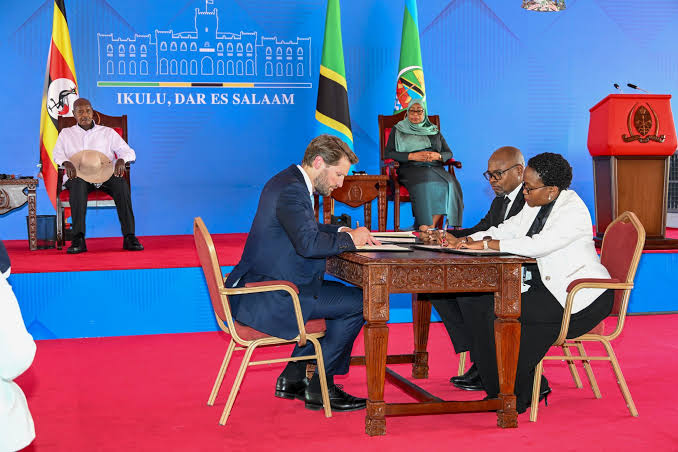
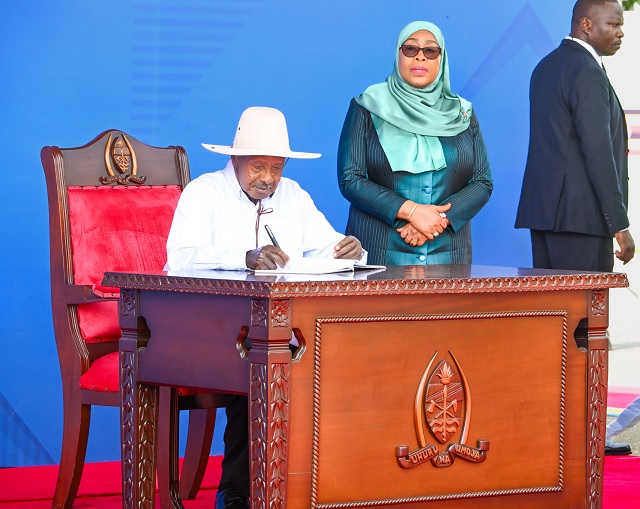
Uganda and Tanzania this week signed a landmark agreement to transform the Tanzanian port city of Tanga into a major regional energy hub, in a deal officials say could ultimately attract more than $20 billion in investment and reshape the flow of oil and refined fuel across East Africa. Presidents Yoweri Museveni and Samia Suluhu Hassan oversaw the signing in Dar es Salaam on Thursday, framing it as the next phase of a deepening Uganda-Tanzania energy partnership.
The agreement, structured as a memorandum of understanding, brings together three parties: the Uganda National Oil Company (UNOC), the Tanzania Petroleum Development Corporation (TPDC), and Vitol Bahrain E.C., the Bahrain-registered arm of Vitol, one of the world's largest independent energy trading firms. Together, the three intend to jointly develop petroleum storage, refining, logistics, trading and distribution infrastructure at Tanga, positioning the port as a supply node not just for Tanzania and Uganda but for landlocked neighbors such as Rwanda.
Tanga's strategic value comes from its geography. The port sits close to the terminus of the East African Crude Oil Pipeline (EACOP), the 1,443-kilometer heated pipeline being built to carry crude oil from Uganda's Lake Albert oilfields to the Tanzanian port of Tanga for export to international markets. By developing storage, refining and logistics capacity at the same location, Uganda and Tanzania are aiming to capture more value from the oil pipeline rather than simply exporting crude, while also using the hub to import and distribute refined products more efficiently across the region.
As part of the broader arrangement, Vitol has entered into a separate seven-year partnership with UNOC to support Uganda's fuel supply and infrastructure programme, backed by financing of up to $2 billion for petroleum storage terminals, pipelines and related logistics. Officials describe the planned Tanga hub as complementary to Uganda's other major oil infrastructure investments, including the 60,000-barrel-per-day Hoima oil refinery under development in western Uganda, which is intended to process a portion of domestically produced crude for the local and regional market rather than exporting all of it as raw crude.
Regional analysts have characterized the deal as more than a straightforward energy-infrastructure investment. For decades, Uganda has relied heavily on Kenya's Mombasa corridor to import refined petroleum products, a dependency that has occasionally exposed Kampala to supply disruptions and pricing disputes with Nairobi. By channeling new investment toward Tanzania's Tanga corridor instead, Uganda is widely seen as building a long-term alternative fuel supply route, reducing its reliance on Kenyan infrastructure and giving it more leverage in regional energy politics. Coverage of the deal in regional trade publications has framed it explicitly as tightening the squeeze on Kenya's traditional fuel corridor.
The timing of the agreement is significant. Uganda has spent more than a decade preparing to become an oil-producing nation since commercially viable reserves were confirmed in the Lake Albert basin, and the country is now targeting first oil production before the end of 2026, having already missed an earlier target set for July. Officials and independent experts have cautioned that the timeline for first oil has proven optimistic before, given the scale and complexity of the Tilenga and Kingfisher upstream projects being developed by TotalEnergies and CNOOC alongside the government, but the Tanga hub deal signals that Kampala and its partners are moving ahead with midstream and downstream infrastructure regardless of exact upstream timing.
The energy hub announcement lands amid a broader improvement in Uganda's economic outlook. The Economic Policy Research Centre's Uganda Business Climate Index rose by 20.1 points to 124.9 in the second quarter of 2026, up sharply from 104.8 in the first quarter, with businesses in transport, trade and hospitality reporting improved expectations as economic activity picked up. Uganda's economy is projected to grow around 6.2 to 6.8 percent in 2026, with growth expected to accelerate toward 8 percent in 2027 as oil production ramps up alongside continued strength in agricultural exports; coffee shipments, one of Uganda's largest foreign-exchange earners, rose 17.5 percent year-on-year between July 2025 and April 2026. The country's GDP is projected to approach $66 billion in 2026, according to figures from the Uganda Investment Authority.
For Tanzania, the deal reinforces President Samia Suluhu Hassan's push to position her country as East Africa's principal energy and logistics gateway, building on Dar es Salaam's existing port infrastructure and its role as the EACOP terminus. Tanzanian officials have described the signed memorandum as a strategic milestone capable of drawing in roughly $20 billion in investment into the Tanga corridor over time, though the agreement itself is non-binding at this stage and will require detailed commercial, financing and regulatory negotiations before construction begins.
Several open questions will determine how quickly the Tanga hub materializes. Financing commitments beyond Vitol's initial $2 billion facility have yet to be finalized, and large East African energy infrastructure projects, including EACOP itself, have a history of extended timelines shaped by financing negotiations, environmental and social impact assessments, and periodic opposition from environmental and human rights groups concerned about the pipeline's ecological footprint and community resettlement issues. Kenyan officials and businesses that currently benefit from Uganda's fuel-import dependency are also likely to watch the project closely, given its explicit aim of diversifying Uganda's supply routes away from Mombasa.
In the near term, attention will turn to how quickly UNOC, TPDC and Vitol move from the signed memorandum to binding commercial agreements, what specific infrastructure gets prioritized first, whether Uganda's first-oil target for the end of 2026 holds, and how Kenya responds to a deal explicitly designed to reduce Uganda's reliance on its fuel corridor. The coming months should also clarify how the Tanga hub project interacts with EACOP's own construction timeline, since much of the strategic logic behind the deal depends on crude oil actually reaching Tanga in meaningful volumes.
Published By | Business News Editor