Written By | International News Agencies
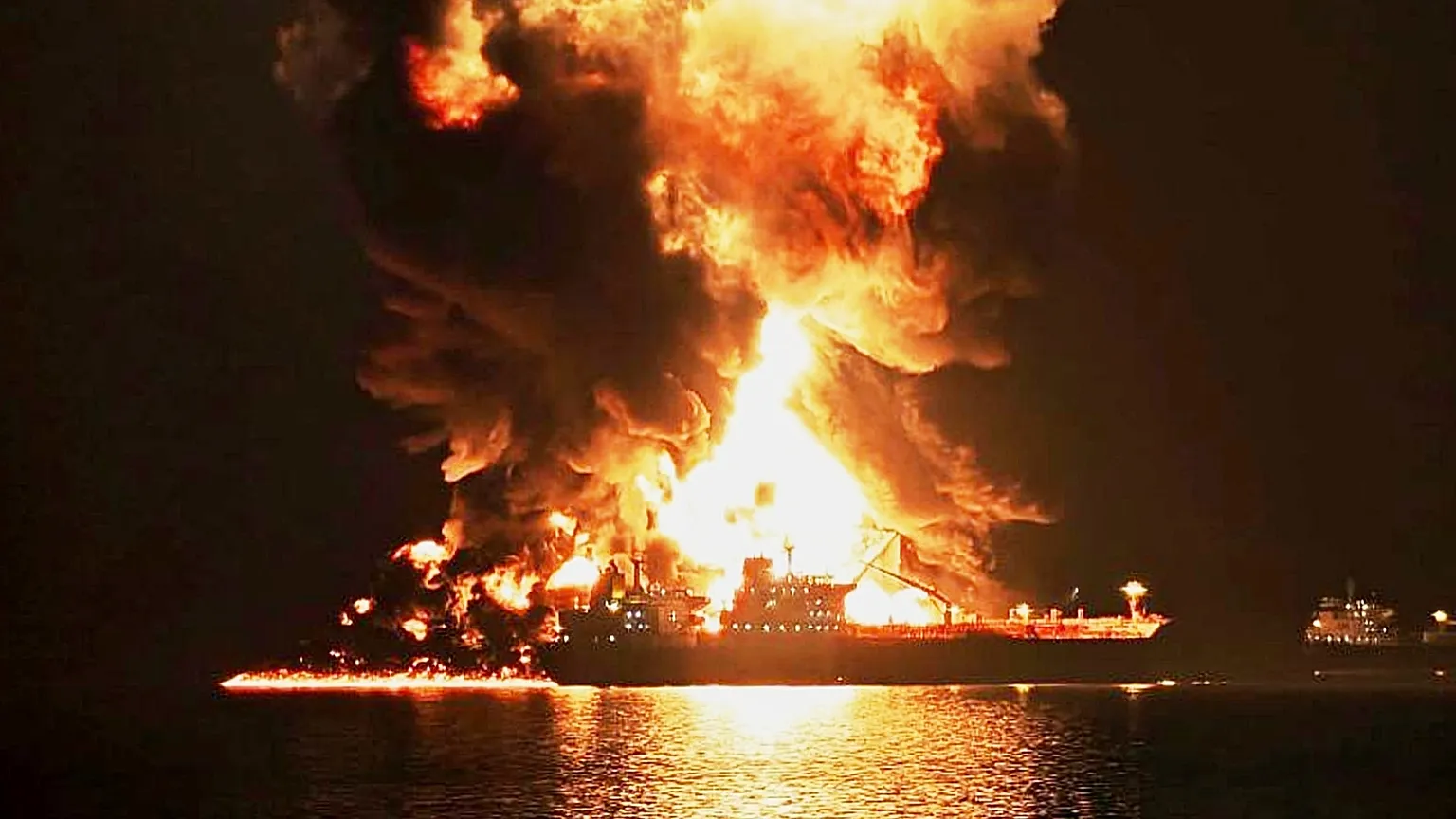
The Revolutionary Guard says it hit four ships and warns it will widen the confrontation to US bases, eight months into a war with no ceasefire and no direct talks.
World Politics
Overview
The war between the United States, Israel and Iran, which began on February 28, took another dangerous turn on Thursday. Iran's Islamic Revolutionary Guard Corps said its navy struck four ships it accused of taking part in illegal oil transfers in the northern Persian Gulf and that three other vessels caught fire after hitting mines west of the Strait of Hormuz. In the same statement the Guard warned that continued American "provocations" could lead it to extend the confrontation to US bases across the region. Iran reportedly claimed that seven tankers in total were hit near the strait. The claims were relayed by Reuters and other outlets and have not been independently verified.
The threat came as the shipping lane that carries a large share of the world's oil remains effectively contested, as American forces maintain a naval blockade of Iranian ports, and as reporting from several outlets suggests that Washington and Jerusalem are drafting plans for a short, intense round of renewed strikes once the US midterm elections on November 3 are over. Brent crude rose about 3 percent to roughly $112 a barrel on the day, according to CBS News. Each of these threads feeds the others, which is why Thursday's developments are being read in capitals as a sign that the conflict may be moving toward a harder phase rather than toward the negotiated exit that mediators have been seeking.
Background: An Eight-Month War With No Settled End
The conflict began on February 28 with the US-Israeli campaign against Iran. Since then it has moved through several stages, including a US-Iran memorandum of understanding signed on June 17, a resumption of strikes around July 8, and a long-running fight over the Strait of Hormuz. Washington has imposed a blockade on Iranian ports and vessels, and Iran has responded by contesting passage through the strait and, according to US and Gulf officials, seeding waterways with mines. A US-led escort effort, referred to in some coverage as Operation Project Freedom, has tried to move commercial traffic through the strait along routes that Tehran says it does not recognize.
No ceasefire is currently in effect. Talks between the two sides are indirect and run through mediators, chiefly Pakistan and Qatar. Iranian Foreign Minister Abbas Araghchi said on Wednesday that those contacts continue, but he accused Washington of "closing the path." According to his account, the United States is trying to add clauses to a seven-day ceasefire proposal that Iran tabled in September and that President Donald Trump rejected at the time. Iran's own package, as described by CBS News, calls for an end to the American naval blockade, the lifting of oil sanctions, the reopening of Hormuz and the release of frozen Iranian assets. Iran's security chief has also rejected the idea of shipping Iran's enriched uranium abroad, one of the central Western demands.
Key Developments on Thursday
The Guard's statement is the most direct warning to American forces in weeks. It framed the threat as a reaction to Washington "urging vessels to pass through mined waterways illegally," arguing that the American escort program puts commercial ships in harm's way and violates Iranian authority over the passage. The Guard said its forces had been tracking the four ships involved in oil transfers since Wednesday before they were hit simultaneously and caught fire. Because the claims come from the Guard itself, the identity, flag and cargo of the vessels, and the number of casualties if any, remain unclear. Maritime security firms and insurers typically take days to confirm such incidents.
Al Jazeera's live coverage also noted Iranian rhetoric that its defence doctrine is turning "offensive," including talk of an invasion, language that analysts treat as signalling as much as planning. President Trump, for his part, denied that Iran is negotiating at all and said the situation would resolve "fairly soon," while also saying the United States is "doing very well with Iran" and is weighing how to win. That position sits awkwardly beside Araghchi's description of indirect talks, and it is not possible from public reporting to say which account is closer to what is actually happening in the mediators' channels.
Regional security is deteriorating around the strait as well. Iran-aligned Houthi forces struck Riyadh's airport on October 10, shutting it for the day. On Wednesday an attack on King Fahd International Airport in Dammam, in Saudi Arabia's Eastern Province, killed people and wounded others; CBS News reported at least two dead and eight injured, while other outlets, including The Hill and Naharnet, reported one killed and eight wounded, a discrepancy that reflects early and shifting casualty counts. The attack was attributed to the Houthis. The State Department has ordered non-emergency US government employees and their families to leave Saudi Arabia, and several American embassies in the region have moved to restricted operations.
The Planning for Renewed Strikes
Alongside the maritime escalation, regional reporting this week says the United States and Israel are drafting plans for renewed strikes on Iran after the November 3 midterms. Those plans are described as short and intensive and as potentially targeting energy sites, nuclear facilities and missile and drone arsenals. The reports also say Defense Secretary Pete Hegseth made a secret visit to Israel and met Prime Minister Benjamin Netanyahu. The Financial Times reported that Trump blocked a planned multiday Israeli strike on Iran around October 10. Netanyahu has publicly denied that Trump stopped any attack, so the question of who is restraining whom remains disputed.
Netanyahu's own words have sharpened the picture. After talks with American officials he said that toppling Iran's regime is the "primary objective," and on Wednesday he said he had directed Israeli forces to work toward that end, according to CBS News and Iran International. That goes beyond the stated US aim of forcing Iran to the table on its nuclear program and the strait, and it raises the prospect of a gap between the two allies over goals even where their timing may align. It also lands nine days before an Israeli election on October 27, in which Netanyahu is trailing in some polls and in which Iran policy is a central theme. Trump, in turn, has said publicly that the United States would not act alone against Iran under a different Israeli leader.
The American Posture and the Domestic Clock
CBS News reported on Wednesday, citing sources, that US forces have been quietly reducing their presence at some Middle East posts because of threats from Iran and the Houthis. A Central Command spokesperson declined to discuss movements "for operational security reasons." A thinner footprint at exposed bases is consistent with a force preparing for retaliation by missiles and drones, and it also reduces the number of targets the Guard's new threat could reach. It sits uneasily with the escort mission in the strait, which keeps American warships close to the mine-affected waters Iran says it will contest.
Politics at home adds pressure. Recent polling shows Trump's approval near record lows, in the low 30s in some surveys, with fuel prices driven by the war cited as a major source of discontent two weeks before the midterms. A spike in crude prices is therefore costly for the administration, which gives it an incentive to avoid a major new offensive before voters go to the polls and a reason, critics argue, to delay any big strike until afterward. Supporters of a tougher line counter that waiting only gives Iran time to rebuild and to tighten its hold on the strait.
Reactions and Regional Dynamics
Gulf governments are caught in the middle. Saudi Arabia is now a direct target of Houthi attacks, and Egypt's president has reportedly backed Riyadh while ruling out an attack on Yemen. Greece said it would implement Iran-linked sanctions after US Treasury measures against a Greek law firm, a sign that the shipping and financial front of the war is widening into Europe. Britain, France and Germany are due to meet counterparts from Turkey, Saudi Arabia, Pakistan and Egypt in Istanbul to discuss the region, including Hormuz, Yemen and the Palestinian issue. Mediators in Islamabad and Doha continue to try to keep the indirect channel open.
Shipping and energy markets are responding in the way that these episodes usually prompt: higher war-risk premiums, rerouted cargoes, and price jumps on every report of a hit. Because the Guard's claims are unverified, traders are reacting to risk more than to confirmed damage, and prices could swing sharply in either direction depending on what independent confirmation shows over the next few days.
What to Watch Next
Several points will determine whether this week is a spike or a turning point. The first is whether the Guard follows its threat against American bases with an actual attack, and whether Washington responds by escalating or by scaling back the escort mission. The second is verification: independent confirmation of which ships were hit, by what, and with what casualties, will shape insurance costs and diplomatic reactions. The third is the mediation track, where Araghchi's claim that Washington is adding clauses to the September proposal will either be answered by a revised US offer or left to harden into a standoff.
The fourth, and the largest, is the calendar. Israel votes on October 27 and the United States on November 3, and multiple reports link the timing of any major renewed strike to the aftermath of those elections. If the planning described this week is accurate, the coming two weeks may be the last window for diplomacy before a short and intense phase of fighting, a prospect that gives every incident in the Gulf an outsized political weight. The risk of a miscalculation, with an unplanned hit on a ship, a base or a civilian airport, is real, and it exists precisely because neither side currently has a direct line to the other.



