JOHANNESBURG
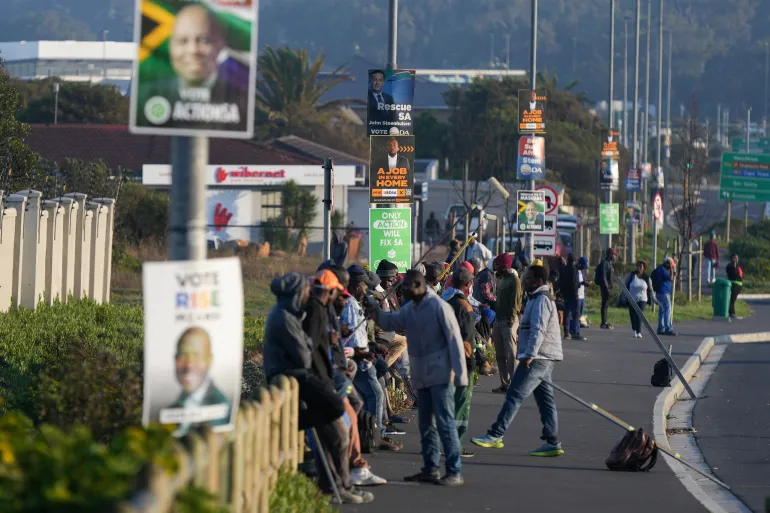
South Africans vote on Wednesday, November 4, in local government elections that will test the Government of National Unity (GNU) formed after the African National Congress lost its parliamentary majority in 2024. With four weeks to go, polls conflict with one another, the ballot is the most crowded in the country's history, and analysts say that coalition bargaining after the vote may matter more than the vote itself.
The setting
President Cyril Ramaphosa proclaimed the date on April 30 at a meeting of the Presidential Coordinating Council in Ekurhuleni, saying that November 4 "will have completed a full five years since [the] 2021 [elections]," according to SAnews, the government's news agency. Under the legal timetable reported by the Daily Maverick, the elections had to be held between November 2, 2026 and January 31, 2027. Ramaphosa also stressed turnout, particularly among young people, and said that "fewer people who vote" is a concern for the health of democracy.
The poll covers all 257 municipalities: 8 metropolitan, 44 district and 205 local, the Rio Times reported. About 29 million voters were registered as of August, with 754,000 new voters added during two registration weekends in June and August, according to Wikipedia's summary of electoral commission data. The election will fill 10,526 council seats.

The national backdrop
The 2024 general election ended the ANC's three decades of parliamentary dominance. The party fell from 57.5 percent to 40.2 percent of the vote, according to the Friedrich Naumann Foundation, and Jacob Zuma's uMkhonto weSizwe (MK) party won 14.6 percent in its debut, which the foundation called the best debut of a new party in South Africa's democratic era. The ANC then formed the GNU with the Democratic Alliance (DA) and eight smaller parties. This is the first major electoral test of that arrangement, according to the Rio Times.
The DA has a new leader. It elected Geordin Hill-Lewis in April 2026 to replace John Steenhuisen, Wikipedia's summary of the election records. Hill-Lewis will run the party's campaign while the DA remains inside the GNU, an awkward position for a party that is simultaneously a governing partner nationally and the ANC's main rival in the cities.
What the polls say, and why they disagree
The headline national numbers come from an Ipsos survey cited by the Rio Times and by IOL: ANC 31 percent, DA 25 percent, MK 14 percent, and the Economic Freedom Fighters (EFF) 11 percent. A separate July poll by the Social Research Foundation put the ANC at 34 percent, the DA at 27 percent and MK at 15 percent, according to Wikipedia. Municipal elections are not national contests, and neither survey is a forecast of the seat count. But they agree on the direction: an ANC well below its 45.59 percent share of the vote in 2021, in a three-party race with the DA and MK.
At metro level the numbers diverge sharply, and readers should treat them with caution. In Johannesburg, the Rio Times reported Ipsos figures of ANC 31 percent and DA 27 percent. The Friedrich Naumann Foundation, citing public polling, reported the DA at 42 percent and the ANC at 18 percent. For Tshwane, IOL and the Rio Times cited Ipsos figures of DA 31 percent and ANC 22 percent, while the foundation cited DA 43 percent and ANC 32 percent. The gap in the figures may reflect different pollsters, dates and methodologies, such as whether undecided voters are excluded; the sources reviewed do not explain the difference. In eThekwini (Durban), MK is projected to lead, with Ipsos showing 55 percent among voters who expressed a party preference, according to IOL. The foundation reported MK at 33 percent, the DA at 23 percent and the ANC at 18 percent. The ANC won 42 percent there in 2021, IOL noted. In Cape Town, IOL reported that the DA is at 46 percent and could exceed 50 percent.
The consistent message across sources is that no party can count on an outright majority in most of the big metros. Professor Theo Neethling told IOL that "no single party can assume or take for granted an outright majority in most of the major metros." Johannesburg, Tshwane, Ekurhuleni, eThekwini and Nelson Mandela Bay are the likeliest to produce hung councils.
The most crowded ballot yet
IOL reported that 136,790 candidates are competing for 10,526 seats, which it called the most crowded ballot in the country's history. The number of registered parties is reported variously: the Daily Maverick said 508 had registered as of April, and Wikipedia's later summary cites 620. Johannesburg's proportional representation ballot alone carries 75 parties, requiring double-column ballots, IOL reported.
Candidate disputes have already reached the courts. The Electoral Court dismissed an ANC challenge against the exclusion of 181 candidates, IOL reported, a decision that affects Eastern Cape municipalities such as Port St Johns and Ngquza Hill, where the ANC has traditionally dominated. The ANC has not announced final mayoral candidates for any of the eight metros, IOL reported, and instead published a list of 42 potential candidates in August. In Johannesburg, the DA's Helen Zille is the leading name in prediction-market pricing: IOL cited a 67.5 percent chance on Polymarket that she becomes the next mayor. That is a betting-market figure, not a poll.
Voter alienation
Ipsos found that "nearly half of South Africans feel politically homeless," the Daily Maverick reported. Turnout could fall to about 42 percent, from 45.79 percent in 2021, IOL reported, with young, unregistered citizens a "missing" constituency. Ramaphosa himself identified the failures voters see most directly. He cited "ageing infrastructure, illegal connections, inadequate metering, weak monitoring, poor maintenance" in water services, which he said affect nearly every municipality. Crime, corruption, unemployment and failing infrastructure feed the disillusionment, the Daily Maverick reported.
The paradox is that low turnout could magnify the weight of parties with disciplined, committed supporters. None of the sources reviewed offers a turnout-weighted projection, so how low turnout would redistribute seats is unknown.

The coalition question
The central issue is governance after the count. South Africa, the Naumann Foundation noted, "has no statutory coalition framework governing coalition formation and running." The Rio Times headlined its coverage with growing coalition fears in Johannesburg. A proposed Coalition Bill would set a legislative structure for hung councils, including coalition agreement provisions and mechanisms to remove office-bearers, IOL reported, but the sources reviewed do not indicate it will be in force by November 4.
Smaller parties stand to be kingmakers. ActionSA is reported by IOL to have double-digit support in Johannesburg and Tshwane and to bolster the DA in Ekurhuleni. The EFF is in contention in Buffalo City with 27 percent in the Ipsos figure cited by IOL. The party arithmetic therefore points in different directions: an ANC-DA arrangement mirroring the GNU, a DA-led combination of smaller parties, or arrangements involving MK or the EFF that would cut across the national coalition's logic.
Analysis: a test with two audiences
The first audience is domestic. If the ANC loses control of one or more of its remaining big-city strongholds, it will face pressure inside the party and within the GNU to defend its place as the senior partner. If the DA does less well than polls suggest, Hill-Lewis, only months into the job, could face questions about the cost of being in government with the ANC.
The second audience is financial. The Rio Times argued that the results will signal whether coalition governance can stabilize or whether fragmentation will deepen, with consequences for investor confidence and the rand. That view is an analytical judgment rather than a measured effect, but it reflects a widely held assumption that municipal instability feeds through to service delivery and, eventually, to confidence in the national government.
What to watch
In the next four weeks, watch for the ANC's announcement of its metro mayoral candidates, for any new Ipsos or other credible metro polling that narrows the divergent estimates, and for movement on the Coalition Bill. Watch also whether the DA and ANC pledge to cooperate after the vote or campaign in ways that make cooperation harder. On election night, the first signals will be turnout against the 45.79 percent baseline and the MK result in eThekwini. The real outcome may not be known until the councils meet to elect mayors, which, in a fragmented system, is where this election will actually be decided.
Published By | News Editor