Written By | Fashion and Design Desk
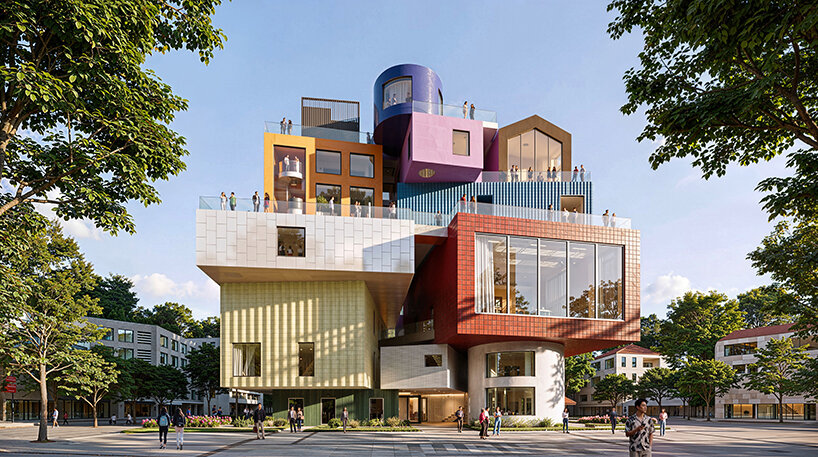
Dutch firm MVRDV's Bihailou Art Village stacks a museum, a theater and a marketplace into one colorful structure at the Hong Kong border — and reimagines what a single building can be.
SHENZHEN, CHINA
In the Shatoujiao district of Shenzhen, a few hundred meters from the fenced border crossing into Hong Kong, a new kind of civic building is rising — one that refuses, almost on principle, to look or behave like a single building at all.
Bihailou Art Village, designed by Rotterdam-based firm MVRDV and now under construction, is a 6,500-square-meter mixed-use cultural complex that stacks a museum, retail spaces, restaurants and a double-height performance theater into a jumble of individually shaped, individually colored volumes. Renderings released this month by the firm show a structure that looks less like a conventional facade than a small town compressed vertically — a literal architectural translation of MVRDV's long-running "Vertical Village" concept, applied here to one of China's fastest-changing border districts.
A Building Designed to Look Like Many Buildings
The concept driving Bihailou Art Village is disarmingly simple to describe and considerably harder to execute: rather than wrapping a cultural program in a single unified envelope, MVRDV gave each function — the museum, the theater, individual retail units, dining spaces — its own distinct architectural volume, complete with its own shape, material palette, color scheme, and dedicated entrance. The result is a composition that reads, from a distance, as a spectacular abstract stack of colorful boxes, and up close as an intimate sequence of individually scaled spaces.
"Though it may look like something that has never been done before, it is in fact a remix of the surrounding village: combining the colours, materials, and shapes of both its neighbours and the restaurant that once stood on this site," said Winy Maas, MVRDV's founding partner and the project's lead designer. The building's palette and massing are drawn directly from the low-rise village fabric of Shatoujiao itself, a neighborhood whose character predates Shenzhen's transformation into a mega-city over the past four decades — meaning the tallest, most photographed new building in the district was designed, deliberately, to reference the smallest and oldest structures around it.
Circulation through the building is where the "village" metaphor becomes structural rather than just decorative. An external network of staircases, ramps, escalators and elevated walkways connects the stacked volumes, all of it left publicly accessible regardless of whether individual venues inside are open. Visitors can wander the building's exterior circulation network at any hour, climbing toward rooftop terraces that open onto views of the surrounding mountains, the city skyline and Shenzhen Bay, whether or not they've bought a ticket to whatever exhibition or performance happens to be running that day.
Public Space as the Point
That decision — to make the connective tissue of the building permanently public, independent of programming or operating hours — is central to what Maas calls the project's civic ambition. "The joy of this design lies in its contradictions," Maas said. "It looks spectacular from afar, and up close, there is an intimacy to each space." The stacked geometry also creates practical shelter at ground level: overhangs formed by the offset volumes above provide cover from sun and rain for pedestrians moving through the site, a small but deliberate gesture toward comfort in a subtropical climate where both are near-daily concerns.
Border Architecture With a Cultural Mandate
Shatoujiao's position — wedged against the fence line that separates mainland Shenzhen from Hong Kong's New Territories — gives Bihailou Art Village a symbolic charge beyond its architecture. Border districts across the Pearl River Delta have increasingly become sites of ambitious cultural investment as Chinese cities compete to define what a 21st-century creative economy looks like at their literal edges — part economic development strategy, part soft-power statement to visitors crossing between two very different administrative and cultural systems within minutes of each other.
For MVRDV, a firm that built its international reputation on provocative, often polarizing large-scale interventions — from Rotterdam's Markthal to Seoul's Skygarden — Bihailou Art Village continues a design philosophy the practice has pursued for over two decades: that density doesn't have to mean uniformity, and that a single large structure can still contain the visual and experiential variety of an entire streetscape.
What This Means for Visitors and Cities Alike
For visitors, the appeal is immediate and legible even from renderings alone: a cultural destination that promises to reward both a five-minute walk-through and a full afternoon, thanks to its permanently open public circulation and rooftop terraces. For urban planners and architects watching from elsewhere, Bihailou Art Village is a working test case for a question more cities are quietly grappling with — how to build cultural density at a human scale, without resorting to either a monolithic single-use tower or a sprawling low-rise campus that eats up increasingly precious urban land.
The Bottom Line
Bihailou Art Village won't open for visitors for some time yet, but its renderings have already done what the best architecture proposals do: reframed a familiar typology — the mixed-use cultural center — as something genuinely unfamiliar. In a neighborhood defined by its border fence, MVRDV has designed a building whose entire architectural argument is that walls, even stacked ones, don't have to separate anything at all.
The project also lands at a moment when Chinese municipal clients are increasingly willing to greenlight architecturally ambitious cultural buildings as a form of urban marketing, wagering that a striking silhouette can do for a district what decades of conventional planning could not. Shenzhen in particular has used this playbook before, transforming itself from a fishing village into a design-forward metropolis within a single generation. Whether Bihailou Art Village becomes the next widely photographed symbol of that transformation — or simply one more ambitious rendering that gets quietly value-engineered before completion — will depend on how faithfully its stacked, contradictory geometry survives the gap between architect's vision and finished construction, a gap that has swallowed no shortage of equally bold proposals before it.



