Written By | Staff Writer
How Lake Albert's first oil and a record coffee harvest are reshaping East Africa's fastest-accelerating economy — and why poverty and debt still shadow the story
BUSINESS
A Rare Double Boom
Uganda enters the second half of 2026 in an unusual position for a low-income East African economy: two of its export sectors are booming simultaneously. On one side, the country is on the verge of becoming an oil exporter for the first time, with the Tilenga and Kingfisher fields on Lake Albert nearing completion. On the other, Uganda has just overtaken Ethiopia to become Africa's leading coffee exporter, riding a global price surge. Together, these two stories are driving some of the fastest growth forecasts on the continent, even as debt sustainability warnings and a still-high poverty rate complicate the picture.
The African Development Bank projects growth of 6.2% in 2026, accelerating to 8.0% in 2027 as oil production ramps up, while the IMF's July 2026 Article IV consultation put growth at 7.5% for 2026 and flagged the prospect of near double-digit expansion in fiscal year 2026/27 once crude begins flowing. The World Bank's own baseline sees growth reaching 6.8% in 2026 before a further acceleration in 2027 and 2028 as oil output ramps up. All three institutions agree on the underlying driver: large-scale capital investment tied to the East African Crude Oil Pipeline (EACOP) and the associated upstream fields, which has been supporting construction, services, and import activity even before a single barrel has been exported.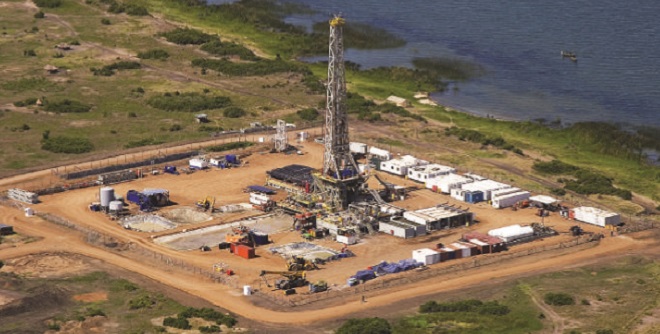
Lake Albert's Long-Awaited First Oil
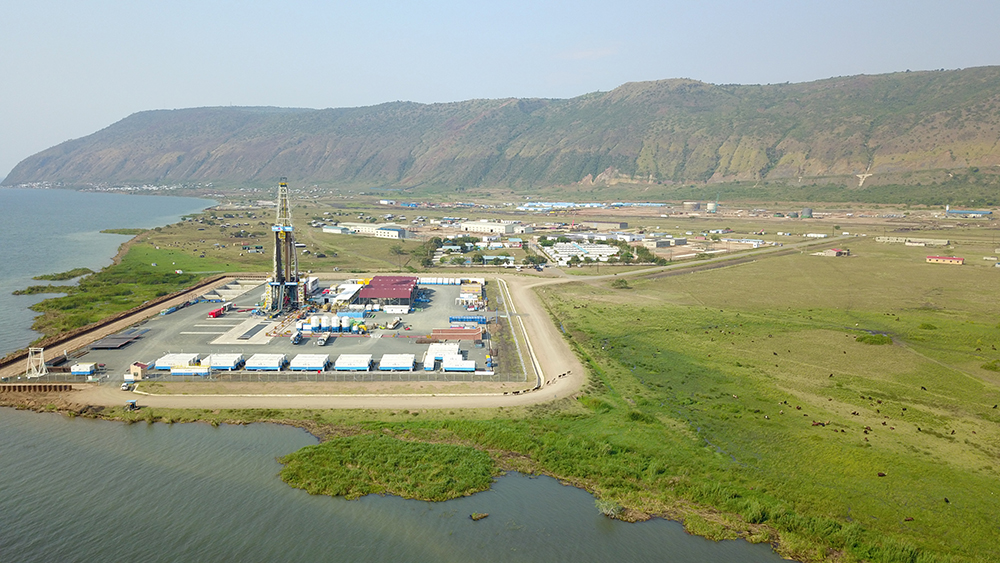
Uganda's oil ambitions date back more than a decade, and the timeline for first oil has slipped repeatedly — a point Ugandan media has tracked closely, with the Monitor newspaper cataloguing how the government has missed successive targets. But by mid-2026 the physical progress is difficult to dispute. The Tilenga development, operated by TotalEnergies, was reported at 74% complete as of June 2026, with 234 wells drilled — comfortably past the 170-well minimum required to begin production. The smaller Kingfisher project, operated by China's CNOOC, had reached 79% completion, with its Central Processing Facility and feeder pipeline nearing finish.
Once online, Tilenga is expected to add roughly 149,000 barrels per day and Kingfisher a further 27,000 barrels per day. The export route, the 1,443-kilometre-plus EACOP linking Uganda's oilfields to the Tanzanian port of Tanga, stood at around 90% overall progress in mid-2026, according to project updates compiled by African Energy and Uganda's Ministry of ICT and National Guidance. Government officials have pointed to the second half of 2026 as the target window for first commercial oil, with some industry trackers, including the Observer, reporting an October 2026 export target, even as independent analysts such as the Institute for Energy Economics and Financial Analysis (IEEFA) have urged caution about repeated timeline slippage and the fiscal assumptions built into Uganda's budget planning.
The stakes are large. Oil is expected to transform Uganda's trade balance and government revenue over the coming decade, and the AfDB's growth acceleration to 8.0% in 2027 is explicitly premised on oil output hitting its stride. But the experience of other new producers is a reminder that first oil is a milestone, not a guarantee — production ramp-up curves, global price cycles, and local content commitments will all shape how much of that value stays in Uganda.
Coffee's Record Run
While oil dominates headlines, it is coffee that has already delivered a windfall. Uganda's coffee exports totalled 8.8 million 60-kilogram bags in the year ending April 2026, generating roughly $2.4 billion — a 28% increase in volume and a 36% increase in value over the prior year, according to figures compiled by the Uganda Investment Authority and the US Department of Agriculture's Foreign Agricultural Service. Separately, industry tallies for the twelve months from June 2025 to May 2026 show Uganda shipping 8.6 million bags, enough to move past Ethiopia as the continent's top coffee exporter by volume.
Italy remains Uganda's largest buyer, followed by Sudan, Germany, India, Morocco, China, Spain, the United States, Belgium and Portugal — a spread that reflects both traditional European demand and Uganda's proximity to regional and Asian markets. The USDA's Coffee Annual report forecasts total production for the 2026/27 marketing year rising to 7.2 million bags, with exports projected at 6.8 million bags, suggesting the boom has further room to run even if year-on-year growth rates moderate.
The coffee story also intersects with Uganda's push to capture more value from the African Continental Free Trade Area (AfCFTA). Uganda's coffee exports are valued at roughly $1.5 billion annually in raw form; officials and trade advocates argue that AfCFTA's harmonised rules and reduced tariffs create an opening to shift toward processed and branded coffee products rather than raw green beans, capturing higher margins within the continent's own 1.3-billion-person market rather than exporting the value-add opportunity abroad.
The Debt and Fiscal Balancing Act
Growth acceleration has not come without cost to Uganda's fiscal position. Public debt is projected to climb to 55.5% of GDP in the current financial year, up from 52.3% in FY2024/25, according to Ugandan Ministry of Finance figures reported in local media, and up further still from 50.9% at the close of FY2024/25 by an earlier measure. The IMF-World Bank Debt Sustainability Analysis published in February 2026 classified Uganda's risk of external and overall public debt distress as moderate, but with limited space to absorb further shocks.
The IMF's July 2026 Article IV consultation was explicit about the mechanics behind the deterioration: higher public spending, limited access to concessional financing, and a growing reliance on more expensive domestic borrowing have widened the fiscal deficit and pushed up debt levels, with debt service costs now exceeding one-third of government revenue. That is a meaningful constraint for a government simultaneously trying to fund oil-sector infrastructure, service a young and fast-growing population, and avoid crowding out private credit through heavy domestic borrowing. The Fund's own technical assistance report from December 2025 on Uganda's public debt statistics underscored ongoing concerns about data quality and transparency in the debt figures themselves — a governance issue that compounds the underlying fiscal risk.
Poverty: Progress, But From a High Base
Social indicators show a similarly mixed picture. The World Bank's 26th Uganda Economic Update, subtitled 'Cultivating Prosperity Through Agro-Industrialization,' estimated that poverty measured against the national poverty line declined modestly to 51.5% in FY2024/25 from 52.9% the year before. Measured against the international extreme poverty line of $2.15 per day (2017 PPP), poverty stood at 41.3% in 2024. The Bank's outlook anticipates further, gradual declines in 2026 and 2027, but the pace remains slow relative to the scale of the challenge in a country where roughly 70% of the workforce remains tied to agriculture.
This is the tension running through Uganda's current moment: extractive and export windfalls are lifting aggregate growth figures into some of the highest in Africa, but translating that into durable poverty reduction depends on how effectively oil revenues and coffee earnings are channelled into broad-based investment — in agro-industrialization, infrastructure, and human capital — rather than being absorbed by debt service or concentrated in capital-intensive sectors that generate relatively few jobs directly. The World Bank's own framing of its latest Economic Update, built around agro-industrialization rather than oil, is itself a signal of where multilateral advisers believe the more inclusive growth opportunity lies.
What to Watch
Three signals will determine whether 2026 marks a genuine inflection point for Uganda's economy. First, whether Tilenga and Kingfisher deliver first oil within the government's stated window rather than slipping again, given the pattern of missed targets that has characterized the project since its inception. Second, whether coffee's price-driven boom proves durable as global supply responds to higher prices, or whether Uganda's gains prove cyclical. Third, and most consequentially for ordinary Ugandans, whether the government can stabilize its debt trajectory — currently on a rising path toward and past 55% of GDP — while still funding the agro-industrialization and infrastructure investment that multilateral lenders argue is the more sustainable route to reducing poverty than extractive windfalls alone.



