Written By | International News Agencies
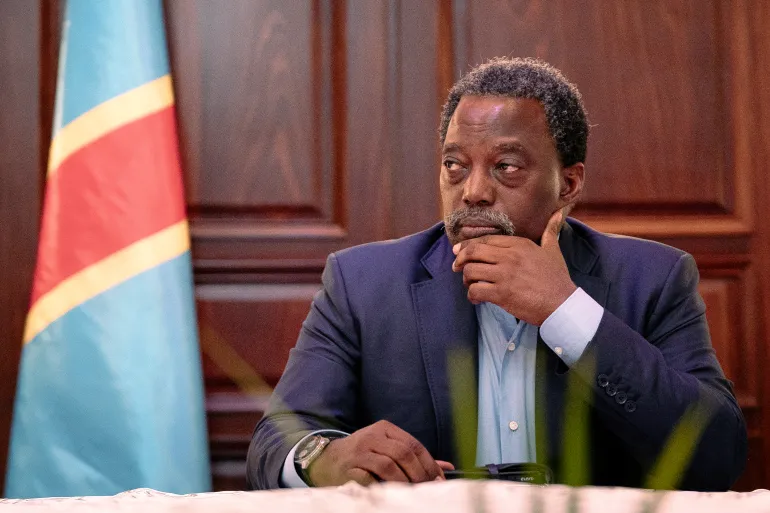
Joseph Kabila, who ruled the Democratic Republic of Congo for 18 years, has returned to the political stage as the head of an armed coalition
GOMA, Democratic Republic of Congo
Joseph Kabila, who ruled the Democratic Republic of Congo for 18 years, has returned to the political stage as the head of an armed coalition. On Monday, he launched the Front for the Refoundation of the Nation (FRN) at his residence in Goma, a city the M23 rebels have held since January 2025. The new movement merges Kabila's political following with the rebels who control much of eastern Congo. Its spokesman says it will end "tyranny by any means necessary, including the use of force." The announcement arrives while African Union mediators are still shuttling between Goma, Kigali and Kinshasa, and it threatens to turn a rebellion that Kinshasa describes as a Rwandan proxy war into a direct contest between two longtime rivals for control of the state.
What was announced
Coalition adviser Claude Ibalanky unveiled the FRN at a news conference held at Kabila's Goma home on Monday, Oct. 12, according to reports by The Associated Press and RFI. The Associated Press, as republished by ABC News, reported that the front includes the M23 rebels as well as the armed groups formerly united under the Congo River Alliance (AFC). Corneille Nangaa, the alliance's former leader, will serve as one of the FRN's four vice presidents, the AP reported. RFI described the movement as "politico-military" and said it will combine the resources and forces of Kabila's supporters and the M23 fighters. Al Jazeera, reporting on Oct. 13, said Kabila will lead the movement alongside rebel leaders and that Nangaa will be one of his deputies.
Ibalanky said the front aims to "unite and coordinate all resistance forces." He said the signatories had "decided to pool their forces, resources, and means" to liberate the country, and that their goal is to restore the pillars of a functioning republic. RFI reported that the founding documents were signed on Oct. 12. Neither the AP nor Al Jazeera had received a response from the government of President Félix Tshisekedi when they published their reports.
Who is Joseph Kabila?
Kabila, 55, took office in 2001 at the age of 29, after his father, Laurent-Désiré Kabila, was assassinated. He governed until 2019. After his constitutional term ended in 2017, he delayed elections for two years, the AP noted. In the December 2018 election, the candidate he backed lost to Tshisekedi, his longtime rival, who has governed since 2019. RFI reported that he has largely stayed out of public view since leaving office.
His legal and financial position has deteriorated sharply. Last year, a Congolese high military court sentenced him to death in absentia for treason, war crimes and crimes against humanity. The court found that he collaborated with Rwanda and with M23. Kabila denies the charges and calls the case politically motivated. Earlier this year the United States imposed sanctions on him over his alleged role in funding and supporting rebel groups in eastern Congo. Congolese authorities also accuse him of being a driving force behind the AFC, an accusation he denies, according to RFI. The FRN launch effectively converts that disputed allegation into an openly declared alliance.
The battlefield he is joining
M23 is one of roughly 100 armed groups competing for control of Congo's mineral-rich east, which borders Rwanda, the AP reported. The group's leadership is drawn largely from the Congolese Tutsi community, RFI noted. It launched an insurgency in 2012 and returned to arms in late 2021. Last year it captured Goma, the capital of North Kivu province, and other key cities in a rapid advance. Al Jazeera's correspondent in the region said the rebels now hold Goma and Bukavu, the airports and key border crossings with Rwanda and Uganda, and that the government has been unable to push them back. Congo, the United States and United Nations experts accuse Rwanda of backing M23. Rwanda denies this.
The conflict has produced one of the world's largest humanitarian crises, and eastern Congo has been affected by armed violence for more than three decades, RFI noted. Several diplomatic tracks have tried to end it, among them African Union mediation, the East African Community, the Southern African Development Community, the Washington process and the Doha dialogue, according to the AP. Their results have been limited. A Washington-backed agreement between Kinshasa and Kigali signed in December "has produced little change on the ground," RFI reported, and a Qatari-mediated ceasefire process agreed between Kinshasa and M23 in July 2025 has not stopped the fighting. Al Jazeera reported that the government and M23 agreed in August on a roadmap for peace talks, and that representatives are expected to meet in Qatar in November.
Why the timing matters
Two political threads converge in this announcement. The first is the peace process. The AU Panel of Facilitators has been traveling between Goma, Kigali and Kinshasa to bridge the parties' positions, the AP reported. A united political and military opposition gives Kinshasa a new adversary and may complicate any deal that assumed M23 would negotiate alone. Yvon Muya, a researcher at the University of Ottawa, told Al Jazeera that the front signals "direct confrontation" between Kabila and Tshisekedi and predicted "an escalation on the military front." He said M23's integration into the new front makes the Doha process hard to see working and risks jeopardizing it.
The second thread is domestic and concerns Tshisekedi's own future. His second and final five-year term is due to end in 2028. RFI reported that figures in the presidential majority have recently raised the possibility of constitutional changes, which has alarmed the opposition over whether the term limit could be revised. Al Jazeera added that Tshisekedi's allies have been preparing public opinion for changes to the two-term limit as rebel activity intensifies, and that police cracked down in September on protests against constitutional change, where hundreds had demonstrated against a third presidential term. Kabila, in other words, is positioning himself as an alternative at the moment when critics accuse the sitting president of looking for a way to stay.
Kabila's military pedigree adds a further risk. Al Jazeera's correspondent said that because Kabila is a former army chief, there are fears government soldiers could defect to him. That concern is a reporter's characterization of anxieties in the region rather than evidence that defections have begun, and no source reviewed for this story documented any.
Reactions and what is not yet known
As of Thursday, the sources reviewed for this story reported no formal government reaction to the launch. The Associated Press noted that Kabila has faulted Tshisekedi for "choosing war" over peace, according to a headline linked from its report, though the full statement was not available for review. The same coverage pointed to other recent diplomatic activity, including Rwandan President Paul Kagame's hosting of the AU peace panel in Kigali. Al Jazeera separately listed AU-hosted talks in Kigali on Oct. 13 amid continued fighting in the east. Details of those discussions, and whether they addressed the FRN, were not available in the sources reviewed.
Several basic facts about the front also remain unclear. RFI said it had no details on the FRN's governance or membership beyond Kabila's leadership. Reports differ on the exact leadership structure, with the AP describing four vice presidents and Al Jazeera referring to deputies, so the precise arrangement should be treated as unsettled until the front publishes it. No source reviewed gave numbers for fighters under the front's command, and none described any change in battlefield positions since the announcement.
Analysis: the rebellion acquires a political head
Until now, M23 and the AFC could be portrayed in Kinshasa and in Western capitals primarily as a Rwandan-backed insurgency. Kabila's presence changes the framing. A former president with a national name, his status as a former army chief and a long-running rivalry with Tshisekedi gives the rebels something they lacked: a claim to national legitimacy that does not depend on the east alone. The AP observed that the group's inclusion gives the FRN "battlefield credibility" while Kabila brings national stature. Whether that combination persuades ordinary Congolese is another matter. Kabila's own record, including the two-year election delay and the allegations of Rwandan collaboration that Kinshasa has pressed against him, makes him a polarizing figure. The AP noted that it is unclear whether he can unite Congo's fragmented opposition.
For Tshisekedi, the launch is both a threat and an opportunity. It validates his government's long-held argument that Kabila is in league with the rebels, which may help him rally nationalist sentiment and international sympathy. It also makes it harder for either side to claim that a purely political settlement is within reach. The sanctions and the death sentence already hanging over Kabila may also leave him little personal incentive to compromise, though that is an inference rather than anything the sources report.
For mediators, the difficulty is structural. The peace tracks were designed to bring a government and a rebel group to the table. A front that explicitly commits to using force and rejects the government as a tyranny does not fit comfortably inside that design. Mediators may now have to decide whether to treat the FRN as a party to talks, a spoiler, or a reason to broaden the agenda toward questions of political reform and the 2028 succession.
What to watch next
The first indicator is Kinshasa's response, both rhetorically and legally. Congo's authorities already have a death sentence against Kabila in hand, so they could pursue new charges against FRN figures or press international partners for tighter sanctions. The second is whether mediators keep the Qatar meeting expected in November on the calendar and who is seated at the table. The third is the military ground: any renewed offensive beyond the territory M23 already holds would be the clearest signal that the front's rhetoric is turning into operations. The fourth is the constitutional debate. If Tshisekedi's allies move ahead on changing term limits, the FRN is likely to cite it as justification, and street protests could merge with the armed opposition's narrative.
For now, the main fact is simple: the war in eastern Congo is no longer only a regional conflict with a rebel face. It now has a former head of state at its helm, and the country's most contested political question, who gets to govern Congo after Tshisekedi, is being argued with weapons as well as words.



