Written By | Joshua Nahamya
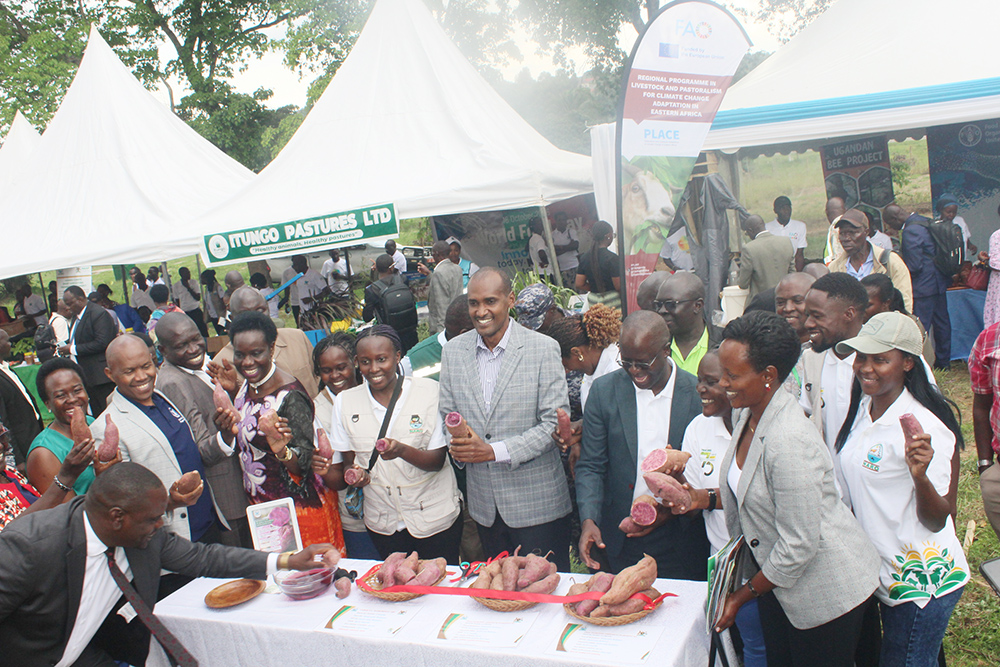
Minister Frank Tumwebaze launching the sweet potato meant to stand against diabates and cancer. Joshua Nahamya
Mbarara City
The Minister of Agriculture, Animal Industry and Fisheries (MAAIF), Frank Tumwebaze, has challenged farmers across the country to transition from traditional subsistence farming to intentional, tech-driven commercial agriculture that balances household food needs, financial income, livestock nutrition, and environmental conservation.
Minister Tumwebaze delivered the call on Friday, October 16, 2026, during the national commemoration of World Food Day held at the Mbarara Zonal Agricultural Research and Development Institute (MBAZARDI) in Mbarara City. Celebrated under the theme “Innovate Today, Nourish Tomorrow,” the event coincided with the centennial milestone of MBAZARDI, which was established in 1926 as the historic Mbarara Stock Farm (locally remembered as "Famu y'omujungu").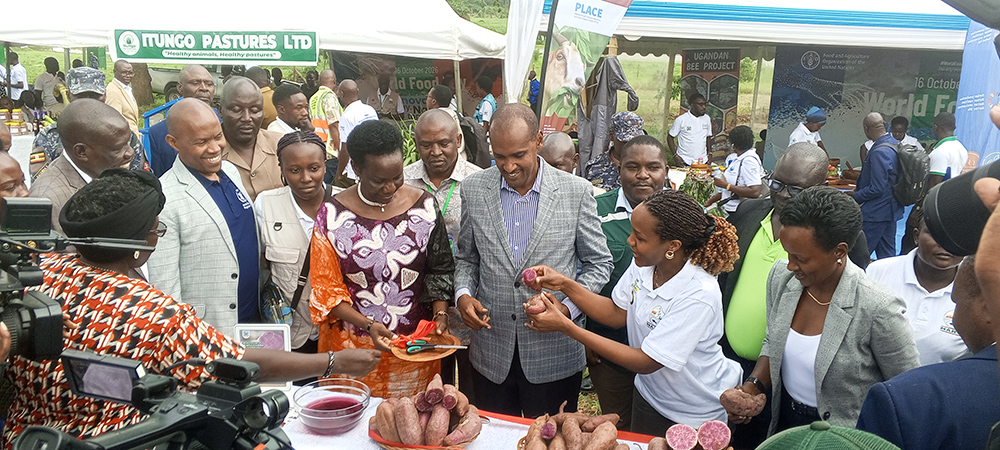
Bridging science, research, and livelihoods
Speaking to a gathering of scientists, district leaders, and agriculturalists, Tumwebaze stressed that public research institutions like the National Agricultural Research Organisation (NARO) must focus on applied, market-oriented research that directly solves community challenges rather than producing purely academic papers.
“My message today is that we must be intentional as planners, as MAAIF, as NARO, and as leaders,” Tumwebaze said. “The way we farmed 30 years ago is not the way we are now. The way MBAZARDI was 50 years ago is not the way it is now. We need research that serves livelihood value—not just academic value for university examiners.”
Tumwebaze emphasized that farmers must intentionally balance four core pillars: food security crops, income security crops, animal feed crops, and environmental protection enablers.
“Food will be here forever,” the Minister noted. “Whether you develop computer technologies or go to the moon, nothing replaces food. Can we have a crusade for intentional farming? Number one, prioritize food security crops like bananas, cassava, and millet. Number two, plant lucrative income security crops like coffee and cocoa under the four-acre model. Number three, farm animal feeds. And number four, maintain environmental security using NARO enablers.”
Release of cancer-fighting sweet potato varieties and mass irrigation mandate
Marking the centennial celebrations, NARO scientists officially unveiled three new improved sweet potato varieties known as the “Purple-Fleshed Sweet Potatoes.”
Dr. Bernard Yada, a lead potato plant breeder at NARO, explained that the new purple variety matures quickly, yields heavily, resists common crop diseases, and contains high concentrations of zinc, vitamin A, vitamin C, and anthocyanin antioxidants.
“Purple potatoes are rich in anthocyanins—compounds that help the body fight diseases caused by cellular oxidation, including cancer and high blood pressure,” Dr. Yada detailed. “They convert into protective nutrients, help manage diabetes and hypertension, and serve as raw materials for value-added industrial flours and wines.”
Addressing climate disruptions, Tumwebaze revealed that President Yoweri Museveni and Cabinet have directed a comprehensive shift toward mass-scale agricultural irrigation, ending reliance on increasingly unpredictable rain-fed cycles.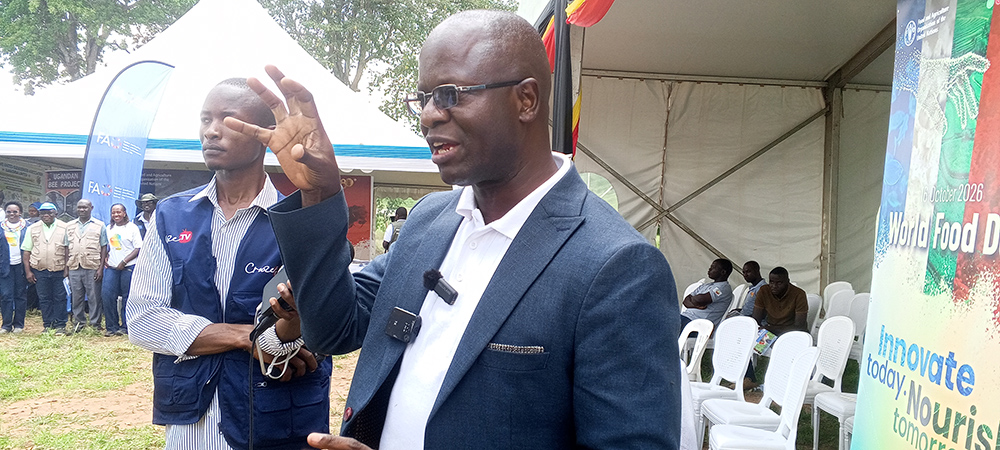
Dr Benard Yada- a lead potato plant breeder at NARO
“In the past, our irrigated farming coverage was less than 2 percent because rain-fed agriculture was guaranteed,” Tumwebaze stated. “In my village, we knew that on the Feast of the Assumption on August 15th, rains would fall predictably. But now it is October and the rains are unreliable. The Ministry of Water and Ministry of Agriculture are partnering to scale up five key irrigation interventions across rivers, farm dams, and rehabilitated valley schemes.”
The Minister further urged district extension workers to mobilize communities to utilize idle land, pointing out that despite Uganda possessing 40 million acres of arable land, official statistics from UBOS and the FAO indicate that less than two million acres are currently under effective, mechanized agricultural production.
Tumwebaze appealed to NARO’s commitment to expanding NARO’s research infrastructure across regional stations like Kacwekano in Rubanda for Irish potato breeding and Rwebitaba for specialty caffeine-free teas among others.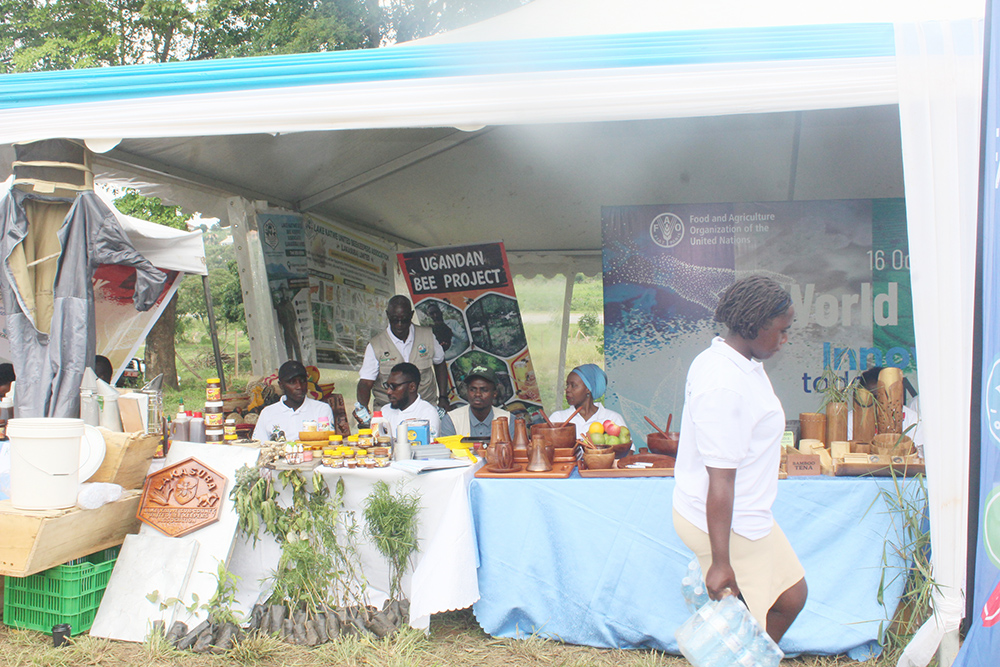
Some of the food stuffs exhibited during the World Food Day at MBARZARDI
100 years of MBAZARDI: transforming southwestern agro-ecologies
Reflecting on the institute’s century-long trajectory from a colonial dairy breeding station into a modern regional research center, MBAZARDI Director Dr. Chrisostom Ayebazibwe announced the launch of the Southwestern Agro-Industrial Technology and Innovation Centre to bridge scientific research and commercial enterprise.
“Celebrating 100 years as MBAZARDI is a monumental milestone,” Dr. Ayebazibwe stated. “For a century, this institute has sustained regional dairy and crop production. Without this facility, we would not have the thriving milk sector we see in Uganda today. Today, we are multiplying high-yielding climate-smart banana varieties, specialized KR coffee cultivars, cocoa, probiotics for greenhouse gas reduction, and the Chinese Big-Ear goat breed—found nowhere else on the African continent—to supply foundation stock to commercial farmers.”
Elaborating on NARO's national mandate, NARO Deputy Director Dr. Kasimu highlighted the strategic upgrade of MBAZARDI into a national center of excellence for semi-intensive dairy farming and high-grade livestock breeding.
“We upgraded MBAZARDI to a national center of excellence for semi-intensive dairy farming,” Dr. Kasimu noted. “We are multiplying foundation seed, pasture varieties, and superior animal breeds so communities and commercial seed companies can expand them. As we commemorate 100 years, we must reflect on the four core fights: fighting poverty, food insecurity, nutritional deficits, and environmental degradation.”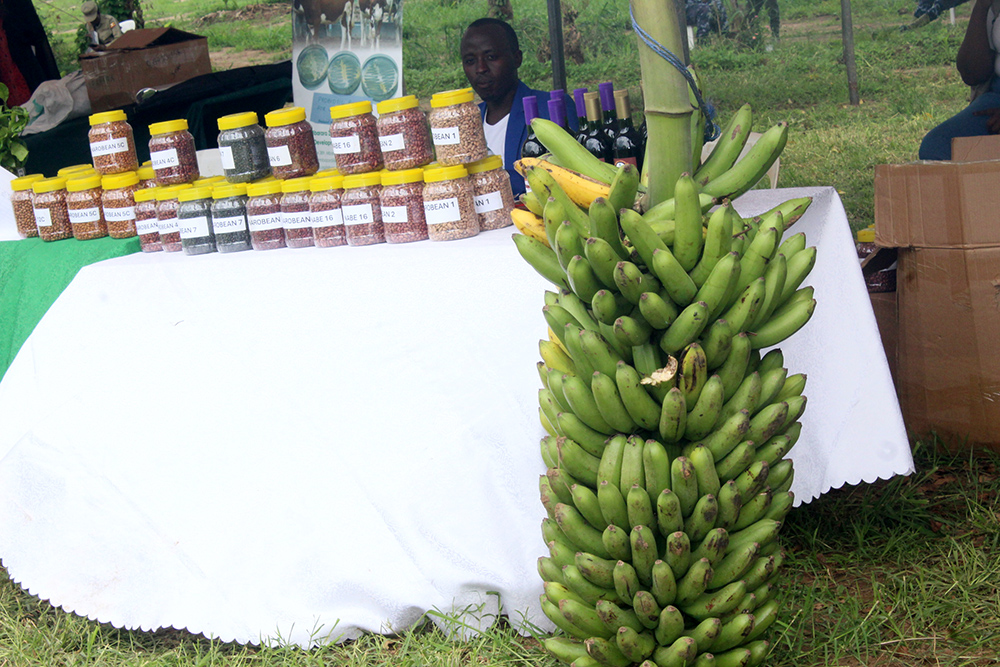
World Food Day exhibitions at World Food Day MBARZARDI
Reaffirming the ministry's administrative backing, MAAIF Undersecretary Mary Aacha Orikiriza, representing Permanent Secretary Maj. Gen. David Kasura-Kyomukama, emphasized that agricultural research must translate into direct societal solutions and tangible rural prosperity.
“It is an opportunity to recognize past achievements and renew our commitment to research and innovation that responds to farmers’ needs and improves future food and nutrition security,” Orikiriza stated. “As we celebrate 100 years of MBAZARDI, let us honor agricultural research by ensuring that innovation reaches farmers and improves their lives. Let us turn agricultural knowledge into practical solutions, production into prosperity, and food availability into better nutrition for all Ugandans.”
Martin Ameu, Assistant Country Representative (Programme) for the Food and Agriculture Organization (FAO) in Uganda, commended NARO and MAAIF for sustaining national agri-food systems and called for the rapid transfer of research prototypes into rural smallholder fields.
“World Food Day challenges us to build agri-food systems that are more productive, inclusive, resilient, and sustainable,” Ameu observed. “Innovations must move from research laboratories and demonstration plots into real farm fields. Food must be safe, diverse, nutritious, accessible, and affordable to nourish Uganda tomorrow.”



