Written By | Fashion and Design Desk
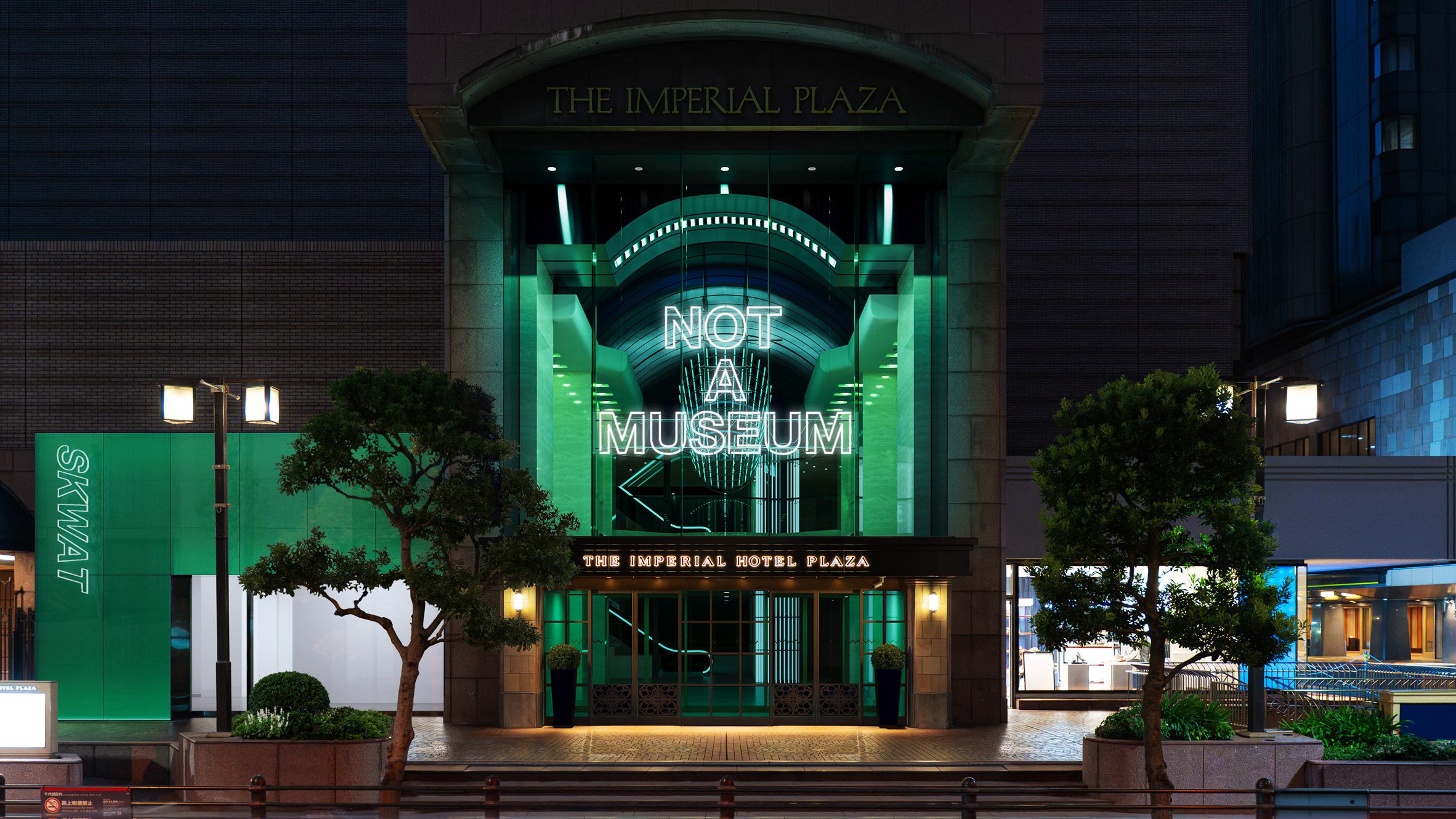
Nota’s first cultural space, Not a Museum, will occupy four floors of the Imperial Hotel Plaza Tokyo for four years before the building is demolished.
TOKYO
In many cities, a building slated for demolition is a building waiting to be forgotten. In Tokyo, one of them is about to get a second life — briefly, deliberately, and with an ambitious cultural program. Nota, the company behind the hospitality brand Not a Hotel, is opening Not a Museum at the Imperial Hotel Plaza Tokyo, using the structure as a temporary platform before it makes way for new construction.
The project
Reported by Dezeen on October 12, the project is Nota’s first cultural space. It will occupy the first through fourth floors of the 2,000-square-meter commercial center from summer 2027 to 2031. The Imperial Hotel Plaza is set to be torn down to make way for the reconstruction of the Imperial Hotel Tokyo tower, though the building’s demolition has been delayed due to rising construction costs — a delay that effectively creates the window for this project.
Not a Museum is being designed by Not a City, a Nota subsidiary, together with SKWAT, a Tokyo cultural collective that runs the SKWAT Kameari Art Centre. SKWAT is led by founder Keisuke Nakamura of the design firm Daikei Mills. The two groups will handle everything from planning to management over the four years the space is open. The companies describe the venue as an “experimental platform for the future” where art, music, books, cinema, fashion and other culture converge.
Designing with an expiration date
The notable idea here is temporal. Not a City aims to use unused spaces in Tokyo, where buildings are often demolished rather than reused. A four-year lease on a doomed building turns a typical architectural end point into a design brief: what can a space do when it is guaranteed to disappear? Without the pressure of permanence, a venue can be more experimental, more porous, and less bound by the conventions of museums. That is interpretation rather than a statement from the project team, but the stated goal of an experimental platform points in the same direction.
SKWAT’s record offers some clues about what to expect. The collective has previously hosted exhibitions by designer Kwangho Lee and by the architects Herzog & de Meuron, suggesting a program that moves comfortably between design, architecture and contemporary art. Its Kameari Art Centre is the existing proof of concept for how an unconventional space can host serious work.
Part of a larger Nota strategy
The museum sits alongside another major Nota project, Japa Valley Tokyo. That new commercial district is set to open in 2027 in the yet-to-be-built Yurakucho Park, developed with Mitsubishi Estate on a site left empty after two 1960s buildings were demolished. It is being designed by producer Pharrell Williams and fashion designer Nigo, who joined Nota as creative advisors last year. Together, the two projects show a company expanding from luxury accommodation into urban culture, with high-profile creative collaborators.
Why it matters for design
Adaptive reuse is a familiar idea; adaptive reuse on a countdown is less so. Tokyo’s property cycle is famously fast, and the demolition of mid-century buildings often passes with little ceremony. A project that deliberately programs the final years of a structure acknowledges that buildings have life stages and that the last one can be productive rather than empty. It also raises questions the designers will have to answer: how do you create an immersive environment with materials you cannot invest in permanently, and how do you build an audience for something that has a fixed end date?
The delay in demolition due to rising construction costs adds another layer. Economic pressures that might freeze a development have instead opened a creative gap. It is a reminder that urban culture often grows in the seams of the property market.
What this means for you
If you plan to be in Tokyo between summer 2027 and 2031, Not a Museum offers a limited-time cultural destination in the Hibiya area; since opening details have not been published, check Nota’s official channels before planning a visit. For designers and architects, the project is a case study in temporary programming: short-term occupation of a doomed building as a way to test ideas, build community and generate cultural value. For city-dwellers elsewhere, it suggests a model worth asking about locally — what buildings near you are waiting for demolition, and could they host something in the meantime?
Lessons for cities and clients
Temporary use of buildings is increasingly discussed by planners as a way to bridge the gap between a property’s old life and its next one. The attraction is obvious: it keeps lights on, brings footfall, and builds an audience before a permanent project arrives. The challenge is making such programs feel intentional rather than stopgap. A named, designed and managed institution with a defined four-year run is a sturdier proposition than an ad hoc pop-up.
The pairing of a hospitality company with an arts collective is also instructive. Hotels and cultural venues compete for the same travelers and city-dwellers, yet they rarely share a design language. By commissioning a collective with exhibition experience, Nota is signaling that it sees culture as part of its brand rather than decoration around it. That is a strategy several hospitality groups around the world have adopted, and Tokyo, with its dense creative scene, is a natural testing ground.
Finally, the project raises a sustainability question that designers are increasingly asked: if a building will be demolished, what is the most responsible use of its remaining life? Extending its usefulness with a lightweight, flexible program is arguably better than leaving it empty, though it is no substitute for the larger debate about when demolition is truly necessary.
Conclusion
Not a Museum will not be permanent, and that is the point. By treating a condemned shopping complex as a four-year canvas, Nota, Not a City and SKWAT are making a quiet argument that the end of a building’s life can be its most creative chapter. Whether the experiment succeeds will be visible from summer 2027, when the doors open on a structure that everyone involved knows will not be there forever.



