Written By | Joshua Nahamya
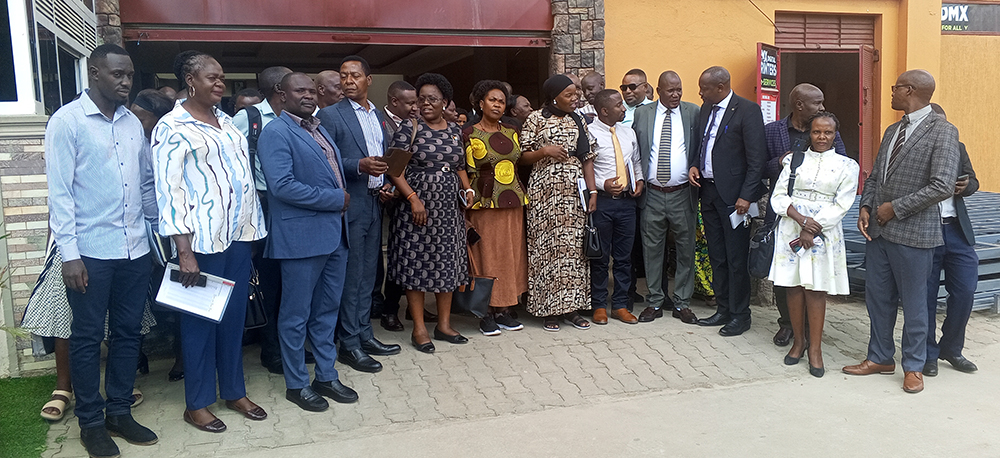
Some of the Members of Parliament on the Committee of HIV and other related issues after an engagemnet in Mbarara on Tuesday
Mbarara City
Health officials in Mbarara have raised alarm over a worrying demographic shift in new HIV infections, with older men now emerging as the most affected group—a trend that threatens to reverse gains made in the fight against the epidemic.
Speaking during a high-level regional engagement with the Parliamentary Committee on HIV/AIDS and focal persons from 12 districts in Ankole and six in Kigezi, Mbarara District Health Officer Dr. Peter Sebutinde noted that the tide has turned from the traditional narrative of HIV as a predominantly female affliction.
"The section that you are seeing—males of older age—are becoming more affected. Something is happening, and it is going to grow. They are dominating," Dr. Sebutinde warned. "We initiate these people on ART, but slowly, it is these same people who drop out of the programme. They become the reservoir of HIV and spread it highly. We must tighten the nut here so that we don’t lose people."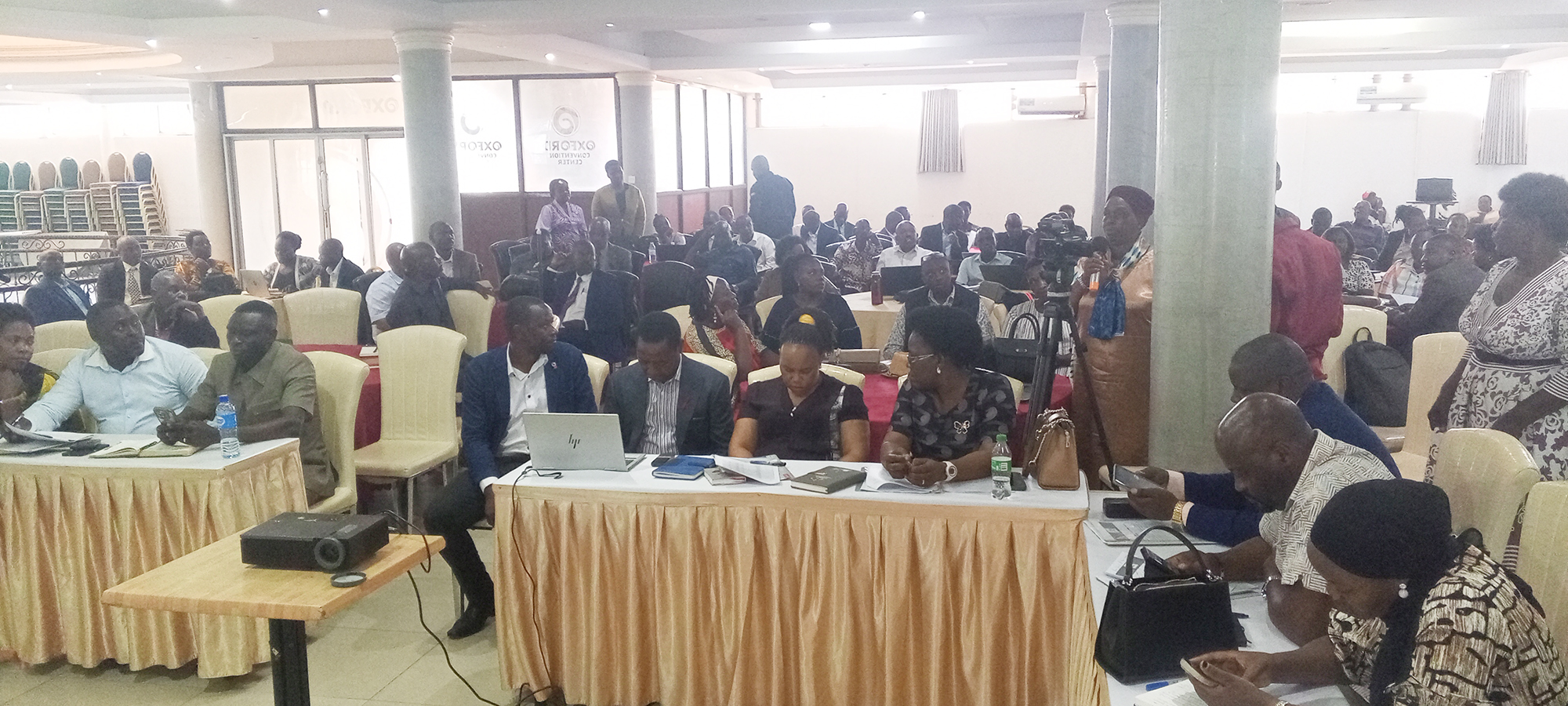
HIV focal persons, parliamentarians and district local government leaders attending an HIV stakeholders' engagement in Mbarara on Tuesday
The multi-district oversight engagement, which opened in Mbarara City, was aimed at evaluating interventions to end HIV as a public health threat by 2030. Welcoming the regional delegates, Steven Kisa Bakubalwayo, Chairman of the Parliamentary Committee on HIV/AIDS and Related Matters and MP for Luuka South County, underscored the urgency of the visit.
"Your participation is a demonstration of our shared commitment to ending HIV/AIDS as a public health threat by 2030," Bakubalwayo stated. "It is a rare opportunity for us to listen, learn, and jointly identify practical solutions."
Drivers of New Infections
During deliberations, stakeholders identified key drivers of new HIV infections in the region, including:
Neighboring districts continue to record alarming prevalence figures, with Bushenyi at 8%, Sheema at 7.3% (12,453 cases), and Buhweju at 3.3%, compared to the national average of 4.7%.
In response to the limited resources allocated to combat the rising figures, Michael Matsiko from the Uganda AIDS Commission, in charge of the Southwestern region, called for an urgent increase in funding.
"We can't fight HIV prevention in isolation with 0.1% of the national budget," Matsiko emphasized. "We need more resources to tackle it as a pivotal role."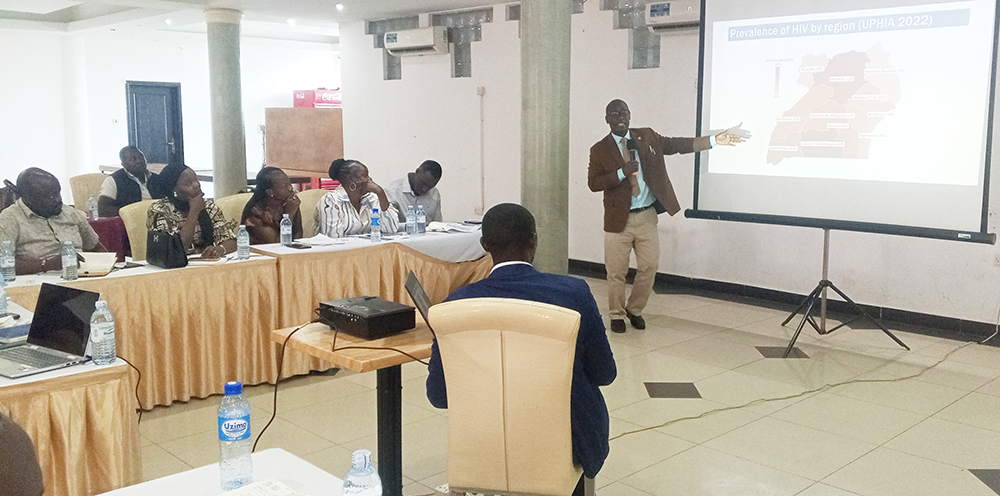
Dr Peter Sebutinde, Mbarara District Health Officer presenting the statistics
Mbarara City: Cases Doubling
Providing specific figures for Mbarara City, HIV Focal Person Dorcus Twinabaitu revealed that actual cases have far outpaced early demographic projections.
"As a city, population estimates showed we should have 17,224 people living with HIV, but we now have 32,000—meaning we are doubling from the estimates," Twinabaitu explained. "When you go to testing services, we have tested 55,000 people, out of which over 1,000 tested HIV positive in just one quarter—from April to June 2026. Those most infected are females aged 20–24 years, males aged 30–39 years due to cross-generational sex, and 54% of sex workers as a result of transactional sex in the city."
Elaborating on the changing dynamics of the virus, Dr. Sebutinde urged leaders to move past traditional assumptions regarding who is most at risk.
"We know that HIV has been having a female face, but here, we are beginning to see evidence that as people grow older, the female face changes. Many more adults, especially men, begin to catch HIV," Dr. Sebutinde noted. "When you're talking about HIV, you're also going to talk about syphilis because the gate is the same—they all enter through one opening at the same time. Where HIV passes, syphilis will pass. So we cannot fight HIV in isolation."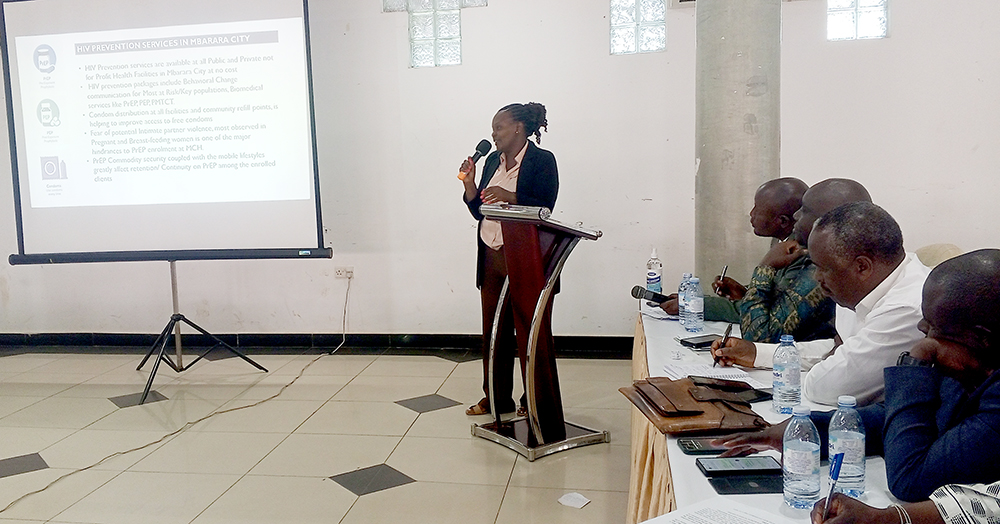
Dorcus Twinabaitu narrating the HIV prevalence statistics in Mbarara City
Night Economy and Young People at Risk
Dr. Sebutinde also raised alarm over young people in secondary schools and universities exposed to active nightlife and urban leisure hubs across the region's main cities.
"Science does not lie. Numbers do not lie. What is at stake are the young people. Where does the business happen? In massage parlours, in brothels, in dance halls, in schools," Dr. Sebutinde warned. "These children in secondary schools and universities are super sexually active. Mbarara is topping, then Kabale, and then the others. But what is common about all these cities and places? The night economy. If we are going to think about new HIV infections, we must tackle the night business."
He expressed concern that out of an estimated 9,000 HIV-positive individuals in Mbarara district, only 7,000 have been reached and enrolled on treatment, warning that unreached or non-suppressed individuals risk spreading the virus further. He particularly pointed out challenges faced by students living with HIV in boarding schools.
"These children—many of them were born with HIV. They are of young age and in boarding schools," Dr. Sebutinde said. "If we are to reduce this, we must improve HIV care in school programming. Our schools and headteachers must know that among the beautiful, young-looking children, there are those that are living on drugs."
Funding Gaps and Resource Strain
Addressing the operational strain on regional health facilities, Dr. Deus Twesigye, Acting Director of Mbarara Regional Referral Hospital, cited international funding disruptions as a primary contributor to resource gaps.
"Much of the human resource working in this area has been supported by the US government, and the beginning of President Trump's term decided to trump on these services," Dr. Twesigye stated. "We are trying to get back into shape because money has been identified, and come October, we shall have some smooth running. We are very optimistic."
Dr. Denis Nansera, a Consultant Paediatrician at Mbarara Regional Referral Hospital, called on the parliamentary committee to review national policies to adjust to reduced health budgets.
"The policies we have were written during the honeymoon period when we had a lot of resources. We might need to refocus—now that the money is less, how can we modify a few things to fit in?" Dr. Nansera asked. "We need community workers who know what they are doing so that we join community and facility care together. We also need to talk to National Medical Stores. It’s time to revise the essential drugs list. Dr. Deus will tell you that there are some medicines he buys that can consume his budget for a whole quarter."
Dr. Nansera also urged health practitioners to treat non-communicable comorbidities alongside HIV care to improve patient retention.
"A lot of people living with HIV are likely not to die from HIV but from comorbidities—hypertension and other conditions are becoming very prevalent," Dr. Nansera remarked. "If we are going to look after our people, let's make sure that as we focus on ARVs, other medicines for comorbidities are also taken care of, including lab services."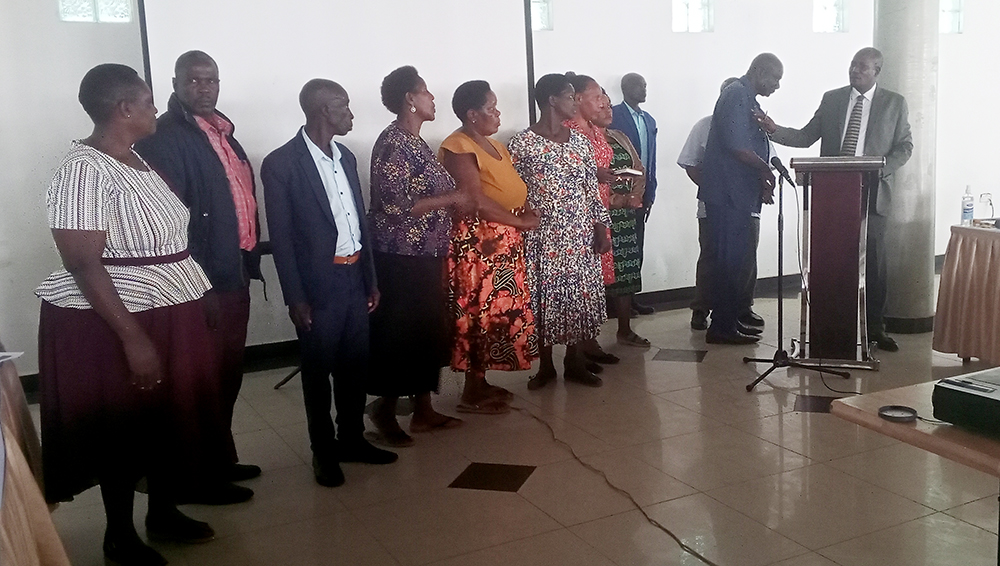
Some of the stakeholders in Ankole and Kigezi living happily with HIV in the region
Prevention and Policy Recommendations
Summarizing the core purpose of the oversight visit, Committee Chairman Steven Kisa reiterated that prevention remains the most viable path forward.
"The HIV prevalence in Mbarara City is about 11.4%, and the rise in infection is high—that's the reason why we are here," Kisa said. "HIV prevention remains the most cost-effective way of reducing the prevalence of HIV on individuals, families, and the government. It is not enough for services to take a list of data; the service must reach the intended beneficiaries. Every resource allocated to HIV must translate into services and interventions or an outcome that benefits the people."
Former HIV Committee Chairman and current MP for Shema North Constituency, Dr. Elioda Tumwesigye, echoed the need for biomedical innovations, improved staffing levels, and stronger local infrastructure.
"The key takeaways here have been that we need to increase the availability of biomedical interventions that can reduce HIV transmission, such as injectable PrEP," Dr. Tumwesigye observed. "We are also going to push for staffing. Many of these health facilities are understaffed. We visited Mbarara Regional Referral Hospital and found only two doctors on government payroll looking after over 12,000 people with HIV and AIDS—all the others are volunteers. We need more staff."
Dr. Tumwesigye added that Parliament would advocate for systematic transitional funding as foreign donors withdraw support, alongside pushing for the operationalization of the HIV/AIDS Trust Fund.
Voices of People Living with HIV
Representing people living with HIV, Immaculate Nyamwiza urged lawmakers to ensure that government poverty-alleviation initiatives explicitly cater to their constituency.
"When government programmes like PDM [Parish Development Model] come, we are not considered," Nyamwiza stated. "Why don't you create for us a fund so that it can also help us take good care of ourselves? Because we have many challenges that need redress."
In response to the testimonies shared during the session, the visiting lawmakers mobilized Shs 2 million on the spot to assist local support groups in establishing a SACCO to fund sustainable economic activities.
Following their session in Ankole and Kigezi, the parliamentary committee proceeded to Fort Portal to continue its national field assessment.



