Written By | Jovita Hasto
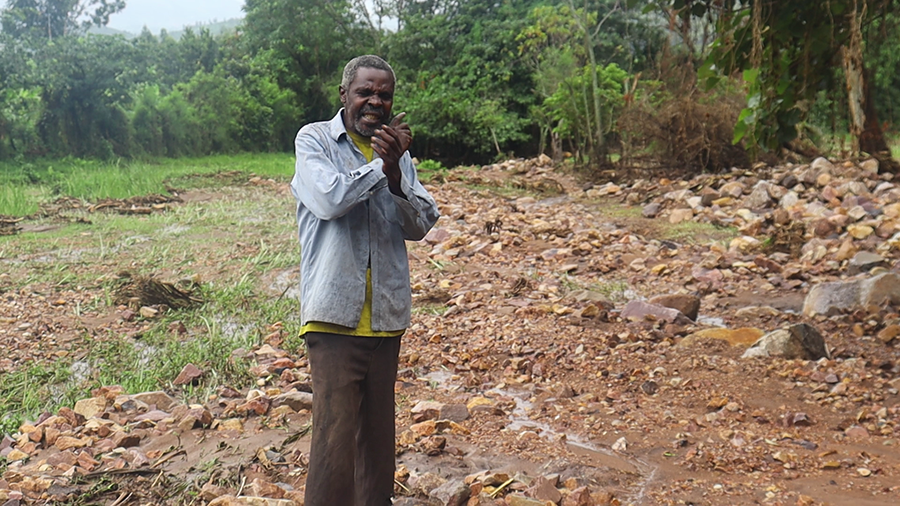
A man standing stranded after his crops were destroyed by heavy rains in Katembe parish in Ibanda district. [Photo: Jovita Hasto]
IBANDA
Ibanda District is grappling with the devastating effects of heavy rains that have triggered mudslides and floods in several villages in Katembe and Kigunga parishes, Kicuzi Sub-county, destroying houses and plantations and leaving families stranded.
The most affected areas include Njembe I and II and Eihome in Kigunga, where property has been damaged and some houses are on the verge of collapse.
Residents are appealing to the government to intervene and provide emergency assistance, saying such disasters recur during the rainy season, threatening food security and livelihoods.
One of the affected residents, Ms Dinavence Kamarembo, narrated her ordeal after her home and livelihood were destroyed.
“The kitchen was washed away, and the house could collapse at any time. Our plantations and coffee were also destroyed, but we thank God that we are still alive. We request help because I have children in school and university, and I borrowed money. I am really stuck and do not know how to cope with the situation,” she said.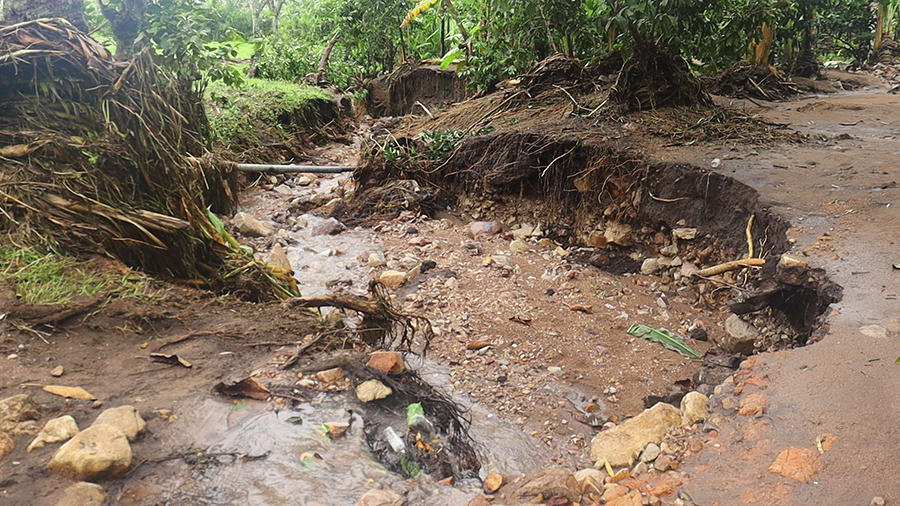
Land in Kigunga parish in Ibanda district was washed away and coffee plants uprooted by the heavy rains
Ms Jane Kyosimire said she now lives in constant fear whenever it threatens to rain.
“I am now living in fear whenever it threatens to rain. I remain worried because of what has happened. Stones from the hills covered my compound and destroyed gardens and banana plantations. The bean garden was also covered with stones, and we do not know how we shall survive,” she said.
Residents are calling for government intervention and collaboration with landowners to restore the degraded hills.
Mr Godfrey Mugisha said the government should work with landowners to promote tree planting and sustainable farming practices.
“If the government can collaborate with landowners so that they plant trees, it would help. On the hill that was washed away, residents had been advised to use proper cultivation methods, including terracing, but some failed to comply. We are in a dangerous situation, and we call upon the government to intervene. Moreover, we have loans and taxes to pay, as well as families to look after,” he said.
Mr Mugisha added that environmental degradation has been particularly severe on the hills separating Ibanda District from Buhweju District. He explained that bush burning had also contributed to the problem by leaving the land bare and increasing the risk of flooding.
He called for residents to be trained in proper farming methods and urged communities on both sides of the hills to take responsibility for environmental protection.
“Residents should also be advised to ensure that disasters originating from the Buhweju side of the hills are controlled on the Ibanda side. People have often failed to take action, arguing that the problem originates in Buhweju, yet some residents continue to cultivate poorly and cut grass from the hills for mulch,” he added.
Mr Paddy Katehangwa, the LC1 chairperson of Njembe I, said floods had affected several homes and that he had compiled a list of residents whose property had been damaged.
“Three houses were affected. We do not have food, and we have requested help from the government. Even leaders from the Sub-county came here but failed to help the affected people. I compiled a list of those affected and the damage to their property. Nearly two-thirds of the residents in Njembe I and II were severely affected,” he said.
He added that water flows down from the hills, worsening the flooding.
“People were stopped from cultivating on the hills, but when we arrested some of them, they were released. Others burn bushes on the Buhweju side, and we are also affected,” he said.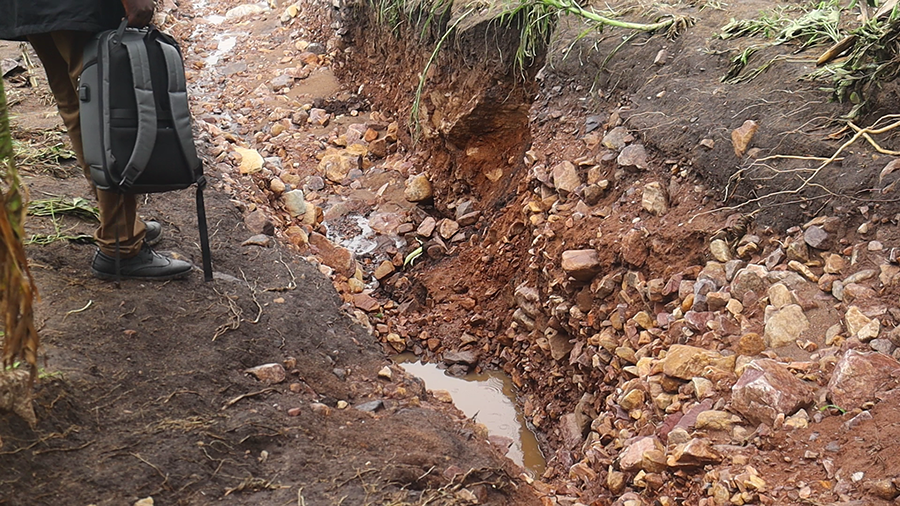
A village road that was destroyed by heavy rains in Katembe Parish in Ibanda district
Previously, Ibanda District officials distributed tree seedlings for planting in areas where environmental degradation has been severe.
During the launch of the distribution exercise, Mr Elly Kirya, the Ibanda District Natural Resources Officer, warned that the district could experience severe soil erosion due to the anticipated El Niño conditions during the rainy season.
“This season, we are expecting El Niño, and in hilly areas, soil is likely to be washed away. We want to control mudslides by planting trees in this area, including Katoma Cell on Kagongo Hills and areas in Kicuzi Sub-county,” he said.
Mr Kirya attributed the disasters to environmental degradation and poor land management practices on the hills.
“The hills in Katoma and Kicuzi are being degraded by stone quarrying and cultivation. Many areas are frequently washed away by mudslides, and the intervention is to plant trees. We want to advise people to stop bush burning in hilly areas,” he said.
He added that most of the factors contributing to environmental degradation were caused by human activities, including stone quarrying and poor cultivation methods.
“People should practise terracing to control soil erosion,” he said.
Mr Godfrey Mbetegyereize, the Ibanda District Resident District Commissioner (RDC), said the rains had already started causing destruction, although no deaths had been reported.
“The rains have started causing havoc in Kigunga, Ihome and Katembe, where a lot of property has been damaged and houses affected,” he said.
He attributed the floods along the steep slopes to human activities, including deforestation and the destruction of vegetation that protects the topsoil.
“Heavy rains have caused flooding along the steep slopes, exacerbated by human activities. Trees have been cut down, and the grass covering the topsoil has been destroyed. When it rains heavily, the water flows downhill without being absorbed or slowed by vegetation. What is encouraging is that no deaths have been reported, although some families have lost their homes,” he said.
Mr Mbetegyereize urged residents to follow guidance from natural resources experts to reduce the risks associated with natural disasters.
“We request people using these areas to follow land management guidelines provided by environment officers. Runoff water should be controlled using embankments on steep slopes. Terraces are lacking, and people are using the land unsustainably. If there is no change, we shall continue experiencing such disasters,” he added.



