ADDIS ABABA/ASMARA
Ethiopia has formally accused Eritrea of colluding with a hardline faction of the Tigray People's Liberation Front to prepare an armed offensive against the federal government, in a letter to the United Nations that marks the most direct warning yet of renewed war between the two Horn of Africa neighbors — a conflict that, if it materializes, could draw in outside powers from across the Red Sea basin.
In a letter to UN Secretary-General António Guterres, Ethiopian Foreign Minister Gedion Timothewos alleged that collusion between Eritrea and the TPLF hardliner faction had become "more evident over the past few months" and that the two were "actively preparing to wage war against Ethiopia," according to a copy of the letter reported by AFP and cited by the BBC. Gedion further accused Eritrea and the TPLF faction of "funding, mobilizing and directing armed groups" in Ethiopia's Amhara region, where the Fano militia has been fighting federal forces.
Eritrea had not issued an official response to the letter as of this week, but its government has grown increasingly vocal in rejecting Ethiopian rhetoric on related disputes, and the TPLF faction named in the letter has flatly denied the accusations.
What Just Happened
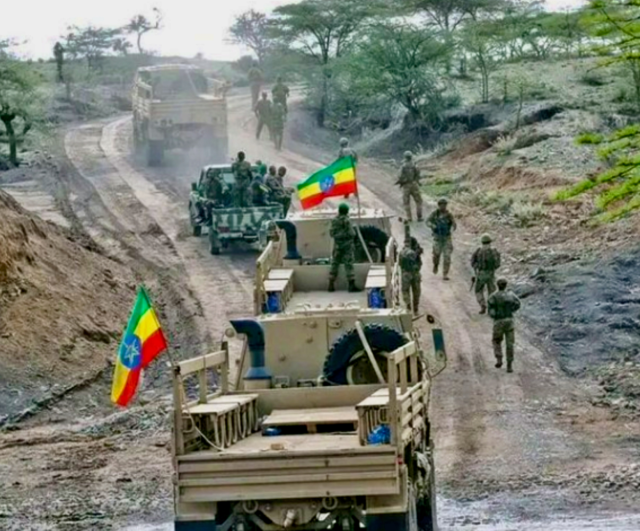
The accusation follows a series of escalatory incidents documented over the past two weeks. On Aug. 3, senior Eritrean military commanders crossed into Ethiopian territory at the border town of Zalambesa in what regional analysts described as a deliberately publicized display, accompanied by the open flying of the Eritrean flag — an incident captured on video that circulated widely on social media. Days later, on Aug. 6, additional Eritrean military assets, including tanks and heavy weaponry, were reported moving into northern Ethiopia's Tigray region.
Both incidents were tied by Ethiopian officials and regional commentators to an alliance referred to as "Tsimdo," which analysts describe as a loose coordination framework between the Eritrean government and hardliners within the TPLF who reject the terms of Tigray's postwar political settlement. Fetlework Gebregziabher, deputy chair of the TPLF faction, has publicly discussed the Tsimdo framework in recent statements.
The TPLF hardliner faction, led by Debretsion Gebremichael, controls the regional government in Tigray, which borders Eritrea directly. Debretsion rejected Ethiopia's accusations as "fabricated stories and smear campaigns" intended, he said, to divert attention from the federal government's own failure to fully implement Tigray's 2022 peace agreement. He went further, describing the foreign ministry's letter as "a dangerous inversion of history — an attempt to portray the aggressor as the victim and the victims as the aggressor" — and countered that it is the federal government training new militias to destabilize Tigray.

Background: A Peace That Never Fully Held
Ethiopia and Eritrea fought a brutal border war from 1998 to 2000, centered on the contested town of Badme, that killed tens of thousands of people before ending in a fragile standoff. Relations remained frozen for nearly two decades until Ethiopian Prime Minister Abiy Ahmed took office in 2018 and moved quickly to normalize ties with Eritrean President Isaias Afwerki, a rapprochement that earned Abiy the 2019 Nobel Peace Prize.
That alliance was tested severely when war broke out in November 2020 between the Ethiopian federal government and the TPLF, which had previously dominated Ethiopian politics for nearly three decades before Abiy's rise. Eritrean forces fought alongside the Ethiopian military against the TPLF during that conflict, which devastated the Tigray region before a peace agreement was signed in Pretoria, South Africa, in November 2022. Crucially, Eritrea was not a party to that agreement, and it has since developed grievances of its own — both toward the terms of the Tigray settlement and toward the TPLF faction, led by Getachew Reda, that has cooperated with the federal government in implementing it.
Since the Pretoria deal, the TPLF has effectively split. The Debretsion-led hardliner faction, which retains control of Tigray's regional administration, has increasingly aligned itself with Eritrea in opposition to both the Getachew faction and the federal government in Addis Ababa. Ethiopian officials say this alignment — the "Tsimdo" coalition — has grown steadily more overt since the start of 2026.
Layered on top of this is a separate and increasingly serious point of friction: Ethiopia's renewed push for direct access to the Red Sea. Landlocked since Eritrea's 1993 independence, when it took control of the coastline, Ethiopia has argued with growing insistence since October 2023 that ceding its ports was a historic mistake it now intends to correct. That claim has alarmed Asmara, which views it as a direct threat to Eritrean sovereignty over its coastline.
Escalating Rhetoric Beyond the Battlefield
The dispute has spilled well beyond military maneuvers into pointed public exchanges between senior officials. Speaking before Ethiopia's parliament this week, President Taye Atske Selassie — whose role is largely ceremonial but whose remarks reflect government messaging — described the Red Sea and the Nile River as "great water resources, which are essential to our country's existence," language that was widely read in Asmara as a fresh assertion of Ethiopian ambitions toward the Eritrean coast.
Eritrea's Information Minister, Yemane Gebremeskel, responded sharply, dismissing the Ethiopian government's language as "too crass and pathetic to sell" and describing what he called Addis Ababa's "obsession" with the Red Sea and the Nile as "bizarre and mind-boggling by all standards."
Ethiopia's foreign minister, for his part, has characterized Eritrea's escalation as a response to Ethiopia's Red Sea ambitions — arguing, in effect, that Asmara is moving preemptively to destabilize Ethiopia because it feels threatened by Addis Ababa's stated intent to regain coastal access, according to reporting by Ethiopia's privately owned Addis Standard newspaper. That same reporting cited the foreign minister's letter as alleging that TPLF hardliner commanders and fighters directly participated in a Fano militia operation aimed at capturing the town of Woldiya in Ethiopia's Amhara region.
The Amhara Complication
The dispute is further complicated by Ethiopia's separate, ongoing conflict in the Amhara region, where the Fano militia — once allied with Abiy's government in the war against the TPLF — has since turned against federal forces after rejecting government demands that it disarm. Fano says it is defending the Amhara ethnic group from abuses by federal troops, and it has increasingly signaled ambitions beyond regional grievances, with some elements now framing their campaign as aimed at toppling Abiy's government outright.
Ethiopia's accusation that Eritrea and TPLF hardliners are directly supporting Fano operations — including the alleged involvement in the push on Woldiya — ties together what have generally been treated as separate conflicts (Tigray and Amhara) into a single, more dangerous narrative of coordinated, externally backed destabilization directed at the federal government from multiple fronts simultaneously.
Political and Regional Stakes
The implications extend well past Ethiopia's borders. Regional analysts have warned that a renewed Ethiopia-Eritrea conflict would almost certainly draw in outside actors with strategic interests in the Red Sea corridor and the broader Horn of Africa, including Egypt, the United Arab Emirates, Israel and potentially Saudi Arabia — all of which have competing interests in regional shipping lanes, port access and the balance of power along one of the world's most strategically significant waterways.
There is also a direct connection to Sudan's ongoing civil war. Ethiopian officials have said Tigrayan fighters are being used as mercenaries in the Sudan conflict, and any renewed Ethiopia-Eritrea confrontation would likely intersect with the already tangled web of external involvement in Sudan, where Gulf states and regional powers have been accused of backing rival factions in that country's fighting.
Diplomatically, both the European Union and the United States have taken limited steps aimed at discouraging further escalation, including sanctions targeting TPLF hardliner figures, though these measures do not appear to have altered the trajectory of events on the ground in the weeks since they were imposed. Ethiopia's government has said it made a direct written appeal to Eritrea for dialogue in February 2026, delivered through its foreign ministry, but that Asmara has not responded with any substantive engagement.
What to Watch Next
The most immediate signal to watch is whether Ethiopia's federal government follows through on what regional security analysts describe as a likely military operation aimed at TPLF hardliner positions in Tigray in the coming weeks — a move that would risk direct confrontation with Eritrean forces given the reported presence of Eritrean tanks and personnel in the region. Any Ethiopian offensive into Tigray would test whether Eritrea intervenes overtly on behalf of its TPLF hardliner allies, which would represent a significant and rapid escalation toward interstate war.
Also worth monitoring: whether the UN Security Council or African Union takes up Ethiopia's letter formally, and whether any third-party mediation — from Gulf states, Western governments or continental bodies — succeeds in reopening a diplomatic channel between Addis Ababa and Asmara. Given that Ethiopia's government has publicly framed further restraint as increasingly untenable, the coming weeks are likely to determine whether the current standoff cools into another uneasy truce or hardens into the first open Ethiopia-Eritrea military confrontation since the 1998–2000 war.
Published By | News Editor