Strasbourg
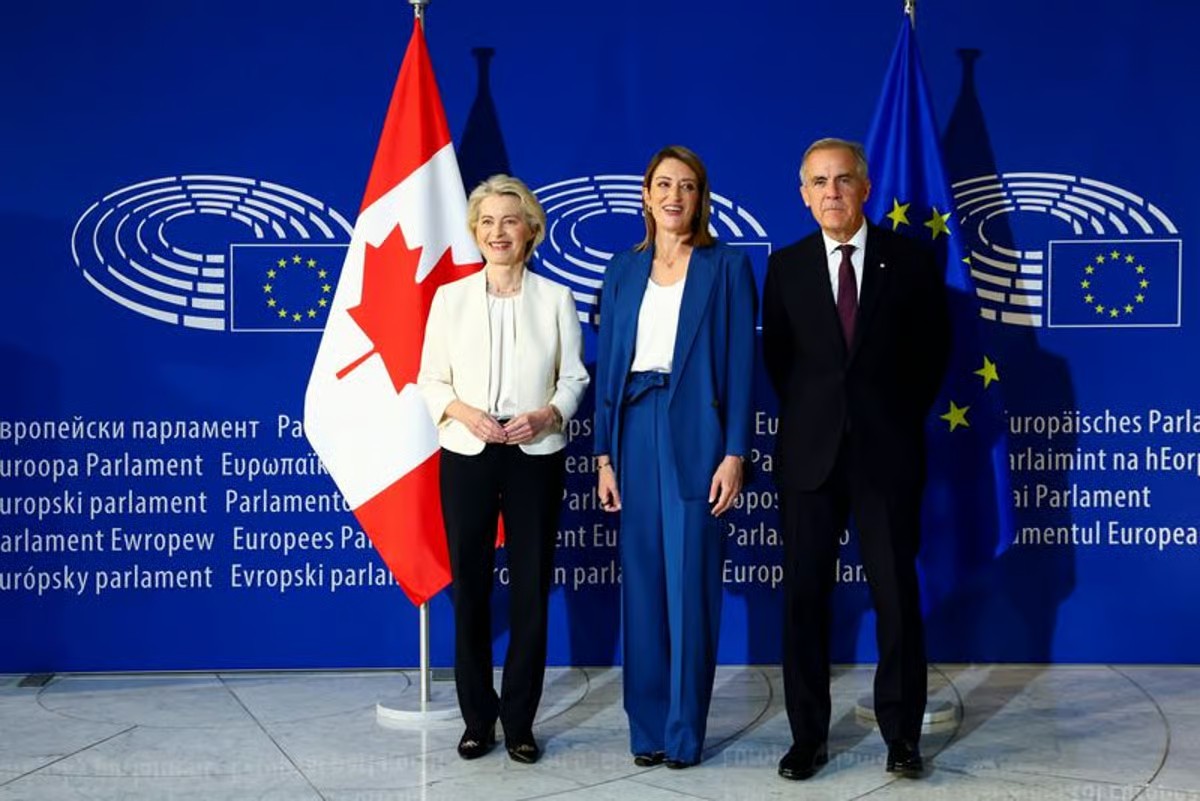
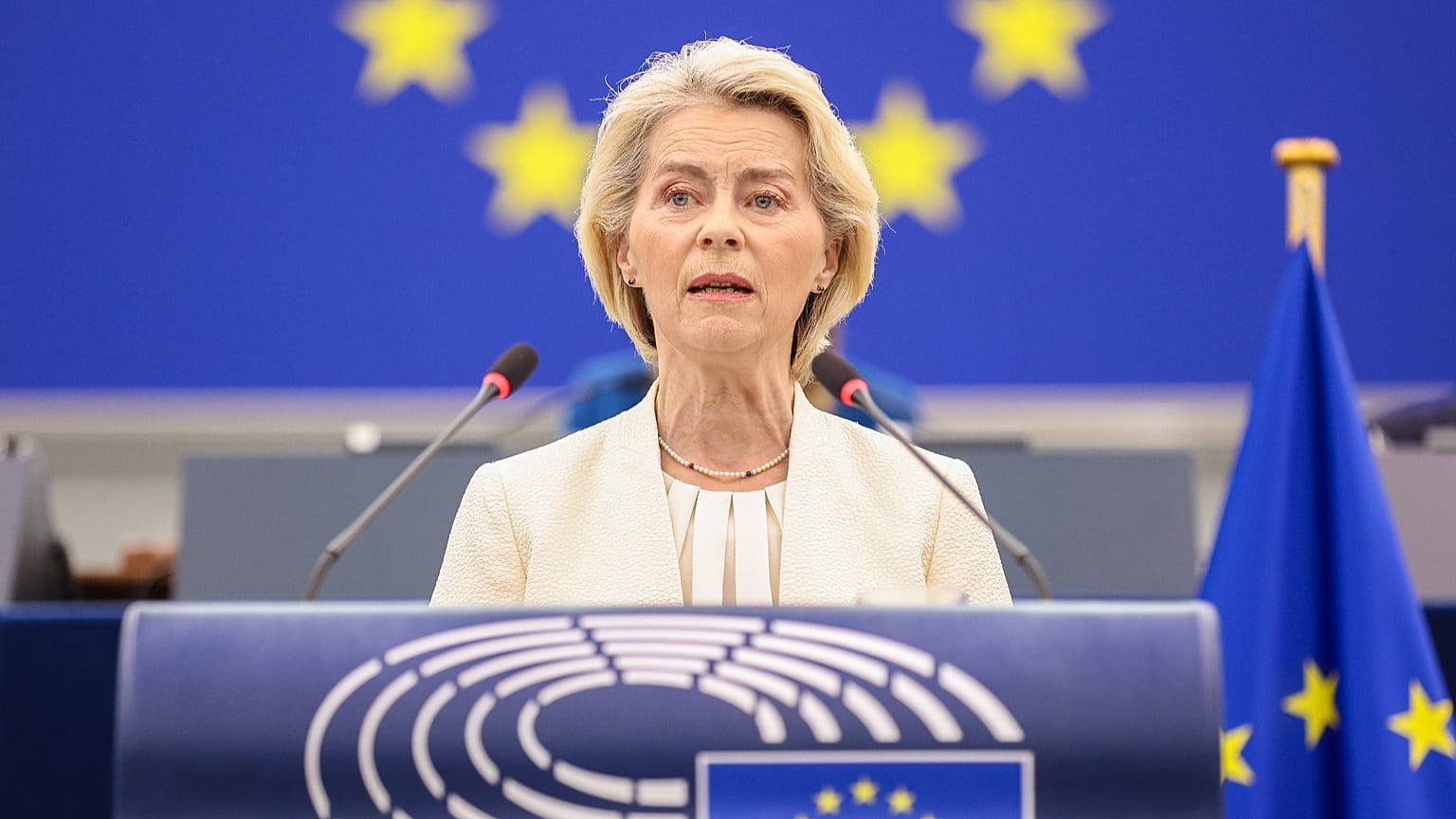
Ursula von der Leyen used her annual State of the European Union address on Wednesday morning to make an offer no president of the European Commission has made before, to any country, anywhere. Speaking to the European Parliament in Strasbourg with Canadian Prime Minister Mark Carney seated in the front row to her left, she said: "I would like to work with you on opening the door for Canada being the first associate member of the EU."
Carney nodded, rose from his seat, embraced her and kissed her on both cheeks. The chamber gave a standing ovation. It was, as the Brussels outlet Eunews noted acidly within hours, a scene "carefully staged, designed to give maximum drama" — and one announcing a category of membership that does not exist in European Union law, has no agreed legal basis, no timeline, and which von der Leyen appears to have discussed with almost nobody in Europe before saying it out loud.
Background: A Neighbour Looking for Somewhere Else to Stand
The overture did not come from nowhere. Roughly 70 per cent of Canadian exports go to the United States, a dependence that looked like geography until it started to look like exposure. President Donald Trump's tariff campaign, his repeated musings about Canada becoming the 51st state, and a trade conflict that has escalated steadily through this year have pushed Ottawa to look for economic and security partners that are not Washington. Canada has retaliated against U.S. tariffs and has rejected trade terms that Carney says would weaken Canadian sovereignty.
Carney has been making the intellectual case for that pivot since January, when his speech at the World Economic Forum in Davos urged the world's middle powers to combine their leverage rather than face great powers one at a time. "When we only negotiate bilaterally with a hegemon, we negotiate from weakness. We accept what is offered," he said then. "This is not sovereignty. It is the performance of sovereignty while accepting subordination." The speech drew a personal rebuke from Trump. Speaking on Tuesday, ahead of the Strasbourg address, Carney returned to the theme, saying that economic integration — once understood almost entirely as an asset — is increasingly "being used as a weapon by certain countries."
There is already more substance in the Canada–EU relationship than the word "overture" suggests. The two sides trade under CETA, the Comprehensive Economic and Trade Agreement, which has been provisionally in force since 2017 and has lifted bilateral trade substantially. Earlier this year Canada became the first non-European country to join SAFE, the EU's €150 billion (about $173 billion) defence procurement instrument, giving Canadian firms access to joint European arms purchasing. A Canadian official told the Associated Press last week that Ottawa was exploring an arrangement that would stop just short of membership, including the right for Canadians to live and work in Europe without visas.
What Is Actually Being Offered
Stripped of the embrace, von der Leyen's concrete proposal is a successor framework to CETA that she called an "Alliance for the Future," intended to create what she described as "a common prosperity and economic security space." Her roadmap, as delivered: "We will move from CETA to an Alliance for the Future to create a common prosperity and economic security space. We will work on intelligent manufacturing. We will create a tech alliance. We will integrate defence industrial bases. We will make the Arctic a flagship joint project." To that list she added energy, critical minerals and batteries, artificial intelligence, quantum computing, cybersecurity and economic security.
She framed the relationship as ideological as much as commercial. "Above all, dear Mark, Europe and Canada believe in democracy," she told Carney. "We believe that power does not belong to the strongest, the richest or the loudest, but to all of us. That democracies have the freedom to choose with whom to work." And, pre-empting the obvious reading: "This is a partnership not against anyone else, but for our common strength. In short, we want to bring the relationship with Canada to the highest level possible."
What she did not say was how associate membership would work, what rights or obligations it would carry, how it would sit alongside the queue of countries negotiating full accession, or when any of it might happen. Carney's office welcomed the proposal, saying Canada was deepening ties with the EU "to strengthen our sovereignty" and supported moving beyond CETA. Jonathan Wilkinson, Canada's ambassador-designate to the EU, said Ottawa had discussed associate membership with European officials before the speech and "knew that that was something was on the table" — Canada had raised the Alliance for the Future; the Europeans had raised associate membership. Wilkinson was explicit that Canada is not seeking full membership, because that would mean surrendering some sovereignty. The aim, he said, is "to get as close as we possibly can" in a way that strengthens Canadian sovereignty rather than diminishing it.
The Legal Problem Nobody Solved Before the Applause
There is no associate membership of the European Union. No treaty creates it, no state holds it, and the phrase carries no legal content. Article 49 of the Treaty on European Union, which governs accession, provides that a "European State" may apply to join. Canada is not a European state. Any new structured relationship would therefore have to find a legal basis somewhere in the existing treaties and then have its scope, duties and obligations defined from scratch — a process analysts quoted this week suggested could take as long as a decade.
The ratification arithmetic is worse than the drafting problem. CETA itself took roughly seven years to negotiate and was nearly derailed in 2016 by the objections of a single Belgian region, Wallonia. Nine member states, including France and Italy, have still not ratified it. A deeper arrangement would run the same gauntlet in a political climate markedly less friendly to trade liberalisation than 2017, with farm lobbies in Paris and Rome already hostile and several governments reluctant to manufacture a fresh quarrel with Washington.
There is also a precedent risk Brussels has resisted for years: granting a third country deep single-market access without the obligations of membership invites both existing members and departed ones — the United Kingdom above all — to ask why they cannot have the same terms. The most likely outcome, Eunews suggested, is that "associate member" turns out to mean intensified economic and political relations without any formal new framework at all.
Reactions
The warmest responses came from the Parliament's centre-left and liberal benches. Iratxe García Pérez, president of the Socialists and Democrats group, praised Carney for showing "great courage confronting Donald Trump" and said allies were needed to defend "sovereignty, solidarity and international law." Barry Andrews, who chairs the Parliament's Development Committee, called Canada "a perfect ally for Europe" and noted that more than 10 per cent of Canadians claim Irish ancestry.
The sharpest question of the morning came from Manon Aubry, co-leader of The Left group, who asked von der Leyen simply: "Who gave you the mandate?" It is not a rhetorical objection. The Commission president announced an outcome without involving Parliament and, by most accounts in Brussels, without clearing it with all member-state governments — which raises a question of legitimacy before it raises one of law.
Hovering over the whole exchange is an awkward contrast. The EU did not fight Washington on trade; it settled, accepting a 15 per cent U.S. tariff ceiling on the vast majority of its exports while eliminating its own tariffs on American industrial goods. Canada chose the opposite path and is paying for it. Europe is now offering solidarity to the country that took the harder road, which may look to Ottawa less like partnership than like applause from the stands. And Trump, who rebuked Carney personally over the Davos speech, is unlikely to read an EU embrace of his northern neighbour as neutral.
What's Next
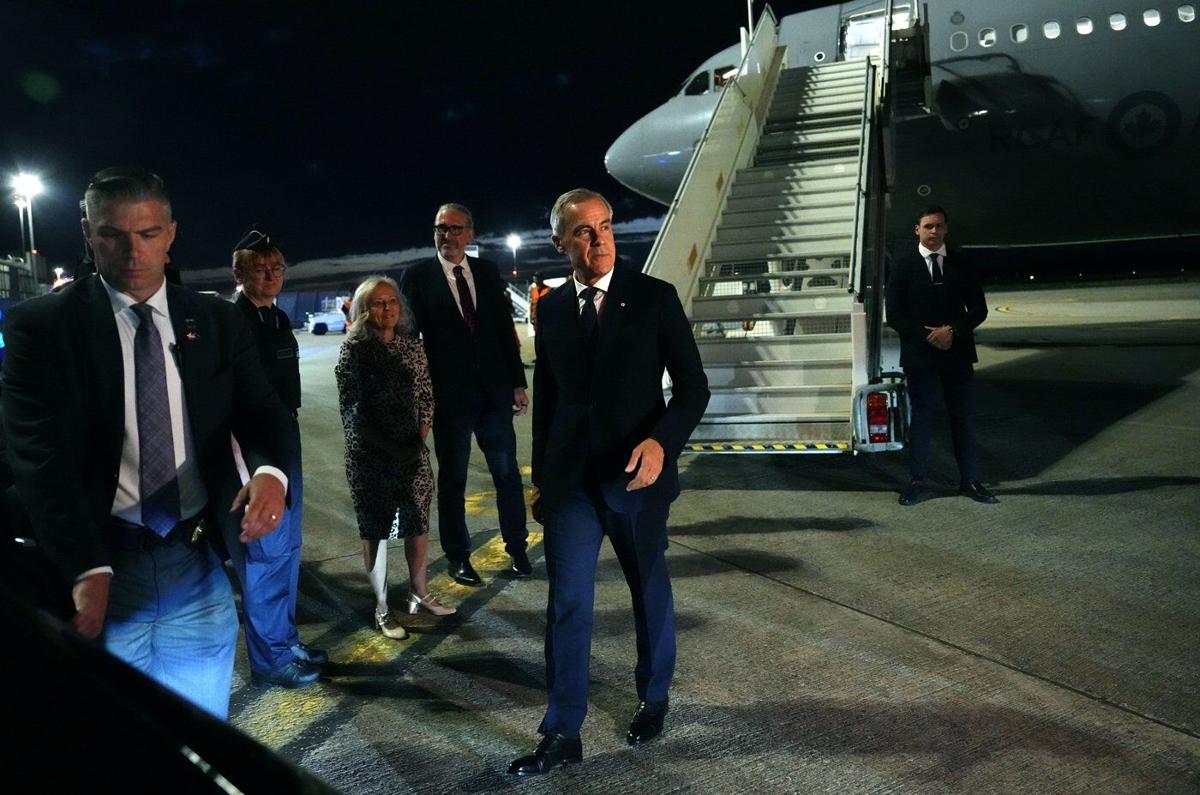
Carney addresses the European Parliament in Strasbourg on Thursday, and the immediate question is whether he takes up the phrase von der Leyen used or quietly declines it in favour of the more modest and more achievable "Alliance for the Future." The substantive work is scheduled for the Canada–EU summit in Montreal on 29–30 October, where Carney is expected to host von der Leyen and European Council President António Costa and where both sides have said more concrete detail will be unveiled.
Associate membership was not the only announcement in an address that also promised a European Heatwave Plan, a ban on social media for children under 13, a new security council with like-minded allies, an emergency framework for mass irregular arrivals modelled on the Ceuta crisis, and new EU-level own resources. Von der Leyen also told the chamber that "the deep suffering in Gaza and unchecked settler violence in the West Bank have deeply affected Europeans," and called the bloc's inaction on Israeli settlements painful — a day after more than 100 MEPs urged her to halt EU trade with them.
But it is the Canadian offer that will be remembered, and its fate will say something about the Commission under von der Leyen. Either the phrase acquires content over the next year — a legal basis, a negotiating mandate, a timetable — or it stands as the most warmly received announcement of a project that never existed.
Published By | News Editor