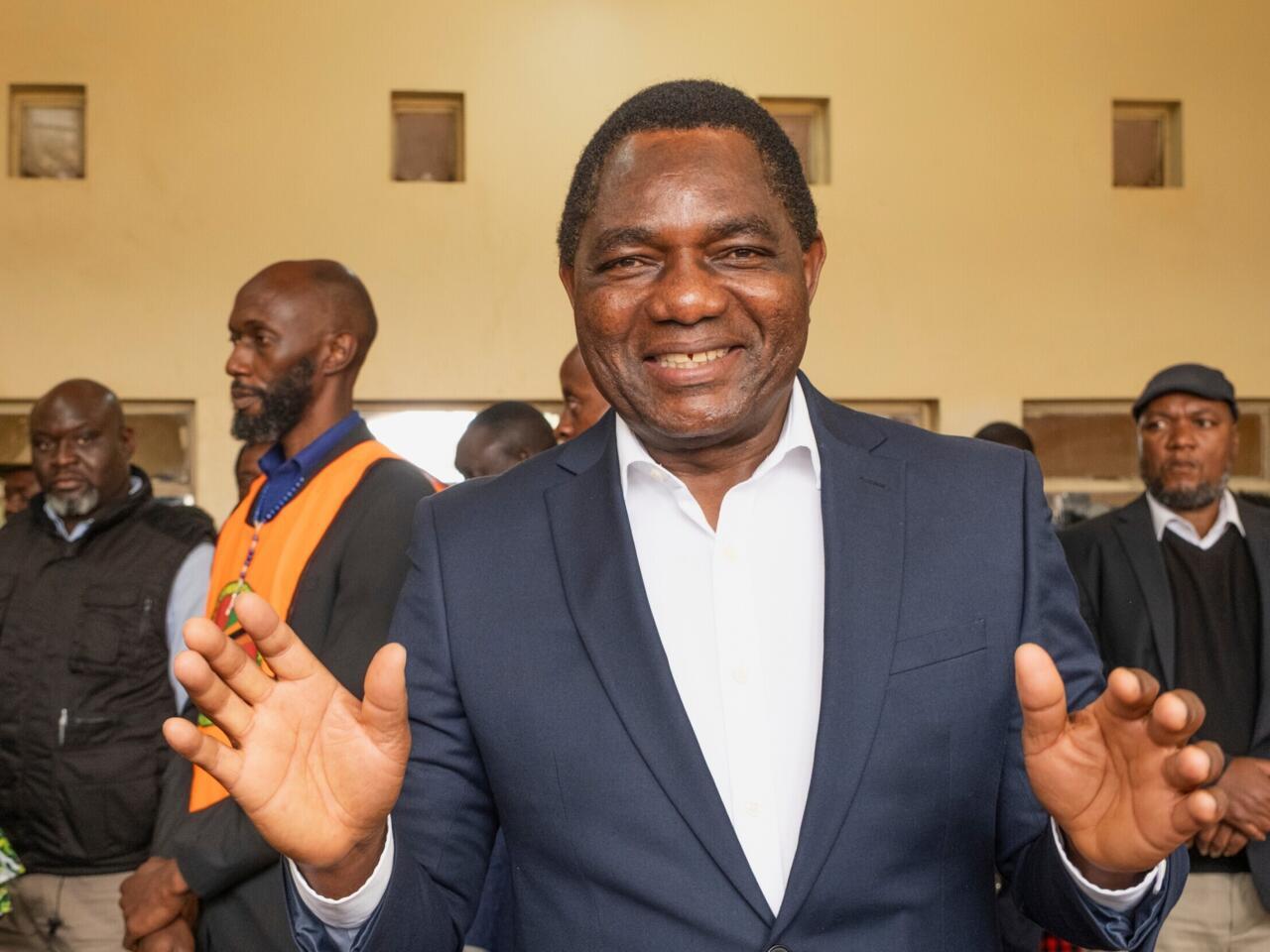
LUSAKA, Zambia
Zambian President Hakainde Hichilema begins a second five-year term under the darkest cloud of his political career: a fatal shooting of an opposition figure by security forces, a crackdown on dissent that human rights monitors say is intensifying, and international observers who have already concluded that the democratic environment surrounding his victory was compromised. Amnesty International on Friday demanded that Zambian authorities launch an independent investigation into the death of Mutotwe Kafwaya, a former cabinet minister and opposition member who was shot dead by security forces during a raid in an affluent Lusaka suburb the night after the country's Aug. 13 general election — a killing that has turned what should have been a routine incumbent's victory lap into a test of whether Zambia's democracy can survive its own success.
The stakes are immediate and concrete. Hichilema, a former businessman who came to power in 2021 promising to restore the rule of law after years of perceived democratic backsliding under his predecessors, was declared the winner of a seventh presidential run on Aug. 18 by the Electoral Commission of Zambia, whose chairperson, Mwangala Zaloumis, delivered the formal declaration five days after polls closed. Official results gave Hichilema 2,965,326 votes, about 61.5% of the ballots cast, against 1,856,217 votes, or roughly 38.5%, for his closest challenger, Brian Mundubile — a margin of some 23 percentage points across the country's 226 constituencies. It was Mundubile's first bid for the presidency after building a career as a lawyer, accountant and, since 2016, a member of parliament for Mporokoso constituency under the formerly ruling Patriotic Front (PF). Because of a long-running dispute over the PF's own registration, Mundubile contested under the ticket of the New Revolution Party United Progressives, a smaller party whose figurehead, Ezra Tembo, retained formal control of the party's structure even as Mundubile served as its presidential standard-bearer within the broader Tonse Alliance opposition coalition.

On paper, the result looks like a comfortable mandate. In practice, it has been overshadowed almost entirely by what happened in Kabulonga, an upscale Lusaka neighborhood, in the hours after voting closed. According to accounts corroborated by Amnesty International, security forces raided a property in Kabulonga linked to Mundubile on Aug. 14, the day after the election. During that operation, Kafwaya — a former cabinet minister and a senior figure in the New Revolution Party United Progressives — was shot and killed. At least three other opposition figures were arrested in the same raid: George Chisanga, Bishop Trevor Mwamba and Patrick Mwansa, all identified by Amnesty as figures within the NRPUP. Zambian authorities have defended the operation, alleging that those detained in Kabulonga were involved in a plot to foment insurrection and that security forces recovered military-grade weapons on the property.
Amnesty International's regional director for East and Southern Africa, Tigere Chagutah, called Kafwaya's death "deeply alarming," particularly coming amid what the organization describes as a broader pattern of arbitrary arrests and detentions of opposition figures during the electoral period. In a statement issued Friday, Amnesty said Zambian authorities must ensure that any investigation into Kafwaya's death is "prompt, thorough, independent, impartial, transparent and effective," including a full accounting of the circumstances of his death and accountability, through fair trials, for anyone found criminally responsible. The organization did not dismiss the government's insurrection allegations outright — it said those claims, too, should be thoroughly and transparently investigated — but it insisted that Zambian authorities remain bound, regardless of the accusations, by the country's constitution and by international human rights law to protect the rights to life, liberty and a fair trial. Amnesty is also demanding that all those detained in the raid have immediate access to lawyers, family members and any necessary medical care, that they be brought promptly before an independent and impartial court, and that anyone held without sufficient evidence of a recognizable criminal offense be released outright.
One detail in Amnesty's account has drawn particular attention in Lusaka: the organization says Kafwaya's family was kept unaware of his condition and whereabouts for five days, from the night of the shooting on Aug. 14 until Aug. 19 — a delay Amnesty says compounds the case for an independent inquiry and that the group wants addressed through full disclosure to the family and access to effective legal remedies.
The killing lands atop an election that was already drawing scrutiny before a single shot was fired. International observation missions monitoring the Aug. 13 vote concluded that the broader democratic environment surrounding the poll had been compromised, even as they did not dispute the numerical outcome. Zambia's economy has been under sustained strain in the run-up to the vote — the kind of cost-of-living pressure that typically erodes an incumbent's support — and Hichilema's margin, while decisive, was narrower than some of his allies had hoped for a leader who took office in 2021 on a wave of anti-corruption, pro-market goodwill. Mundubile, for his part, framed his candidacy in existential terms, telling supporters as he cast his ballot that "second independence is here" — rhetoric that underscored how much of the Tonse Alliance's opposition coalition has come to view this election less as a policy contest than as a referendum on whether Hichilema's government has drifted from the reformist promises that first brought him to power.

That framing now looks prescient in an uncomfortable way. A government that built its legitimacy in large part on a contrast with the perceived authoritarian tendencies of the Patriotic Front era is now facing accusations that mirror those very complaints: a fatal use of force against an opposition figure, arrests of opposition officials in the aftermath of a hard-fought election, and a five-day information blackout for a grieving family. Zambian authorities have not, as of Friday, announced the independent investigation Amnesty is calling for, nor have they released the identities of the security personnel involved in the Kabulonga raid. The government's insurrection allegation, if substantiated, would represent a serious security threat requiring a robust response — but Amnesty's intervention signals that rights monitors are not prepared to take that framing at face value absent an inquiry that meets international standards of independence and transparency.
What happens next will shape how the rest of Hichilema's second term is read internationally, and how much running room the government retains at home. If Zambian authorities open a credible, independent investigation and hold accountable anyone found to have acted unlawfully, the episode could ultimately be absorbed as a tragic but contained incident within an otherwise legitimate transfer of power. If, instead, the government leans further into the insurrection narrative without transparent evidence — or if the crackdown on opposition figures that Amnesty says is already under way continues to widen — Zambia risks a deeper erosion of the democratic credibility that has been central to Hichilema's international standing, including with Western donors and investors who have rewarded his government's market-friendly reforms with renewed engagement after years of relative isolation under his predecessors.
Also worth watching is the fate of the three other NRPUP figures arrested alongside Kafwaya — Chisanga, Mwamba and Mwansa — whose treatment in detention, and whether they are brought before courts promptly, will serve as an early test of whether the government heeds Amnesty's demands. Mundubile himself, whose Kabulonga property was the site of the raid, has not been reported as detained, but the targeting of a property linked to him directly ties the security operation to the losing presidential campaign in a way that will be difficult for the government to fully separate from the political outcome of the election, regardless of how the insurrection allegations are ultimately resolved.
For a country that positioned itself, under Hichilema, as a democratic bright spot in a region that has seen coups, contested elections and shrinking civic space, the Kafwaya case is a pointed early challenge to that narrative — one that will likely dominate diplomatic conversations about Zambia in the weeks ahead, even as the government moves to consolidate the mandate it was formally awarded on Aug. 18.
Published By | News Editor