DAR ES SALAAM
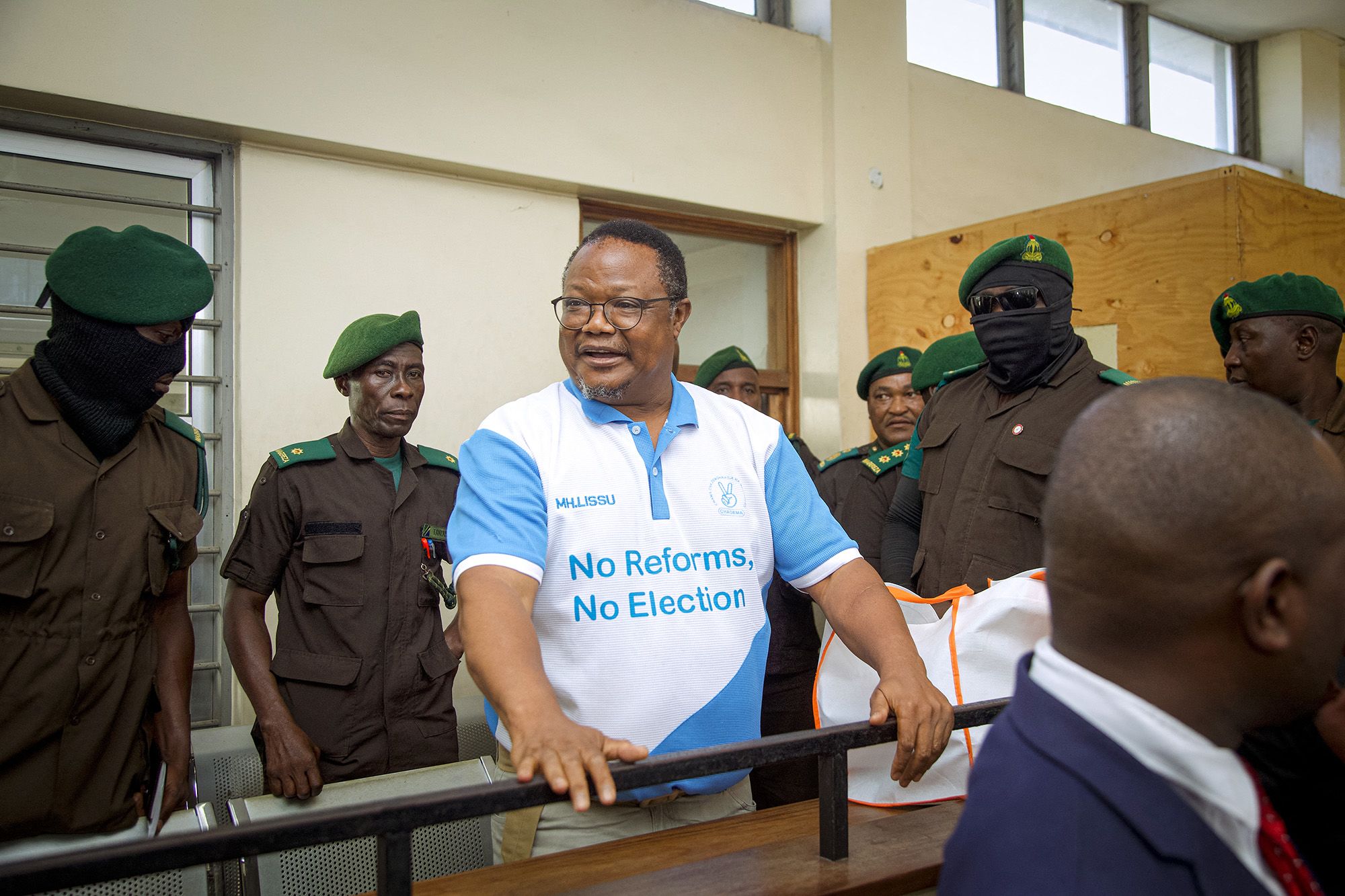
Tanzania has charged a second senior figure from its main opposition party with treason, an offense that carries a possible death sentence, two weeks before a High Court is due to rule in the case against the party's leader, Tundu Lissu.
John Pambalu, a member of the Chadema national council and a former head of its youth wing, appeared before the Kisutu Resident Magistrate's Court in Dar es Salaam this week, according to a Rio Times analysis of the case. The charges against him, reported by Africanews and other outlets, accuse him of intending to "persuade the public to cause obstruction" of the 2025 general election and of "conducting endless protests" to intimidate the executive branch of government. Pambalu denies the allegations, according to GlobalPost.
The timing matters. The High Court has set Nov. 6 for judgment in Lissu's trial, which concluded on Sept. 29. Together, the two cases will test whether the government of President Samia Suluhu Hassan can sustain a strategy of prosecuting opposition leadership for their role in a disputed election, or whether the costs of that approach, at home and abroad, begin to mount.
What Pambalu is accused of
Reports differ slightly on the date of the charge. Rio Times reports that Pambalu was charged on Oct. 21, while Africanews, publishing on Oct. 22, described it as having occurred on "Wednesday, October 22." Oct. 21 was the Wednesday of this week, so this report uses Oct. 21 and notes the discrepancy.
The charge sheet, as quoted by Africanews, has two strands. The first alleges an intent to persuade the public to obstruct the 2025 general election. The second alleges "conducting endless protests" to intimidate the executive. Rio Times, whose account is more detailed, notes that the charge does not allege that Pambalu committed violence or tried to overthrow the state. Treason in Tanzania nonetheless carries a possible death sentence upon conviction. None of the sources reviewed describes his bail or detention status, and the name of the presiding magistrate has not been reported in the coverage found.
Chadema's deputy chairperson, John Heche, told a public meeting in Arusha that he had been informed of Pambalu's charge, according to Africanews. Heche said the authorities intend to bring a similar case against him, but that he will not flee the country. He vowed that Chadema "will fight to the end."
Pambalu is the second senior Chadema figure to face a treason charge. The first is the party's chairman, Lissu.

The Lissu case
Lissu was arrested on April 9, 2025, after a rally in Mbinga in the Ruvuma Region and was charged with treason, according to Rio Times. The case reportedly rests in large part on a speech in which he used the Swahili word kukinukisha, which the authorities read as a call for rebellion. GlobalPost describes the accusation as inciting the public to prevent an election.
The trial ran for about a year and concluded on Sept. 29, 2026, with judgment scheduled for Nov. 6, according to both Rio Times and GlobalPost. Africanews notes that observers regard the trial as largely political. The sources reviewed do not describe the defense's arguments or the prosecution's evidence in detail, and this report does not characterize them.
The disputed 2025 election and its aftermath
The charges cannot be understood apart from the October 2025 election. Chadema was excluded from that vote, and Lissu was in prison. According to official results, as reported by Africanews, President Hassan won with 98 percent of the vote. Chadema rejected the process and mobilized supporters.
The human cost of the post-election period remains contested. The opposition and rights groups say around 2,000 people were killed by police and security forces during the protests, Africanews reports. A government-commissioned inquiry, which the opposition calls biased, put the toll at 518 and did not identify those responsible. The gap between the two figures is wide, and neither has been independently reconciled in the sources reviewed. Readers should treat both as claims by interested parties rather than established tallies.
The government presents the prosecutions as protecting electoral order. Chadema and outside observers describe them as criminalizing dissent, according to Rio Times. The charge against Pambalu, which centers on protests and on encouraging the public to obstruct the vote rather than on any alleged violent act, sits at the heart of that disagreement. If organizing demonstrations against an election can be prosecuted as treason, the line between opposition politics and a capital offense becomes very thin.
A reversal of early expectations
Hassan took office in March 2021 after the death of her predecessor, John Magufuli, and was initially praised for easing restrictions on the opposition and the media, Africanews notes. The opposition now accuses her of returning to Magufuli-era policies. The pattern of prosecutions, an excluded opposition party, and a disputed landslide give that accusation its force. The government's position, in the framing reported by Rio Times, is that it is applying the law to protect the integrity of elections.
This arc is important for understanding the stakes. Tanzania's early-2020s reputation as a country edging toward political opening was an asset in diplomatic and investor circles. The treason cases put that reputation under direct strain.
Analysis: what the cases signal
Three dynamics are worth watching, offered here as analysis rather than reported fact.
First, the sequence suggests a widening of the prosecutorial net. Charging a second senior Chadema figure, and with Heche saying he expects to be next, signals that the leadership layer of the party, not only its figurehead, is exposed. If Heche is charged, the party's top three or four positions could be tied up in capital cases. That would make it hard for Chadema to function as an organized force ahead of future elections, whatever the courts ultimately decide.
Second, the Nov. 6 judgment will set the tone. A conviction on a treason charge that, by Rio Times's account, rests substantially on the interpretation of a single Swahili word would draw sharp criticism from rights groups and foreign governments, and would likely harden the opposition's stance. An acquittal would be a rare rebuke of the prosecution, and could complicate the case against Pambalu, which rests on similar allegations about obstructing the election. A conviction followed by a lesser sentence than death is another possibility; the sources reviewed do not indicate what the court is likely to do, and this report does not predict it.
Third, there is an economic and diplomatic dimension. Rio Times argues that the cases raise political and legal risk for investors in Dar es Salaam's port, mining and energy sectors, and recommends that firms review political-risk insurance, arbitration clauses and supply-chain contingencies. That is one analyst's assessment, and the same article cautions that several claims need confirmation from official court records. It is nonetheless a reasonable signal that the business community is watching the outcome.
What the government has said
The sources reviewed do not include an official government statement on Pambalu's charge, and this report does not attribute one. Previously, the government has framed prosecutions as upholding the law, according to Rio Times. Tanzanian officials were not quoted in the coverage reviewed for this story, and the absence of comment should not be read as either confirmation or denial of any claim.
What to watch
The immediate calendar is clear. Pambalu's case will proceed in the Kisutu court, though hearing dates have not been reported. On Nov. 6, the High Court is due to deliver judgment on Lissu. Chadema's response to either event, including whether it calls for protests, will shape the next phase. So will the actions of Heche, who has publicly said he expects to be charged and says he will remain in the country.
Beyond the courtroom, observers should look for reactions from Tanzania's foreign partners and from regional bodies, none of which was reported in the sources reviewed, and for any movement on the unresolved question of accountability for the post-election killings. The discrepancy between 518 and roughly 2,000 deaths is not merely a statistical dispute. It is a measure of how far apart the government and the opposition remain on the basic facts of what happened in October 2025.
For now, Tanzania's politics are being decided in a courtroom rather than at a ballot box. How the judges handle Nov. 6 will say a great deal about whether that courtroom is seen as independent.
Published By | News Editor